
How to Repair a Damaged Skin Barrier with Korean Skincare | Vampire Glow
How to Repair a Damaged Skin Barrier with Korean Skincare
A damaged skin barrier is one of the most common and least diagnosed skin problems. It doesn’t always present dramatically. The skin just stops behaving the way it used to. Products that were fine before start stinging. Moisturiser doesn’t seem to make any difference. Skin is tight and uncomfortable one hour and oily the next. Redness appears without a clear cause. Breakouts become more frequent and slower to heal.
In Saudi Arabia, the skin barrier is under particular stress. The daily swing between outdoor temperatures that exceed 40 degrees and heavily air-conditioned indoor spaces creates a constant cycle of heat stress followed by moisture stripping, and then back again. Add high UV intensity year-round, fine environmental dust, and the overly aggressive skincare products many people use to fight oiliness in the heat, and a weakened skin barrier is a predictable outcome rather than a rare one.
Korean skincare’s approach to barrier repair is arguably the most developed in the global skincare industry. The concept of the skin barrier and maintaining it has been central to K-beauty philosophy for decades, long before the barrier care trend caught up with Western skincare. This guide explains what a damaged skin barrier actually is, how to identify it, what caused it, and how to use Korean skincare to rebuild it from the foundations.
What Is the Skin Barrier and Why Does It Matter
The skin barrier, technically called the stratum corneum, is the outermost layer of the skin. It functions as a two-directional seal: it keeps moisture inside the skin, preventing transepidermal water loss, and keeps harmful things out, including bacteria, pollutants, UV and environmental irritants.
The barrier is made up of skin cells held together by a lipid matrix of ceramides, fatty acids and cholesterol. When this matrix is intact and well-nourished, the barrier works efficiently. Skin stays hydrated, products absorb normally, and the skin is relatively resilient to environmental stress. When the barrier is compromised, water escapes, irritants get in, and the skin loses its ability to regulate itself.
The skin barrier doesn’t need to be visibly broken to be functionally damaged. Most damage is cumulative and invisible until it has been compounding for long enough to produce noticeable symptoms.
Signs That Your Skin Barrier Is Damaged
Recognising a damaged barrier is the starting point for treating it correctly. The most common signs include:
Skin that stings on product application. If products that have never caused a reaction before, including your normal toner or moisturiser, suddenly sting or burn on application, this is one of the clearest indicators that the barrier has been compromised. The protective layer that should prevent external ingredients from penetrating too quickly is no longer intact.
Persistent tightness and discomfort. Skin that feels tight or uncomfortable shortly after cleansing, even after applying moisturiser, is losing water faster than the barrier can retain it.
Redness and sensitivity without an obvious cause. Reactive skin that flushes, becomes red easily or remains persistently pink in the absence of a specific skin condition is often a damaged-barrier presentation rather than a separate skin type.
Oiliness and dryness at the same time. Skin that produces excess oil in the T-zone while feeling dry or dehydrated elsewhere is a classic damaged-barrier pattern. The barrier isn’t retaining moisture, so the skin compensates with sebum.
Products that used to work seem to stop working. Moisturiser absorbed properly before but now seems to sit on the surface. A serum that caused no reaction is now causing irritation. The issue is usually the barrier rather than the product changing.
More frequent or slower-healing breakouts. A compromised barrier allows more bacteria in, makes skin more reactive to comedogenic triggers, and slows the recovery process after inflammation.
What Causes a Damaged Skin Barrier in Saudi Arabia
Understanding the cause matters for choosing the right approach to repair, and for preventing the same damage from recurring.
Over-exfoliation. Using AHA or BHA exfoliants too frequently, using multiple exfoliants at once, or combining chemical exfoliants with physical scrubs removes too much of the protective lipid layer. This is one of the leading causes of a damaged skin barrier in K-beauty enthusiasts who introduce several actives at once without building up gradually.
Harsh or stripping cleansers. High-foaming, surfactant-heavy cleansers designed to remove every trace of oil damage the barrier lipid matrix over time. In Saudi Arabia, where oiliness is a daily complaint, over-cleansing with harsh products is common and compounds the problem the barrier is supposed to protect against.
Saudi Arabia’s temperature extremes. The daily movement between outdoor heat above 40 degrees and heavily air-conditioned indoor spaces is mechanically stressful on the barrier. Heat causes vasodilation and increases transepidermal water loss. Cold, dry AC air strips moisture continuously. The skin barrier doesn’t have a pause button between the two.
UV exposure without SPF. UV radiation directly damages the lipid matrix and proteins that make up the skin barrier. Without consistent daily SPF, the barrier is exposed to ongoing degradation from one of its most aggressive environmental stressors.
Using too many actives simultaneously. Introducing retinol, BHA, AHA, vitamin C and a strong niacinamide formula all within the same week is a barrier-disruption pattern. Each active alone may be appropriate, but stacking them all at once before the skin has adapted overwhelms the barrier’s capacity to absorb the change.
Dehydration. Both environmental dehydration from Saudi Arabia’s climate and insufficient water intake contribute to barrier function decline. The barrier needs adequate internal hydration to maintain structural integrity.
How Korean Skincare Approaches Barrier Repair Differently
Western skincare often treats barrier damage reactively, reaching for a heavy cream or stopping all actives temporarily. Korean skincare’s approach is more structured and more proactive, based on a decades-long understanding of the barrier as the foundation of all effective skincare rather than a secondary concern.
The K-beauty barrier repair approach rests on four principles.
Eliminate what’s causing the damage first. Before adding repairing ingredients, remove what is continuing to harm the barrier. This usually means stopping all exfoliants, strong actives and any stripping products until the barrier has stabilised.
Restore with the right ingredients in the right sequence. Ceramides, panthenol, centella asiatica and beta-glucan are the core barrier repair actives in K-beauty. Applied in a simplified, layered routine, they restore the lipid matrix and calming environment the barrier needs to recover.
Simplify the routine during repair. A damaged barrier cannot tolerate a ten-step active-heavy routine. Fewer products, simpler formulas, no active treatment ingredients until the barrier signals it has recovered.
Protect throughout the repair process. SPF every morning, no exceptions. A recovering barrier is more vulnerable to UV damage than a healthy one, and unprotected sun exposure during barrier repair actively undoes the repair work.
Easy Dew at Vampire Glow is a Korean medical skincare brand built specifically around barrier care. Mixsoon carries clean, minimalist formulas suited to sensitised, barrier-recovering skin. Browse the skin care range for current barrier repair product options.
The Best Korean Skincare Ingredients for Barrier Repair
Ceramides. The most direct barrier repair ingredient available. Ceramides are the lipid molecules that make up a significant portion of the barrier’s structural matrix. Topically applied ceramides help replenish what has been stripped away by over-exfoliation, harsh cleansers and environmental stress. Look for them in moisturisers and barrier repair creams specifically formulated to restore the skin’s lipid layer.
Centella asiatica (cica). One of the most important calming and barrier-supporting ingredients in K-beauty. The active compounds in centella, including madecassoside and asiaticoside, reduce inflammation, support wound healing and help the barrier recover from stress. Widely found in Korean toners, serums and creams designed for sensitised or damaged skin.
Panthenol (provitamin B5). Attracts and holds moisture in the skin while supporting the skin’s natural repair processes. Well tolerated by virtually all skin types, including the most sensitised and reactive. One of the gentlest effective barrier repair ingredients available.
Beta-glucan. A polysaccharide with powerful soothing and hydrating properties. Supports the skin’s immune response and calms inflammation associated with a damaged barrier. Common in Korean toners and essences designed for stressed skin.
Allantoin. Calms irritated, reactive skin and supports barrier recovery. Found in many K-beauty formulas alongside centella and ceramides for comprehensive barrier support.
Hyaluronic acid. Restores surface hydration and helps the skin maintain the water content the barrier needs to function. Apply on damp skin and follow with a barrier cream or ceramide moisturiser immediately on top.
Niacinamide at 5 percent. Strengthens the barrier by supporting ceramide production and reduces the transepidermal water loss associated with a compromised barrier. At moderate concentrations, it is appropriate for barrier repair. At higher concentrations or when skin is very reactive, introduce gradually after the barrier has begun to stabilise.
The Korean Skincare Barrier Repair Routine: Step by Step
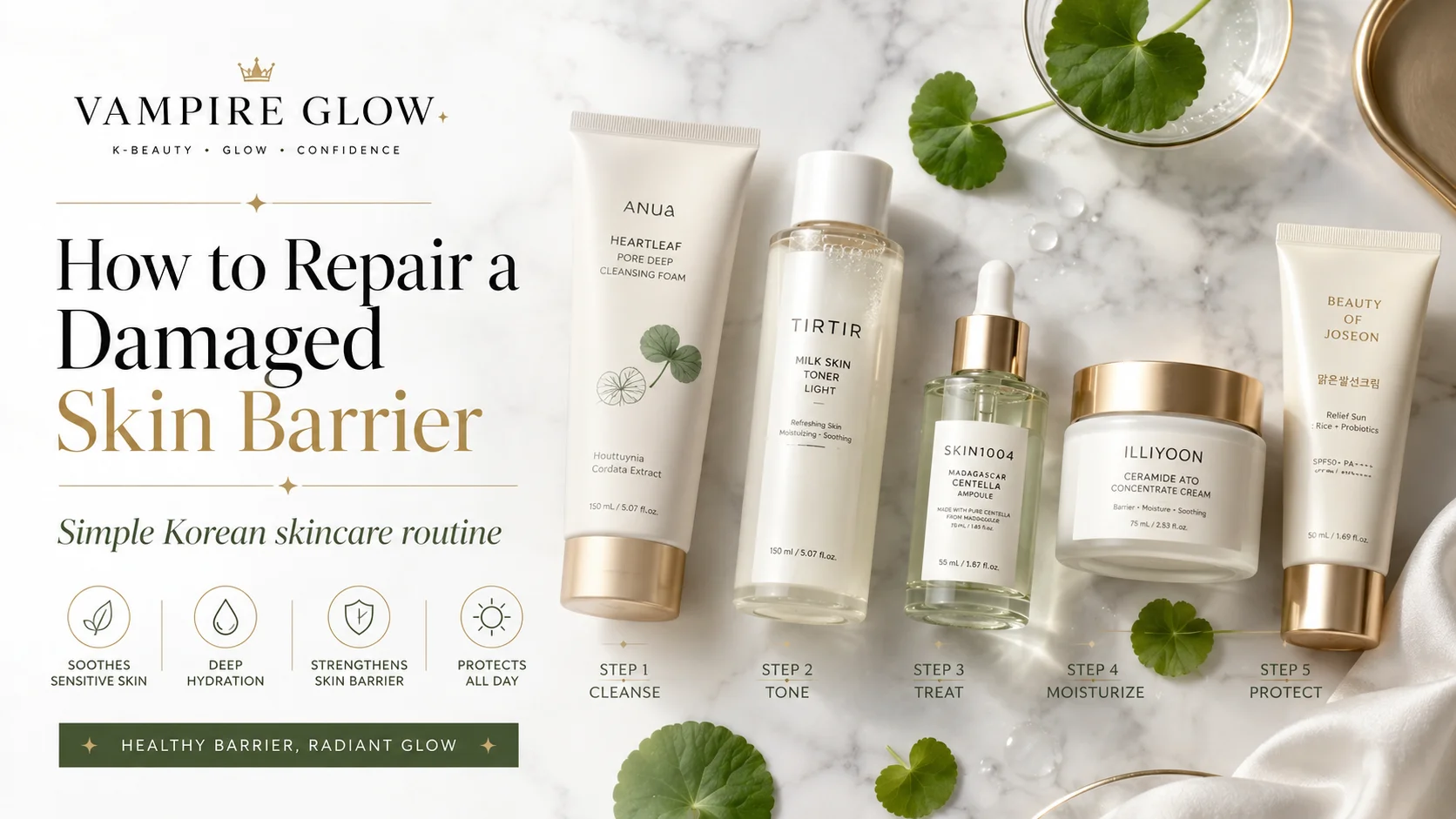
When repairing a damaged barrier, the most important instruction is to simplify. Remove all actives temporarily, reduce the routine to the essential supportive steps and reintroduce treatment products only when the skin signals it has stabilised.
Morning routine: barrier repair mode
Step 1: Gentle, non-foaming or low-foam cleanser. A gentle gel or milk cleanser that does not strip or leave skin feeling tight. No cleansing oils with high-surfactant formulas. No foaming washes with sulfates. The goal of cleansing here is to remove overnight products and sebum without further compromising the barrier. If even gentle cleansing causes stinging, switch to micellar water or a non-rinse cleansing method until the barrier stabilises.
Step 2: Hydrating, alcohol-free toner. A simple, calming hydrating toner with centella, panthenol or beta-glucan. No AHA or BHA toners, no astringents, no alcohol-containing products. This step rebalances the skin after cleansing and delivers the first layer of hydrating support.
Step 3: Barrier repair serum or essence (ceramides, centella, panthenol). A targeted serum or essence with one or two barrier-focused ingredients rather than a full active formula. Centella serums, panthenol essences or ceramide-containing lightweight serums are appropriate here. No retinol, no vitamin C, no acids at this stage.
Step 4: Ceramide barrier cream or repair moisturiser. The most important step of the repair routine. A ceramide-rich cream or barrier repair moisturiser seals all the hydrating layers underneath and begins restoring the lipid matrix that makes the barrier functional. This is the step where the most visible barrier repair happens. Choose a formula specifically positioned for sensitive, reactive or barrier-compromised skin rather than a general-purpose moisturiser.
Step 5: SPF50+ PA++++. Non-negotiable and particularly critical during barrier repair. A recovering barrier is more permeable and less resistant to UV damage than a healthy one. Use a mineral or hybrid SPF if the skin is very reactive to chemical filters during this period, since physical sunscreens have a lower risk of stinging on compromised skin.
Evening routine: barrier repair mode
Double cleanse only if wearing SPF or makeup. If not, a single gentle cleanser is enough. Follow with hydrating toner, barrier serum, ceramide cream. A sleeping mask two to three times a week adds an extra occlusive layer that supports overnight recovery without introducing any actives.
What to Stop Using During Barrier Repair
Stop all chemical exfoliants, including AHA, BHA and PHA, until the barrier has visibly stabilised and stinging on product application has resolved completely.
Stop retinol and retinoids until the barrier is recovered. Reintroduce very gradually, starting at one evening per week rather than nightly.
Stop all physical scrubs permanently, or limit to very occasional gentle use only after the barrier is healthy.
Stop using high-strength vitamin C (L-ascorbic acid at 15 to 20 percent), which can sting significantly on a compromised barrier.
Stop layering multiple actives. During repair, the routine should have one to two active steps at most, not six.
How Long Does It Take to Repair a Damaged Skin Barrier
Mild barrier damage, where stinging and sensitivity have been present for a few weeks and the cause is identifiable, often begins to settle within one to two weeks of a simplified, barrier-focused routine. The skin should feel more comfortable on product application within this timeframe.
Moderate barrier damage, which has been building over several months of cumulative over-exfoliation or environmental stress, typically requires four to six weeks of consistent barrier-focused care before the skin returns to normal tolerance and comfort.
Severe or long-term barrier damage takes longer. If the barrier has been compromised for six months or more, recovery is measured in months rather than weeks, and a dermatologist’s assessment may be appropriate if the skin is not responding to a simplified routine within six to eight weeks.
Individual recovery timelines vary by age, skin type, the underlying cause of the damage and how consistently the repair routine is applied.
How Often to Follow the Barrier Repair Routine
The simplified barrier repair routine is a daily commitment, morning and evening. Consistency during the repair phase is what distinguishes a genuine recovery from a temporary reduction in symptoms that flares again when any active is reintroduced.
Once the skin has stabilised and can tolerate products without stinging or reactive redness, actives can be reintroduced one at a time, starting with the gentlest (niacinamide), then building to stronger options (BHA, vitamin C, retinol) over weeks rather than days.
Aftercare Tips for Damaged Skin Barrier Recovery in Saudi Arabia
Do keep the full routine running even on days when skin feels better. The temptation to reintroduce an exfoliant the moment redness settles is one of the most common reasons barrier damage relapses. Give it at least four weeks of stable, comfortable skin before introducing any active.
Do sleep in a room with a humidifier if possible, or at the very least, ensure the AC isn’t drying the air excessively overnight. Skin does its most active repair during sleep, and a very dry sleeping environment counteracts the barrier recovery work the routine is doing.
Do drink water consistently through the day. Internal hydration supports the barrier’s ability to retain moisture externally. Dehydration is both a cause and a consequence of barrier damage.
Don’t reintroduce multiple actives at the same time once the barrier has recovered. Add one new active every two to three weeks so you can clearly identify if anything causes a reaction.
Don’t use sheet masks during the active repair phase unless they’re positioned specifically for sensitive or barrier-compromised skin. Some sheet mask essences contain alcohol or actives that can worsen a reactive barrier even though masks are generally considered calming.
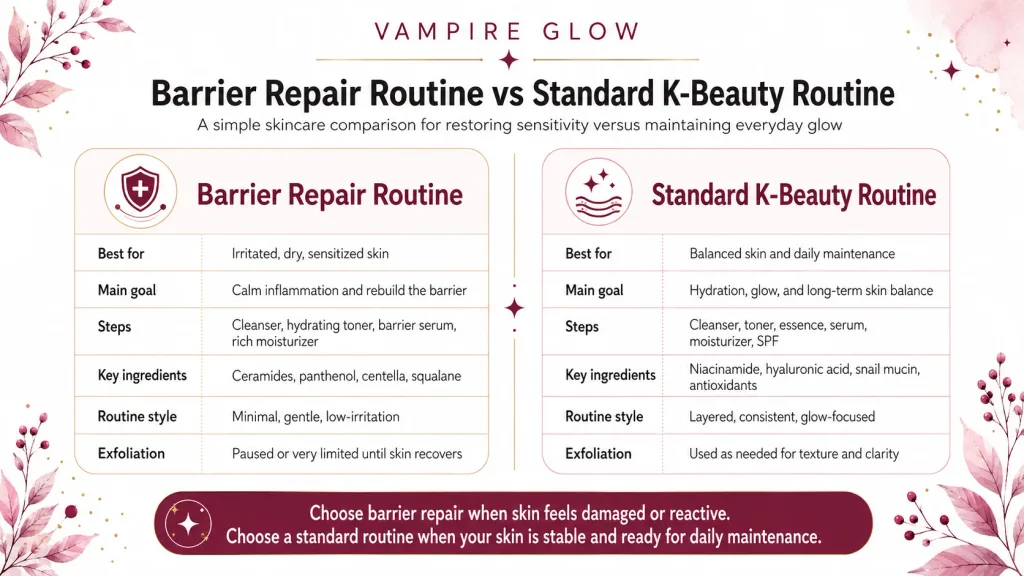
Barrier Repair Routine vs Standard K-Beauty Routine
| Barrier Repair Routine | Standard K-Beauty Routine | |
| Cleanser | Gentle non-stripping gel or milk, no sulfates | Low-pH gel or foam, mild daily cleanser |
| Toner | Alcohol-free, calming: centella, panthenol, beta-glucan | Hydrating, pH-balancing, toner-essence hybrid acceptable |
| Actives | None during repair phase | BHA, AHA, niacinamide, vitamin C, retinol |
| Serum | Barrier-focused: ceramide serum, centella essence, panthenol | Treatment-focused: niacinamide, PDRN, brightening, anti-ageing |
| Moisturiser | Ceramide repair cream, richer or standard gel depending on damage severity | Gel or gel-cream matched to skin type |
| SPF | SPF50+ PA++++, mineral or hybrid preferred during repair | SPF50+ PA++++ daily |
| Exfoliation | None | 2 to 3 times per week with BHA or AHA |
| Sheet masks | Only fragrance-free, barrier-specific formulas | Flexible, once or twice a week |
| Steps count | 4 to 5 maximum | 6 to 10 depending on concerns |
| Duration | Until skin is stable and stinging-free for 2 to 4 weeks | Ongoing, adjusted seasonally |
Possible Side Effects and Precautions
A very small number of people find that even gentle cleansers and hydrating toners cause stinging during a severely damaged barrier phase. In this case, switching to micellar water applied with a soft cotton pad and skipping water-based cleansing temporarily allows the barrier to stabilise before reintroducing any rinse-off step.
Ceramide creams at higher concentrations can occasionally cause milia (small white bumps under the skin) in very oily or congested skin types. If this occurs, switch to a lighter ceramide formulation or a ceramide-containing gel-cream rather than a rich cream.
Anyone whose barrier damage is accompanied by visible redness across a large area, itching, weeping, or symptoms consistent with eczema, rosacea or contact dermatitis should see a dermatologist rather than managing it with topical skincare alone. A damaged skin barrier can be a symptom of an underlying skin condition that requires clinical treatment.
Patch test all new barrier repair products on the inner arm before applying to the full face, even gentle formulas, since a compromised barrier is more reactive than healthy skin to new ingredients
What Does a Barrier Repair Routine Cost
The investment in a barrier repair routine is typically lower than a full active-treatment K-beauty routine, since it uses fewer products and no expensive actives during the repair phase.
Real pricing factors include bottle size and daily usage amounts, brand and formula complexity, currency and region (Vampire Glow displays pricing in AED for Gulf shoppers and USD for other regions) and delivery destination within Saudi Arabia or the wider GCC.
Live prices are on each product page at Vampire Glow. Browse the skin care range to compare current barrier repair options across brands.
Why Choose Vampire Glow
- Authentic Korean brands verified on arrival with batch codes and expiry dates checked
- A curated selection that includes medical-grade and barrier-focused Korean skincare, not only mainstream trend products
- Cruelty-free brands only
- Delivery across the UAE and the wider GCC, including Saudi Arabia, confirmed at checkout
- Full ingredient lists and usage guidance on every product page so you know exactly what’s in each formula before it arrives
FAQs
What Korean skincare is best to fix a damaged skin barrier? The most effective Korean skincare for a damaged skin barrier focuses on ceramides, centella asiatica, panthenol and calming actives rather than treatment-focused ingredients. Easy Dew is a Korean medical skincare brand built specifically around barrier care and is one of the most targeted options for barrier recovery at Vampire Glow. Mixsoon carries clean, minimalist formulas that suit sensitised and barrier-recovering skin without the risk of over-active ingredients. Browse the skin care range for current barrier repair products from both brands.
What is the best Korean barrier repair cream? The best Korean barrier repair cream for a compromised skin barrier is one that leads with ceramides, fatty acids and calming ingredients such as centella or panthenol, is fragrance-free or very low-fragrance, and is designed specifically for sensitive or damaged skin rather than as a general moisturiser. Formulas from Easy Dew are worth examining here, since the brand’s focus is medical-grade barrier support. The texture choice (gel-cream for oily or combination skin, richer cream for dry skin) should reflect your skin type even during the repair phase. Browse current stock at Vampire Glow’s skin care category for available options.
Which Korean serum is best for a damaged skin barrier? For a damaged skin barrier, the best Korean serum is a barrier repair or calming serum rather than a treatment serum. Look for formulas centred on centella asiatica, madecassoside, panthenol or beta-glucan. These support barrier recovery and reduce the inflammatory response that slows it down, without introducing the actives that would aggravate a compromised barrier. Avoid any serum containing AHA, BHA, retinol or high-percentage vitamin C during the repair phase. Mixsoon is known for clean minimal formulas that work well in this step for sensitised skin. Check current stock in the skin care range at Vampire Glow.
What is Korea’s No. 1 skincare? There’s no single “No. 1” Korean skincare brand that holds an official global ranking, and any claim to that title should be treated with scepticism. Korean skincare is known globally not for one brand but for a philosophy: layered hydration, barrier protection, consistent SPF and targeted actives introduced carefully rather than all at once. Different K-beauty brands lead in different categories. For barrier repair, brands with a clinical or medical-grade focus are the most relevant. For acne-prone skin, BHA and niacinamide-focused lines hold that space. For glass skin and hydration, essence-first brands with snail mucin or PDRN formulas lead. The most important factor is whether the brand and formula match your specific concern, not which has the largest following or the highest marketing spend.
How long does it take to repair a damaged skin barrier? The timeline depends on the severity of the damage and its cause. Mild barrier damage from a brief period of over-exfoliation or a harsh product typically begins to settle within one to two weeks of a simplified, barrier-focused routine. Moderate damage that has been accumulating over months takes four to six weeks. Severe or long-term barrier damage, particularly in Saudi Arabia’s challenging climate of constant heat and AC cycling, can take several months of consistent repair-focused care. Individual recovery varies by age, skin type, cause of the damage and routine consistency. If the skin is not showing meaningful improvement after six to eight weeks of a simplified routine, a dermatologist assessment is the appropriate next step.
Can I use niacinamide or retinol while repairing my skin barrier? Niacinamide at five percent is generally acceptable and often beneficial during barrier repair, since it supports ceramide production and strengthens the barrier. At higher concentrations or if skin is very reactive, introduce it after the barrier has begun to stabilise rather than immediately. Retinol should be stopped during the active repair phase. It accelerates cell turnover in a way that can further compromise a weakened barrier and cause additional irritation. Reintroduce retinol very gradually, starting at one evening per week only after the skin has been comfortable and reaction-free for at least two to four weeks. All other strong actives, including AHA, BHA and high-percentage vitamin C, should also be paused until the barrier has recovered.
Start Your Barrier Repair Routine at Vampire Glow
A damaged skin barrier is common, fixable and, once understood, preventable. The Korean skincare approach to barrier repair, simplified routine, calming ingredients, ceramide support and consistent SPF, is one of the most structured and effective frameworks available for rebuilding the skin from its foundation. Shop the skin care range at Vampire Glow, or go directly to the Easy Dew and Mixsoon brand pages for barrier-focused formulas. For a personalised routine recommendation based on your barrier’s current condition, email support@vampireglow.com.
About author
