Best Korean Skincare Routine for Saudi Arabia’s Weather: A Complete Beginner Guide
If you live in Riyadh, Jeddah or anywhere in between, your skin is fighting a battle most skincare advice was never written for. Blistering outdoor heat, dust in the air, and then hours inside under air conditioning that quietly strips moisture from your face. A proper korean skincare routine was built for exactly this kind of push and pull, layered hydration that can survive both extremes without feeling heavy or greasy.
Table of Contents
- What Is a Korean Skincare Routine, Really
- Who Should Follow This Routine
- Benefits of a Layered Korean Skincare Routine
- The Korean Skincare Routine Order: Step by Step
- How Soon Do Results Show
- How Often to Use Each Step
- Aftercare and Usage Tips
- Korean Skincare Routine vs Western Minimalist Routine
- Possible Side Effects and Precautions
- What Does a Korean Skincare Routine Cost
- Why Choose Vampire Glow
- FAQs
- Ready to Build Your Routine
This guide walks through the routine step by step, in the right order, with what to expect and how soon. No fluff, just what actually works when you’re getting ready at 6am before the sun turns brutal.
What Is a Korean Skincare Routine, Really
A Korean skincare routine is built on layering. Instead of one heavy cream doing everything, you use several lightweight products, each with a specific job, applied in a sequence that lets thinner formulas absorb before thicker ones seal them in.
The idea isn’t about owning ten products for the sake of it. It’s about hydration that builds in layers, so skin holds moisture through a long, dry, air conditioned day rather than losing it by noon. For Saudi Arabia’s climate, where humidity indoors and outdoors can swing wildly in the same hour, that layered approach does more than a single rich moisturiser ever could.
If you would rather not assemble the routine piece by piece, the Glass Skin Package covers the core layers in one set.
Who Should Follow This Routine
This routine works for most skin types, with small adjustments.
Oily and combination skin in Saudi Arabia’s heat benefits from lighter essences and gel moisturisers rather than heavy creams. Dry skin, especially indoors under constant AC, needs the full layering sequence to actually hold water in the skin. Sensitive or reactive skin should introduce one new step at a time rather than starting the whole routine on day one, and always patch test anything with acids or actives before applying it to the face.
If you have a diagnosed skin condition such as eczema, rosacea or active acne under treatment, check with a dermatologist before adding new actives, since some ingredients can interact with prescription treatments.
Benefits of a Layered Korean Skincare Routine
- Builds hydration in layers, which holds up better against AC dehydration than a single moisturiser
- Lighter textures that absorb fast, so skin doesn’t feel greasy under makeup or a headscarf
- Daily SPF becomes a habit, which matters enormously under Saudi Arabia’s sun
- Gentle, consistent exfoliation supports smoother texture over time
- Skin barrier support from ingredients like snail mucin, centella and fermented extracts
- Flexible: the core steps stay simple, and you add treatment steps only when skin actually needs them
The Korean Skincare Routine Order: Step by Step
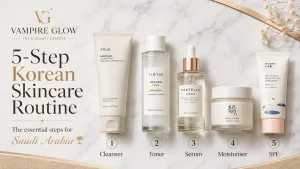
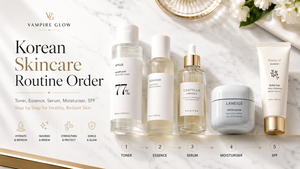
Apply from thinnest texture to thickest. Here’s the sequence that most estheticians in Korea actually recommend, adapted for a hot, dry, air conditioned climate.
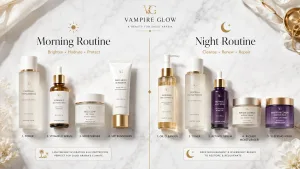
Morning routine
- Gentle cleanser. A light, non-stripping cleanser to remove overnight oil and sweat without disturbing the skin barrier.
- Toner. A hydrating, alcohol-free toner to rebalance skin and prep it for the next layers. Mixsoon’s Bean Essence is a well known starting point in this step.
- Essence. The step most associated with K-beauty. A lightweight, treatment-focused liquid that adds a first real layer of hydration.
- Serum. Targeted actives here, brightening, hydrating or barrier repairing, depending on what skin needs that day.
- Eye cream. Thin skin around the eyes needs its own lighter formula, applied before heavier moisturiser.
- Moisturiser. Locks in everything applied underneath. Gel textures suit oily and combination skin in the heat, richer creams suit dry skin.
- Sunscreen. Non-negotiable. Reapply through the day if you’re outdoors for long stretches.
Evening routine
Double cleanse (oil cleanser first if wearing makeup or SPF, then the gentle cleanser), toner, essence, treatment serum, and a richer night moisturiser or sleeping mask two to three times a week. Some By MI and Mixsoon both carry formulas suited to this step, viewable on the skin care category page.
How Soon Do Results Show
Hydration and a softer texture are usually the first things people notice, often within one to two weeks of consistent use. Brighter, more even looking skin typically takes longer, often six to eight weeks of steady use before the change is really visible. Results vary by skin type, how consistently the routine is followed, and the specific concern being targeted. There’s no fixed date this happens by, and skipping days slows it down.
How Often to Use Each Step
Cleansing, toning, moisturising and SPF are daily, non-negotiable steps, morning and night for the first three. Essence and serum can be used daily for most skin types, though sensitive skin may prefer building up gradually. Sheet masks and exfoliating treatments are better kept to two or three times a week rather than daily, since overuse can irritate rather than help.
Aftercare and Usage Tips
Do apply SPF every single morning, even on cloudy days or when mostly indoors, since UV passes through glass and AC does not block it. Do introduce new actives one at a time so you know what’s working and what isn’t. Do stay consistent, since Korean skincare rewards routine more than intensity.
Don’t stack multiple strong actives, like a vitamin C serum and an exfoliating acid, in the same session without understanding how they interact. Don’t overuse sheet masks or exfoliants expecting faster results, since that usually backfires. Don’t give up after a week, real change here is gradual.
Korean Skincare Routine vs Western Minimalist Routine
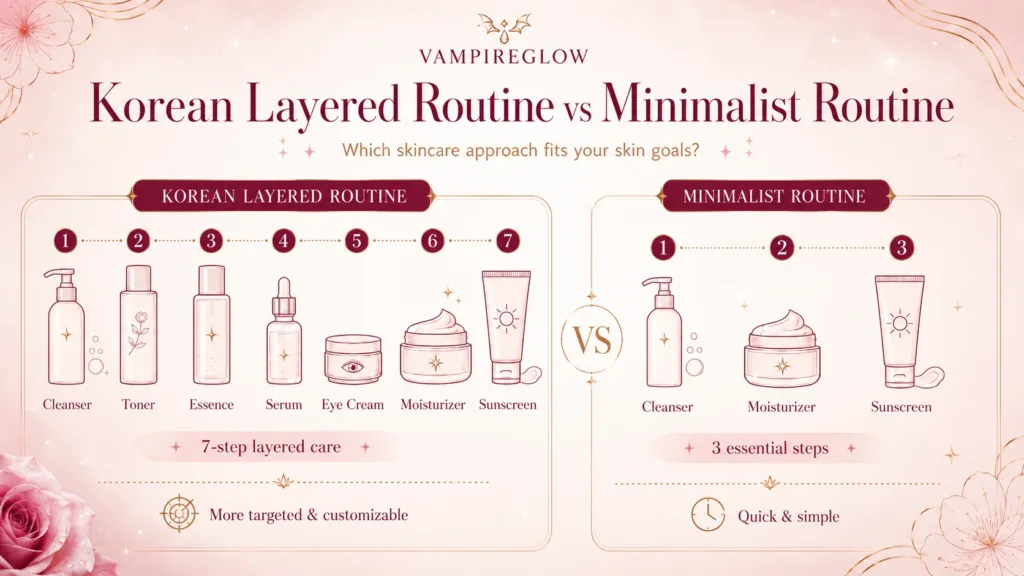
| Korean Layered Routine | Western Minimalist Routine | |
| Number of steps | 7 to 10, layered | 3 to 4, condensed |
| Texture focus | Light, watery layers | Fewer, richer products |
| Best suited to | Climates with big humidity or temperature swings, like Saudi Arabia | Stable, milder climates |
| SPF culture | Daily habit, often reapplied | Often applied but less habitually reapplied |
| Learning curve | Higher at first, more products to learn | Lower, fewer decisions |
Neither is objectively better. The layered approach earns its place specifically because of what heat, dust and AC do to skin here.
Possible Side Effects and Precautions
Introducing several new products at once can make it hard to tell what’s causing irritation if something goes wrong, so build the routine gradually. Products containing acids, retinoids or fragrance carry a higher chance of sensitivity for reactive skin, patch test these on the inner arm before applying to the face. Anyone pregnant, breastfeeding, or on prescription skin treatment should check with a doctor before adding new actives to their routine. Stop use and consult a dermatologist if you notice persistent redness, burning or breakouts that don’t settle within a few days.
What Does a Korean Skincare Routine Cost
Start with the essentials. Cost depends on a few real factors, not a fixed number:
- How many steps you build into your routine at once, versus starting with the core four
- Product size and how long a bottle actually lasts with daily use
- Whether you buy pieces individually or as part of a bundle or set
- Your region and currency, since Vampire Glow displays pricing in AED for Gulf shoppers and in USD elsewhere
- Delivery destination within Saudi Arabia or the wider GCC
Prices are shown live on each product page, since they can shift and differ by region.
Why Choose Vampire Glow
- Authentic Korean brands sourced directly, with batch codes and expiry checked on arrival
- A curated edit, chosen for the Gulf climate rather than an overwhelming catalogue
- Cruelty-free brands only
- Delivery across the UAE and the wider GCC, including Saudi Arabia, with options confirmed at checkout
- Clear ingredient and usage information on every product page
For the general dermatological guidance that sits underneath any routine, the American Academy of Dermatology publishes its own skin care tips.
Related reading
- The correct order for toner, essence, serum and moisturiser
- Whether you really need all 10 steps
- How morning and night routines should differ
- Adjusting your routine for summer heat and air conditioning
- How to get glass skin without looking oily
FAQs
What is the #1 skincare product in Korea? There’s no single official “number one,” but two things come up constantly. The essence step is often called Korea’s real contribution to global skincare, since it’s the layer most Western routines skip entirely. And daily sunscreen is treated as completely non-negotiable in Korean skincare culture, arguably more than any single product.
How do I get Korean glass skin? Glass skin is less about one product and more about consistency: layered hydration from toner through to moisturiser, regular but not excessive exfoliation, daily SPF, and skin that’s genuinely well hydrated rather than just glowing from highlighter. It builds gradually with consistent use, results vary by skin type and starting condition.
What are the 7 steps of Korean skincare? Cleanser, toner, essence, serum, eye cream, moisturiser, and sunscreen in the morning. In the evening, sunscreen is swapped for a night cream or sleeping mask. Some routines add a sheet mask or exfoliating step two to three times a week on top of this base.
Which two serums should I be careful combining? Vitamin C and retinol are the pairing most commonly flagged, since using both together can increase irritation for many skin types. It’s usually better to use vitamin C in the morning under SPF and save retinol for night, rather than layering both in the same session. Strong exfoliating acids and retinol are another combination worth spacing out rather than stacking.
What is the correct order for a Korean skincare routine? Thinnest to thickest: cleanser, toner, essence, serum or ampoule, sheet mask if using one, eye cream, moisturiser, then sunscreen in the morning. Applying in the wrong order, thick before thin, can stop lighter treatment products from absorbing properly.
Ready to Build Your Routine
Saudi Arabia’s climate doesn’t leave much room for skincare guesswork, heat, dust and constant AC all pull moisture from skin in different ways. A layered Korean skincare routine, built step by step and used consistently, is designed to hold up against exactly that. Browse the full range at vampireglow.com and build your routine piece by piece, or message our team on WhatsApp if you’re not sure where to start.


About author