Best Korean Skincare for Hyperpigmentation & Dark Spots in Saudi Arabia
Hyperpigmentation is one of the most common skin concerns across Saudi Arabia, and for reasons specific to this climate. The country’s year-round UV intensity is among the highest globally, and UV exposure is the single most significant factor in both causing and deepening pigmentation. Post-acne marks that might fade within weeks in a lower-UV environment can persist for months here. Melasma triggered by hormonal changes and worsened by sun exposure is particularly prevalent. Sun spots from cumulative UV damage accumulate faster and become more pronounced than they would in milder climates.
Table of Contents
- What Causes Hyperpigmentation and Dark Spots in Saudi Arabia
- Who This Guide Is For
- Why Korean Dark Spot Serums Work in Saudi Arabia's Conditions
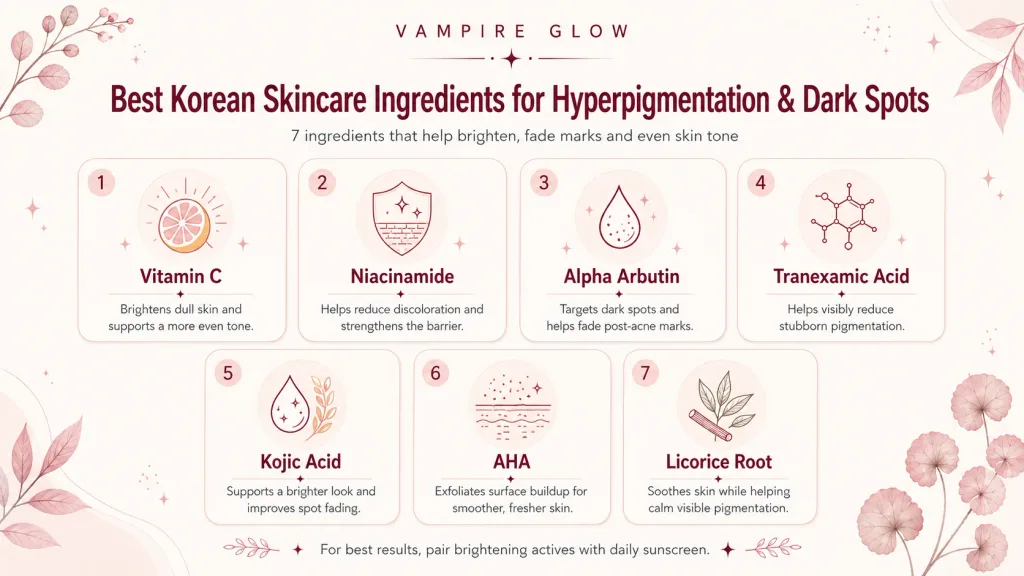
- Best Korean Skincare Ingredients for Hyperpigmentation and Dark Spots
- The Best Korean Dark Spot Serum Routine for Saudi Arabia
- How Soon Results Show
- How Often to Use Each Product
- Aftercare and Brightening Tips for Saudi Arabia
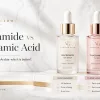
- Vitamin C Serum vs Niacinamide Serum for Dark Spots
- Possible Side Effects and Precautions
- What Does Korean Dark Spot Skincare Cost
- Why Choose Vampire Glow
- FAQs
- Build Your Brightening Routine at Vampire Glow
Most people dealing with dark spots in Saudi Arabia have tried a cream or treatment at some point and found the results disappointing or inconsistent. The majority of the time, the issue isn’t the product. It’s that no brightening serum or dark spot cream can overcome ongoing unprotected UV exposure. Without daily SPF50+ as a non-negotiable foundation, every evening’s brightening routine is partially undone the following morning.
Korean skincare approaches hyperpigmentation with a combination of well-researched brightening actives, consistent barrier support, and an SPF culture that treats sun protection as the first and most important step rather than an optional add-on. This guide covers the best Korean dark spot serum ingredients, the right routine order, and how to build a brightening routine that actually holds up under Saudi Arabia’s sun.
What Causes Hyperpigmentation and Dark Spots in Saudi Arabia
Understanding the type of hyperpigmentation you’re dealing with matters because different causes respond to different treatments.
Post-inflammatory hyperpigmentation (PIH). The most common type in Saudi Arabia. It’s the brown, red or purple mark left after a breakout, a rash, an insect bite or any skin inflammation heals. Darker skin tones are more prone to PIH, and Saudi Arabia’s UV levels mean those marks darken faster and take longer to fade than they would in low-UV environments.
Melasma. Symmetrical, patchy brown pigmentation typically appearing on the forehead, cheeks and upper lip. Primarily triggered by hormonal changes and dramatically worsened by UV exposure. Melasma is notoriously difficult to treat and often requires a consistent, long-term routine alongside dermatological guidance for stubborn cases. SPF is the most important management tool for melasma.
Solar lentigines (sun spots). Flat, well-defined spots caused by cumulative UV exposure over years. Common on the cheeks, nose and temples. These respond well to vitamin C, AHAs and consistent SPF but take time and consistency to visibly fade.
Post-acne erythema. The pink or red marks left after inflamed acne heals. These are vascular rather than melanin-based and respond to different actives than brown pigmentation, particularly niacinamide and centella.
For pigmentation on the body rather than the face, the Snail Whitening Oil and the Gluta Whitening Oil both target uneven tone over a longer timeline.
Who This Guide Is For
This guide is for anyone dealing with dark spots, uneven skin tone or visible hyperpigmentation in Saudi Arabia, regardless of whether it’s post-acne marks, sun spots or melasma. It covers routine building for both prevention and treatment.
Anyone with severe or deeply established melasma, or pigmentation that has not responded to consistent topical treatment over several months, should consult a dermatologist. Prescription-level brightening treatments and professional procedures are outside the scope of topical skincare and this guide does not advise on them.
Why Korean Dark Spot Serums Work in Saudi Arabia’s Conditions
The K-beauty approach to hyperpigmentation centres on layering multiple brightening actives at moderate, well-tolerated concentrations rather than using a single high-dose active that irritates the skin. This matters for Saudi Arabia specifically, since irritation from strong actives worsens post-inflammatory hyperpigmentation. Anything that inflames the skin, even a treatment product at too high a concentration, can trigger new pigmentation.
Korean dark spot serums and brightening products also tend to combine brightening actives with calming and barrier-support ingredients. Vitamin C is paired with niacinamide and centella. Alpha arbutin appears alongside fermented extracts and hyaluronic acid. This means the brightening work happens without compromising the skin barrier, which is particularly relevant for skin that’s already dealing with Saudi Arabia’s UV and heat stress.
Browse the skin care range at Vampire Glow for current Korean dark spot and brightening serums, including formulas from Some By MI and 3W Clinic.
Best Korean Skincare Ingredients for Hyperpigmentation and Dark Spots
Vitamin C (L-ascorbic acid and derivatives). The most studied topical brightening active available. Inhibits melanin production by blocking the enzyme tyrosinase, the key driver of pigment formation. Also provides antioxidant protection against UV-triggered oxidative stress. L-ascorbic acid at higher concentrations is the most potent form, but derivatives such as ascorbyl glucoside and sodium ascorbyl phosphate are more stable and better tolerated by sensitive skin. Korean vitamin C serums often use stabilised derivatives precisely because they’re more compatible with layering.
Niacinamide. Vitamin B3 in a cosmetic form. Reduces the transfer of melanin from pigment-producing cells to skin cells, which is the mechanism that makes dark spots visible. One of the most well-tolerated daily actives available, effective at concentrations as low as five percent, and compatible with virtually everything else in a brightening routine. Niacinamide also has anti-inflammatory properties that help reduce the post-breakout inflammation that leads to PIH in the first place.
Alpha arbutin. A glycoside derived from bearberry. Inhibits tyrosinase activity and reduces melanin synthesis. Well-tolerated, more stable than kojic acid, and effective at low concentrations. A common ingredient in Korean brightening serums specifically because of its gentle efficacy profile.
Tranexamic acid. A newer brightening active gaining prominence in K-beauty. Interrupts several pathways involved in melanin production and is particularly noted for its effect on melasma. Well-tolerated by most skin types including sensitive skin. Often found in Korean brightening serums and ampoules positioned for pigmentation concerns.
Kojic acid. Derived from fermentation, which gives it natural K-beauty credentials. Inhibits tyrosinase and reduces melanin production. Effective but can cause sensitivity in some skin types at higher concentrations. Korean formulas typically use it at skin-friendly levels paired with soothing ingredients.
AHA (glycolic acid, lactic acid). Accelerate surface cell turnover, helping pigmented cells shed faster and revealing fresher skin below. Glycolic acid is the most effective for texture and brightening. Lactic acid is gentler and also hydrating. Used two to three times a week in leave-on exfoliating formulas, they support brightening actives by clearing the surface layer so the actives can reach the cells they’re targeting.
Licorice root extract. A gentle natural brightening ingredient that inhibits melanin production and has anti-inflammatory properties. Often used in Korean formulas designed for sensitive skin dealing with pigmentation.
Fermented ingredients. A K-beauty signature. Fermented rice extract, fermented yeast and galactomyces ferment filtrate provide antioxidants, skin-renewing nutrients and brightening support alongside the primary active ingredients in most Korean brightening serums.
The Best Korean Dark Spot Serum Routine for Saudi Arabia
Morning routine
Step 1: Gentle cleanser. A non-stripping, pH-balanced cleanser. In the morning, a single gentle water-based cleanser is enough. Avoid anything that leaves skin feeling tight or stripped, since barrier disruption triggers more pigmentation in reactive skin.
Step 2: Hydrating toner. An alcohol-free hydrating toner balances skin after cleansing and prepares it for the brightening layers above. Some Korean brightening toners contain low concentrations of niacinamide or licorice extract at this step.
Step 3: Vitamin C serum. Morning is the ideal time for vitamin C, since it provides antioxidant protection against UV-triggered free radicals during the day. Apply after toner, allow it to absorb for 60 seconds before the next layer. A stabilised vitamin C derivative is a better starting point than high-concentration L-ascorbic acid for most skin in Saudi Arabia’s heat, since it’s more stable and less likely to irritate.
Step 4: Niacinamide or alpha arbutin serum. After vitamin C, a niacinamide serum or an alpha arbutin formula addresses melanin transfer and synthesis directly. Allow brief absorption between layers.
Step 5: Lightweight moisturiser. A gel or gel-cream that seals the brightening layers in without adding heaviness. Look for formulas that include hyaluronic acid and centella to support the skin barrier alongside the brightening routine.
Step 6: SPF50+ PA++++. This is the most important step in any dark spot routine for Saudi Arabia. Without it, every brightening active in the routine is working against ongoing UV damage that continues deepening pigmentation. Reapply SPF every two hours if outdoors. A lightweight Korean SPF with a flat, non-greasy finish makes daily reapplication realistic rather than something people skip.
Evening routine
Step 1: Double cleanse. Oil cleanser to remove SPF and any makeup. Water-based cleanser to complete the cleanse. Thorough SPF removal at night is critical since SPF left on overnight contributes to congestion and does nothing for brightening.
Step 2: Hydrating toner. Same as the morning, pressed into the skin on a slightly damp face.
Step 3: AHA or tranexamic acid treatment (two to three evenings a week). On exfoliation or treatment evenings, a glycolic acid or lactic acid exfoliant, or a tranexamic acid serum for melasma-focused concerns, goes here. Tranexamic acid serums can be used nightly for most skin types, while AHA exfoliants benefit from a two to three times per week frequency.
Step 4: Niacinamide serum. Niacinamide can be used both morning and evening without issue. Evening application adds a second daily dose of melanin-transfer inhibition.
Step 5: Richer gel-cream or sleeping mask. Seal the brightening layers with a slightly more occlusive formula at night to support the skin’s overnight repair cycle.
How Soon Results Show
Be realistic with timelines and set expectations accordingly. Surface cell turnover takes roughly 28 days in younger skin and longer in mature skin. Topical brightening actives work with that cycle, not against it.
Improved overall skin tone and reduced surface dullness: typically two to four weeks with consistent daily use. Visible fading of fresh post-acne marks: four to six weeks, faster with strict daily SPF. Older, more established dark spots: eight to twelve weeks minimum, sometimes longer. Melasma: the most resistant type of pigmentation, often requiring three to six months or more of consistent treatment, with significant variation between individuals.
Individual results vary by pigmentation type, skin tone, depth of pigmentation, how long spots have been present, and how consistently the routine is followed. Results are also significantly affected by how well SPF is maintained. Skipping SPF even a few days a week substantially slows brightening progress in Saudi Arabia’s UV conditions.
How Often to Use Each Product
Vitamin C serum: daily in the morning. Niacinamide serum: daily, morning and evening. Alpha arbutin: daily, can be used morning or evening or both. Tranexamic acid: daily in the evening for most formulas. AHA exfoliant: two to three evenings per week. SPF50+: every morning without exception, reapplied every two hours if outdoors.
Aftercare and Brightening Tips for Saudi Arabia
Do keep a small Korean SPF with you and reapply midday if spending any time outdoors. In Saudi Arabia, the gap between a morning application and an afternoon outing is long enough for significant UV exposure to undo brightening progress.
Do wear physical UV protection alongside topical SPF on high-exposure days: a wide-brim hat, UV-protective clothing, or staying in shade during peak hours between 10am and 4pm.
Do introduce brightening actives one at a time. Vitamin C first, niacinamide second, then an AHA or alpha arbutin. Building a brightening routine too quickly can irritate the skin and worsen the pigmentation you’re trying to treat.
Don’t layer vitamin C and niacinamide in the same single-product session if either is at a high concentration and your skin is sensitive. At moderate concentrations, the two are compatible, but if skin is reactive, use vitamin C in the morning and niacinamide morning and evening as separate products with absorption time between them.
Don’t use a physical scrub on dark spots. Physical friction irritates the skin and triggers more post-inflammatory pigmentation. Chemical exfoliation with AHA is always the safer choice for brightening.
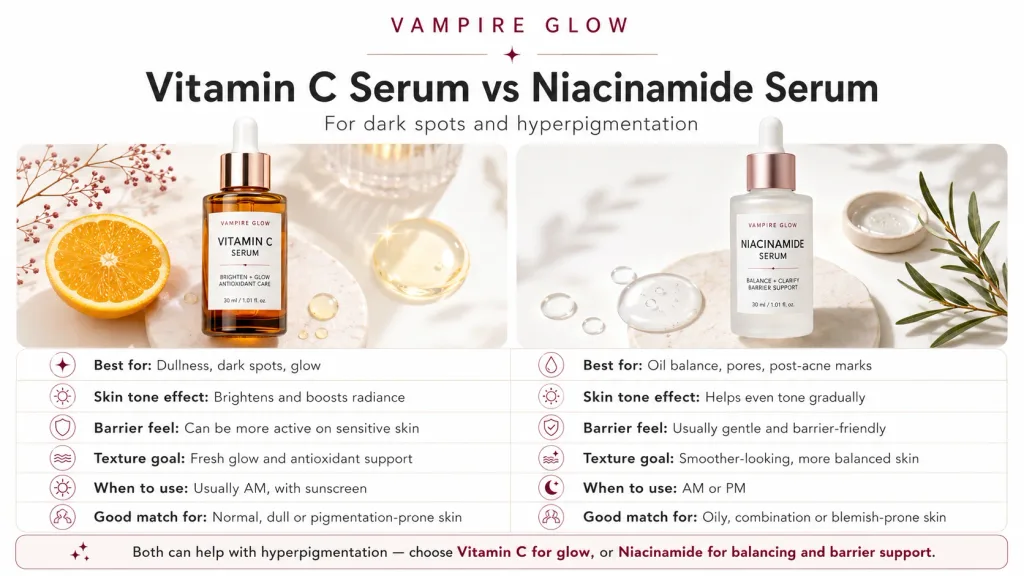
Vitamin C Serum vs Niacinamide Serum for Dark Spots
| Vitamin C Serum | Niacinamide Serum | |
| Primary mechanism | Blocks tyrosinase, antioxidant protection | Inhibits melanin transfer to skin cells |
| Best time to use | Morning, under SPF | Morning and evening, both effective |
| Result speed | Brightening effect visible in 4 to 6 weeks | Pore and tone improvement in 4 to 8 weeks |
| Stability | L-ascorbic acid is sensitive to heat and light; derivatives more stable | Very stable, unaffected by light or heat storage |
| Compatibility with SPF | Excellent, enhances UV protection when used underneath | Excellent, layers cleanly under SPF |
| Irritation risk | Moderate at higher concentrations of L-ascorbic acid | Very low, well-tolerated by most skin types |
| Suitable for sensitive skin | Better with stabilised derivative forms | Yes, one of the best active choices for sensitive skin |
| Climate suitability in Saudi heat | Good with stabilised forms; pure vitamin C can degrade faster in heat | Excellent, stable in heat |
| Post-acne mark fading | Yes, antioxidant and brightening properties support fading | Yes, reduces melanin transfer that makes marks visible |
| Can they be used together | Yes, apply vitamin C first, allow absorption, then niacinamide | Yes |
Both are the standard foundation of a Korean brightening routine. Vitamin C for antioxidant protection and tyrosinase inhibition in the morning. Niacinamide for melanin transfer reduction, morning and evening. They complement rather than compete with each other when applied with a brief absorption break between them.
Possible Side Effects and Precautions
High-concentration L-ascorbic acid vitamin C products can cause tingling, redness or irritation in sensitive skin, particularly when first introduced. Starting with a lower concentration or a stabilised derivative form, and introducing it every other day before daily use, reduces this risk significantly.
AHA exfoliants increase photosensitivity, making daily SPF even more critical in Saudi Arabia’s UV conditions. Anyone adding a glycolic or lactic acid exfoliant to their routine without already having a strict SPF habit should establish the SPF routine first.
Tranexamic acid is generally well tolerated but should be confirmed safe with a doctor by anyone pregnant or breastfeeding, since its use in pregnancy in topical form has not been fully established for all concentrations.
Kojic acid at higher concentrations can cause contact sensitivity in some individuals. Patch test on the inner arm before full facial use.
Do not combine multiple tyrosinase inhibitors at high concentrations in the same session. Vitamin C, alpha arbutin and kojic acid all target the same enzyme. Using all three at full concentration simultaneously doesn’t produce faster results and increases the irritation risk.
Anyone using prescription brightening treatments such as hydroquinone or tretinoin should check with their dermatologist before adding additional brightening actives, since the combination may over-treat and damage the skin barrier.
What Does Korean Dark Spot Skincare Cost
Pricing varies based on real factors.
- Product format and concentration: a high-concentration vitamin C ampoule differs in price from a gentle niacinamide serum or a multi-active brightening toner
- Bottle size and how long the product lasts at daily use amounts
- Multi-step routines where several brightening products are used together versus a simpler two to three step approach
- Currency and region: Vampire Glow displays pricing in AED for Gulf shoppers and USD elsewhere
- Delivery destination within Saudi Arabia or the wider GCC
Live pricing is visible on each product page and updates regularly. Browse the skin care range for current brightening and dark spot serum options.
Why Choose Vampire Glow
- Authentic Korean brands sourced directly, with batch codes and expiry dates verified on arrival
- A curated selection built for Gulf climate skin, including brightening formulas chosen for the UV conditions specific to Saudi Arabia and the GCC
- Cruelty-free brands only
- Delivery across the UAE and the wider GCC, including Saudi Arabia, confirmed at checkout
- Full ingredient lists and usage notes on every product page
Prefer the underlying evidence to any brand's word for it? PubMed indexes the published research on topical hyperpigmentation treatment.
Related reading
- Niacinamide vs tranexamic acid for dark spots
- What glutathione tablets can and can't do for skin tone
- The best PDRN serums available in Saudi Arabia
- The best Korean sunscreen for Saudi Arabia
- Glutathione vs vitamin C for skin brightening
FAQs
Which Korean cream or serum is best for hyperpigmentation and dark spots? The most effective Korean dark spot approach is a layered one rather than a single product. A vitamin C serum in the morning for tyrosinase inhibition and antioxidant protection, a niacinamide serum morning and evening for melanin transfer reduction, and an alpha arbutin or tranexamic acid formula targeting melanin synthesis in the evening. Topped with SPF50+ PA++++ every single morning without exception. Some By MI carries brightening-focused serums available at Vampire Glow, and 3W Clinic has established brightening and skin renewal formulas worth exploring. Browse the skin care range for current stock.
Which cream is good for pigmentation and dark spots in general? For any pigmentation type, the most effective topical approach combines at least one of the following: a tyrosinase inhibitor (vitamin C, alpha arbutin, kojic acid), a melanin-transfer blocker (niacinamide) and something that accelerates surface cell turnover (AHA). A cream or serum that includes two or more of these in a stable formula, used daily alongside SPF50+, is the most reliable structure for fading dark spots regardless of brand origin. In Saudi Arabia, SPF is not optional as part of this treatment. Without it, no topical brightening formula can outpace ongoing UV darkening of existing pigmentation.
Which Korean brand is good for dark spots? Several Korean brands have built strong brightening lines. At Vampire Glow, Some By MI and 3W Clinic are worth exploring for their brightening and skin-renewal formulas. Both are available in the Vampire Glow skin care catalogue with ingredient lists and usage notes on each product page to help you compare formulas for your specific pigmentation concern.
How long does it take for dark spots to fade with Korean skincare? Fresh post-acne marks with consistent niacinamide use and daily SPF: four to six weeks for visible improvement. Older, established dark spots: eight to twelve weeks minimum. Sun spots from accumulated UV exposure: often three months or longer for meaningful fading. Melasma: the most resistant type, requiring consistent treatment over three to six months or more, with results varying significantly between individuals. Results in Saudi Arabia are strongly influenced by how strictly SPF is maintained, since unprotected UV exposure each day counteracts whatever brightening happened the previous evening.
Can I use a Korean dark spot serum during the day in Saudi Arabia? Yes, with conditions. Vitamin C serum is specifically more effective in the morning since it provides antioxidant protection against UV-triggered free radicals during daytime exposure. Niacinamide and alpha arbutin are safe for both morning and evening use. Any serum containing AHA or retinol should be reserved for evening use only, with strict SPF applied the following morning. For all serums used in the morning, a broad-spectrum SPF50+ PA++++ as the final step is mandatory in Saudi Arabia’s UV conditions. Without it, daytime use of brightening actives provides limited benefit since UV exposure undoes progress in real time.
Does Vampire Glow deliver Korean dark spot serums to Saudi Arabia? Yes. Vampire Glow delivers across the UAE and the wider GCC, including Saudi Arabia. Delivery options and timelines are confirmed at checkout for your specific region. Browse the full skin care range for current brightening and dark spot serum options, or visit the Some By MI and 3W Clinic brand pages to explore available formulas.
Build Your Brightening Routine at Vampire Glow
In Saudi Arabia’s UV conditions, hyperpigmentation doesn’t fade by accident. It fades through a consistent layered routine: vitamin C in the morning, niacinamide daily, a targeted brightening active in the evening, and SPF50+ every single day without exception. Korean skincare builds that routine more elegantly than most, combining well-researched actives with lightweight textures that work in the heat and don’t compete with each other in the layering process. Shop the Vampire Glow skin care range to find your brightening routine, or reach out to the team at support@vampireglow.com for a personalised recommendation based on your specific pigmentation concern.

About author