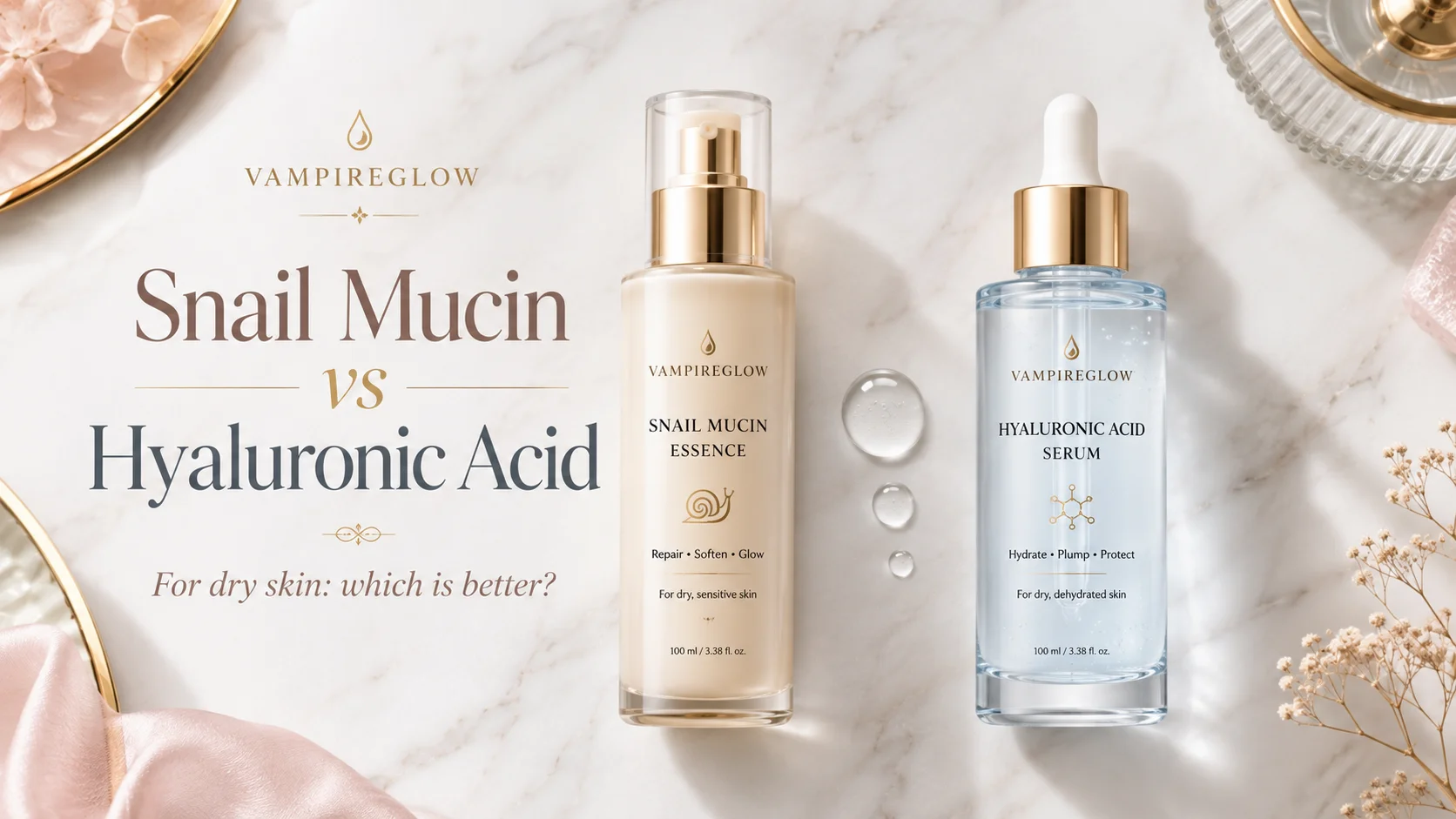
Snail Mucin vs Hyaluronic Acid: Which Is Better for Dry Skin?
If you have dry skin and you’ve been building a Korean skincare routine, chances are you’ve landed on both snail mucin and hyaluronic acid at some point and wondered whether you need both, which one works better, or whether they’re essentially doing the same thing in different packaging.
Table of Contents
- What Dry Skin Actually Needs
- How Hyaluronic Acid Works for Dry Skin
- How Snail Mucin Works for Dry Skin
- Snail Mucin vs Hyaluronic Acid for Dry Skin in Saudi Arabia's Climate
- Which One Is Actually Better for Dry Skin
- Can You Use Snail Mucin and Hyaluronic Acid Together
- Why Is Snail Mucin Sometimes Drying My Skin
- Who Should Avoid Snail Mucin
- How Often to Use Each for Dry Skin
- Aftercare Tips for Dry Skin in Saudi Arabia
- Possible Side Effects and Precautions
- What Does Each Cost
- Why Choose Vampire Glow
- FAQs
- Find Your Dry Skin Combination at Vampire Glow
The short answer is that they’re not doing the same thing at all, even though both are associated with hydration. Hyaluronic acid is a targeted humectant that draws water to the skin’s surface. Snail mucin is a multi-active complex that hydrates, repairs the skin barrier, supports renewal and calms inflammation simultaneously. For dry skin specifically, and especially for dry skin dealing with Saudi Arabia’s year-round UV and air-conditioning combination, understanding the difference is what lets you build a routine that actually holds moisture rather than losing it by afternoon.
This guide puts both ingredients head to head, specifically through the lens of dry skin in Saudi Arabia’s climate, to help you decide which one your routine needs, or whether the right answer is both.
What Dry Skin Actually Needs
Before comparing the two ingredients, it helps to be precise about what’s happening in genuinely dry skin versus dehydrated skin, since the treatment approach differs.
Dry skin is a skin type characterised by reduced sebum production. The skin doesn’t produce enough natural oil to maintain a healthy surface lipid layer, which means the skin barrier is structurally weaker and moisture escapes more easily. Dry skin feels tight, can appear dull or flaky, and is more prone to fine lines and a rough surface texture.
Dehydrated skin is a temporary condition, not a skin type. Even oily skin can be dehydrated. It refers specifically to a lack of water content in the skin, often triggered by environmental factors. In Saudi Arabia, both outdoor UV dryness and extended indoor AC exposure strip water from the skin throughout the day, making dehydration a near-universal daily concern regardless of underlying skin type.
The distinction matters because dry skin needs both water and lipids to be genuinely addressed. Hyaluronic acid delivers water. Snail mucin delivers water plus barrier support. A dry skin type relying on hyaluronic acid alone is often still missing the lipid and barrier repair component, which is part of why skin can feel hydrated immediately after application and dry again an hour later.
For the eye area specifically, where both hydration and elasticity matter, the 3W Clinic Snail Eye Cream combines snail filtrate with collagen rather than making you choose.
How Hyaluronic Acid Works for Dry Skin
Hyaluronic acid is one of the most studied humectants in skincare. It’s a naturally occurring molecule in the skin that holds water, and it’s present in most Korean skincare formulas because of how effectively it draws moisture to the skin surface.
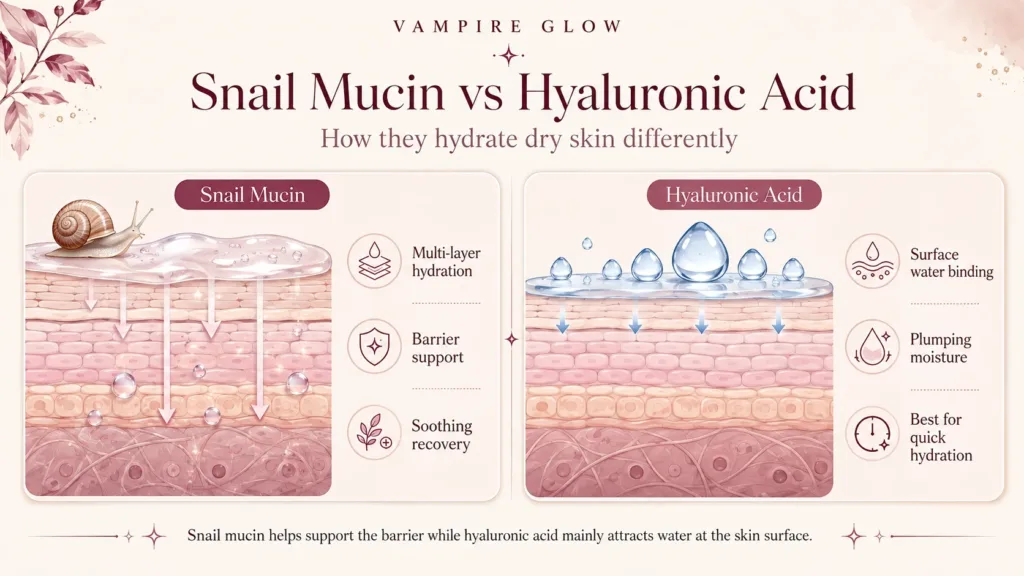
It works by binding water molecules to itself and holding them at the skin surface. Applied on slightly damp skin after toner, it can hold a significant multiple of its own weight in water, which explains the immediate plumping, softening effect that most people notice within the first few uses.
The complication for dry skin, and especially for dry skin in Saudi Arabia’s very dry AC environments, is that hyaluronic acid is a humectant, not an occlusive. It draws water to the surface but doesn’t seal it there. In a very low-humidity environment, such as a heavily air-conditioned office, if there’s no moisturiser applied on top to seal the HA layer, the water it draws to the surface will simply evaporate into the dry air. This is the mechanism behind the experience many people have of HA actually making their skin feel drier over time when used without proper occlusion.
For dry skin, hyaluronic acid is most effective as a pre-moisturiser hydration step, not as a standalone treatment.
How Snail Mucin Works for Dry Skin
Snail mucin, or snail secretion filtrate, approaches dry skin from a broader angle. Its natural active complex includes hyaluronic acid as one of its components, alongside glycoproteins, allantoin, glycolic acid and zinc. Each of these addresses a different aspect of what makes dry skin difficult to manage.
The hyaluronic acid component draws water to the skin, similar to a standalone HA product. The glycoprotein complex supports the skin barrier itself, helping skin retain moisture more efficiently rather than relying entirely on externally applied humectants to compensate. Allantoin calms and repairs skin that has become sensitised from dryness, tightness and environmental stress. The low-level glycolic acid gently resurfaces the flaking, rough texture that often comes with dry skin without the irritation of a dedicated exfoliant.
For genuinely dry skin, this multi-action approach is more comprehensive than HA alone. It doesn’t just add water to the surface. It begins addressing why the skin struggles to hold water in the first place, by supporting the barrier that’s supposed to prevent moisture loss.
Browse the skin care range at Vampire Glow for current snail mucin and hyaluronic acid products suited to dry skin, including formulas from 3W Clinic and Mixsoon.
Snail Mucin vs Hyaluronic Acid for Dry Skin in Saudi Arabia’s Climate
| Snail Mucin | Hyaluronic Acid | |
| Hydration type | Multi-layer: water binding plus barrier support | Surface water binding, humectant only |
| Barrier repair | Yes, glycoproteins and allantoin support barrier recovery | No, HA hydrates but doesn’t repair the barrier structure |
| Works without occlusion | Better than HA alone in dry environments, still benefits from a moisturiser on top | Requires a moisturiser seal above it in dry AC environments or it draws moisture from deeper layers |
| Suitable for flaking dry skin | Yes, gentle glycolic acid supports mild resurfacing | Hydration without exfoliation, texture improvement slower |
| Anti-inflammatory properties | Yes, allantoin component calms dryness-related irritation | Minimal |
| Collagen support | Yes, glycoprotein complex over time | Indirect only, through better hydration |
| Result speed | Hydration within days, fuller barrier benefits over weeks | Immediate surface plumping within first use |
| Best for severe dryness | Strong fit, multi-action approach | Useful but needs more supporting layers for severe dryness |
| Best for mild dehydration | Yes | Yes, faster immediate result |
| Saudi Arabia AC environment | Excellent, barrier repair counters daily AC moisture loss | Good but seal above it or risk drying effect in very low humidity |
| Daily use suitability | Yes, morning and evening | Yes, apply on damp skin each time |
| Cost efficiency | Single product delivers multiple benefits | Highly effective at low cost, widely available |
Which One Is Actually Better for Dry Skin
Neither wins outright, because they’re working on different parts of the same problem.
Hyaluronic acid is faster and more immediately noticeable. Apply it correctly on damp skin under a moisturiser and dry skin feels softer and more comfortable almost immediately. It’s also straightforward: one active, one mechanism, very well understood.
Snail mucin is more comprehensive over time. For dry skin specifically, the barrier repair component is what makes it more meaningful than HA alone. A skin barrier that retains moisture better is the long-term solution to dry skin, not just a daily top-up of water binding.
The honest answer for most people with dry skin in Saudi Arabia’s climate is that both have a role. Hyaluronic acid serum applied after toner on damp skin, followed by snail mucin essence as the treatment layer, gives you the immediate surface hydration of HA underneath the multi-benefit barrier support of snail mucin above it. This is a more effective approach than either alone, and it fits naturally into the K-beauty layering sequence without competing.
Can You Use Snail Mucin and Hyaluronic Acid Together
Yes, and for genuinely dry skin in a climate like Saudi Arabia’s, using both is often more effective than choosing between them.
The layering order is straightforward. Apply your hydrating toner first. Follow with a hyaluronic acid serum while the skin is still slightly damp from the toner. Allow it to absorb for 20 to 30 seconds, then apply the snail mucin essence on top. The HA builds the water base. The snail mucin delivers its multi-active treatment layer above it. Seal with a moisturiser to prevent the water bound by both products from evaporating in dry AC air.
Many snail mucin essences already contain hyaluronic acid as a supporting ingredient within the formula, in which case a separate HA serum may not be needed. Check the ingredient list of your specific snail mucin product. If sodium hyaluronate or hyaluronic acid appears in the first third of the ingredient list, the snail mucin is already covering the HA step and layering an additional standalone HA product is optional rather than necessary.
Why Is Snail Mucin Sometimes Drying My Skin
This is a real and common experience, and it’s almost always caused by one of a small number of fixable issues rather than the ingredient itself.
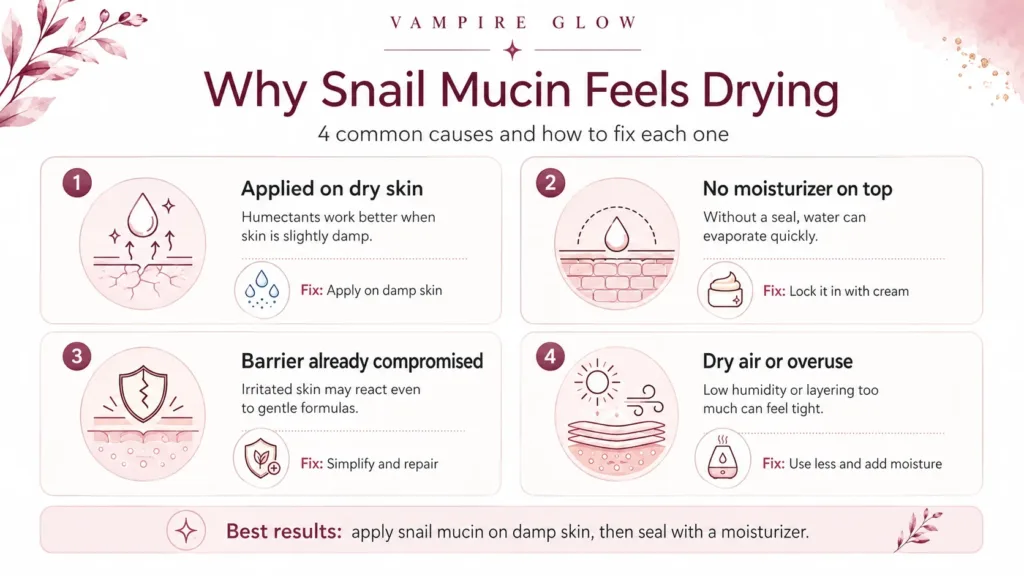
Applied without moisturiser on top. This is the most frequent cause. Snail mucin contains hyaluronic acid as part of its natural complex, and like any humectant used without an occlusive layer in a low-humidity environment, it can draw water to the surface and then lose it to evaporating dry air. Always follow snail mucin with a gel moisturiser or gel-cream, even on oily skin days. In Saudi Arabia’s AC environments this step is non-negotiable.
Applied to completely dry skin in a dry room. Humectants need ambient moisture to draw in. Applied to completely dry skin in a very low-humidity room, they can pull moisture from deeper skin layers instead of from the environment. Apply snail mucin after a hydrating toner so the skin surface is slightly damp.
The formula contains alcohol. Not all snail mucin products are equal. Some contain denatured alcohol or witch hazel as texture-modifying agents, both of which dry the skin. Check the ingredient list of your specific product. Denatured alcohol (listed as alcohol denat.) appearing early in the list is a red flag for a formula that can dry the skin despite its snail mucin content.
Using too much. An excessive amount of snail mucin applied at once can sit on the skin and feel tacky without absorbing properly. Two to three drops of essence is the correct amount. More than this interferes with absorption and can leave a surface film that eventually tightens.
Skipping or under-applying moisturiser. Even if you’re applying a small amount of moisturiser, dry skin in Saudi Arabia’s climate may need more than a light layer. If the skin still feels tight after moisturiser, a richer gel-cream or adding a dedicated ceramide product to the routine may be what’s needed rather than changing the snail mucin product.
Who Should Avoid Snail Mucin
Snail mucin is appropriate for most skin types, but there are specific situations where it needs caution or should be avoided.
Anyone with a mollusc or shellfish allergy. This is the most important avoidance. Snail secretion filtrate is an animal-derived protein, and individuals with documented shellfish or mollusc allergies should consult a dermatologist before using any snail mucin product topically, since an allergic reaction is possible.
Anyone who prefers fully vegan formulas. Snail mucin is an animal-derived ingredient. Individuals following a strict vegan skincare routine should choose hyaluronic acid products or plant-based barrier-repair alternatives instead.
Anyone whose skin is actively sensitised from over-exfoliation or a compromised barrier. While snail mucin’s allantoin is calming, introducing a new active during a period of skin crisis isn’t ideal. Allow the skin to settle first, then introduce snail mucin gradually. In this context, a plain ceramide and hyaluronic acid routine is a better immediate repair option.
Anyone expecting results from a single product without proper routine support. Snail mucin requires a proper routine around it. Without toner underneath and moisturiser above it, it underperforms. This isn’t an avoidance exactly, but managing expectations about what snail mucin can do in isolation is important.
How Often to Use Each for Dry Skin
Snail mucin: Daily, morning and evening, for cumulative barrier repair and hydration results. This is where its advantage over HA becomes most apparent. Consistent daily use builds barrier strength over time in a way that occasional use doesn’t.
Hyaluronic acid: Daily, morning and evening, always on slightly damp skin and always followed by a moisturiser. For dry skin in Saudi Arabia’s AC environments, twice daily application ensures the skin has a consistent water supply to draw from throughout the day.
The pair used together daily gives dry skin a comprehensive daily hydration routine that addresses both the water content and the barrier function components of dryness.
Aftercare Tips for Dry Skin in Saudi Arabia
Do keep a small facial mist in your bag for long days in dry AC environments. A light spritz to the face midday, followed by gently pressing it in rather than letting it evaporate, gives skin a moisture boost that supports the morning routine through the afternoon.
Do apply moisturiser within 60 seconds of applying snail mucin and HA. The window matters in dry environments. The longer you wait between serum and moisturiser, the more opportunity there is for the humectants to lose their moisture to the air.
Don’t skip SPF on the basis that you’re already doing many other steps. SPF50+ is the step that protects the skin from the external UV damage that makes dry skin worse in Saudi Arabia’s conditions. Use a lightweight Korean sunscreen that doesn’t add to the dry, tight feeling.
Don’t overload the routine thinking more products will solve dry skin faster. A focused routine of cleanser, toner, HA serum, snail mucin essence and a rich gel-cream plus SPF is more effective than ten competing products applied on top of each other.
Possible Side Effects and Precautions
For hyaluronic acid, the main precaution is application technique. Used without proper occlusion in very dry environments, it can worsen dryness. Apply on damp skin and always follow with moisturiser.
For snail mucin, the primary precaution is the mollusc allergy risk. Patch test on the inner arm before applying to the face. Anyone allergic to shellfish or molluscs should consult a dermatologist before using any snail secretion filtrate product.
For both, introduce them one at a time if adding both to a routine simultaneously, so you can identify which product any reaction relates to. Anyone pregnant, breastfeeding or under dermatological treatment should consult a doctor before adding new actives to their routine.
What Does Each Cost
Both snail mucin and hyaluronic acid products span a range of price points depending on format, concentration and brand. Pricing at Vampire Glow varies by product size, formula complexity, and whether the product is a dedicated single-active or a multi-ingredient formula where snail mucin or HA is one of several headline actives.
Currency and region affect displayed pricing: Vampire Glow shows prices in AED for Gulf shoppers and in USD elsewhere. Delivery options and any applicable costs for Saudi Arabia and the wider GCC are confirmed at checkout.
Browse live pricing on each product page, since it updates regularly and differs by region.
Why Choose Vampire Glow
- Authentic Korean brands sourced directly, with batch codes and expiry dates checked on arrival
- A curated edit chosen for Gulf climate conditions, with dry skin and barrier-repair formulas selected specifically for what Saudi Arabia’s heat and AC do to skin
- Cruelty-free brands only
- Delivery across the UAE and the wider GCC, including Saudi Arabia, confirmed at checkout
- Full ingredient lists and usage notes on every product page
Prefer the underlying evidence to any brand's word for it? PubMed indexes the published research on hyaluronic acid and skin hydration.
Related reading
- What snail mucin actually does for skin
- How to use snail mucin correctly
- The signs of a damaged skin barrier and how to fix it
- Which Korean skincare ingredients actually work
FAQs
Why do Koreans use snail mucin? Snail mucin has been used in Korean skincare culture for decades, long before it became a global K-beauty trend. Its appeal in Korean skincare is practical: it’s a multi-functional ingredient that delivers hydration, barrier repair, gentle renewal and calming benefits in a single product, which suits the K-beauty philosophy of targeted, layered care perfectly. Korean skincare culture also values ingredients with a documented history of use, and snail secretion’s original application in wound healing gave it a foundation that synthetic actives often lack. For Korean consumers dealing with seasonal climate extremes, from cold dry winters to humid summers, snail mucin’s barrier-repairing properties made it a year-round staple.
What happens if we use snail mucin every day? Daily use is appropriate for most skin types and produces the best cumulative results. Used correctly every day, morning and evening, snail mucin gradually builds better skin barrier function, improves hydration retention, smooths surface texture through its gentle glycolic acid content, and may support collagen production over time. There’s no required cycle-off period, no purging phase and no tolerance ceiling that makes daily use problematic. The only caveat is correct application, always followed by moisturiser on top and SPF in the morning. Snail mucin used daily without a moisturiser above it, particularly in Saudi Arabia’s dry AC environments, can cause the drying effect described in the next question.
Why is snail mucin drying my skin? The most common cause is skipping moisturiser on top. Snail mucin contains humectant actives including hyaluronic acid, which draw water to the skin surface. In a very dry, air-conditioned environment, without a gel moisturiser sealed above them, those water molecules evaporate into the air rather than staying in the skin. The solution is always to follow snail mucin with a gel moisturiser or gel-cream, even on days when skin doesn’t feel particularly dry. The second most common cause is applying snail mucin on completely dry skin in a dry room. Apply it after a hydrating toner while the skin is still slightly damp, and the humectant components can bind to that surface moisture rather than drawing from deeper layers. A third possibility is alcohol in the formula: check the ingredient list for denatured alcohol appearing in the first half of the list.
Who should avoid snail mucin? Anyone with a documented allergy to molluscs or shellfish should avoid snail mucin and consult a dermatologist before using any product containing snail secretion filtrate. Anyone following a strict vegan skincare routine should also avoid it, since snail mucin is an animal-derived ingredient. Individuals with very sensitised, barrier-compromised skin may want to stabilise their skin with a plain ceramide and hyaluronic acid routine before introducing snail mucin, rather than adding it during an active period of skin distress. Anyone pregnant, breastfeeding or on prescription treatment should check with their doctor before adding snail mucin to their routine.
Do I need a moisturiser after snail mucin for dry skin? Yes, and for dry skin in Saudi Arabia’s climate this is especially important. Snail mucin is a treatment active, not a sealing product. Without a moisturiser above it, the hydration it delivers evaporates in dry AC air. For dry skin specifically, a gel-cream or richer cream is needed above the snail mucin layer to hold the hydration in. Think of snail mucin as the treatment that improves the skin’s ability to retain moisture over time and hyaluronic acid as the water delivery beneath it. The moisturiser is the seal that keeps all of that in. Removing any one of those three steps undermines the others.
Can snail mucin and hyaluronic acid be used together for dry skin? Yes, and for dry skin in Saudi Arabia this combination is one of the most effective approaches available in a K-beauty routine. Apply hyaluronic acid serum on slightly damp skin after toner, allow brief absorption, then apply snail mucin essence on top. Seal with a gel-cream or richer moisturiser. The HA draws and holds water at the surface. The snail mucin adds its multi-active barrier support and gentle renewal benefits above it. Together they address both the water delivery and barrier repair components of dry skin more comprehensively than either alone. If your snail mucin product already contains sodium hyaluronate high in its ingredient list, a separate HA serum may be optional rather than necessary. Browse the skin care range at Vampire Glow to compare current formulas and find the right combination for your dry skin routine.
Find Your Dry Skin Combination at Vampire Glow
For dry skin dealing with Saudi Arabia’s climate, snail mucin and hyaluronic acid aren’t competing products. They’re complementary steps that address different parts of the same problem, and used together in the right order they produce better results than either alone. Shop the full skin care range at Vampire Glow to find your snail mucin and HA pairing, or browse the 3W Clinic and Mixsoon brand pages for current dry skin-suited formulas. For a personalised routine recommendation, reach out to the team at support@vampireglow.com.
About author