Best Korean Skincare Ingredients for Glowing Skin
Glowing skin is not a product. It’s a condition of the skin that comes from three things happening at once: the surface is smooth enough to reflect light evenly, the skin is properly hydrated so it looks plump rather than flat, and the tone is even enough that light isn’t broken up by patches of pigmentation.
Table of Contents
- What Actually Creates Glowing Skin
- The Hydrating Ingredients
- The Barrier-Supporting Ingredients
- The Brightening Ingredients
- The Renewal and Texture Ingredients
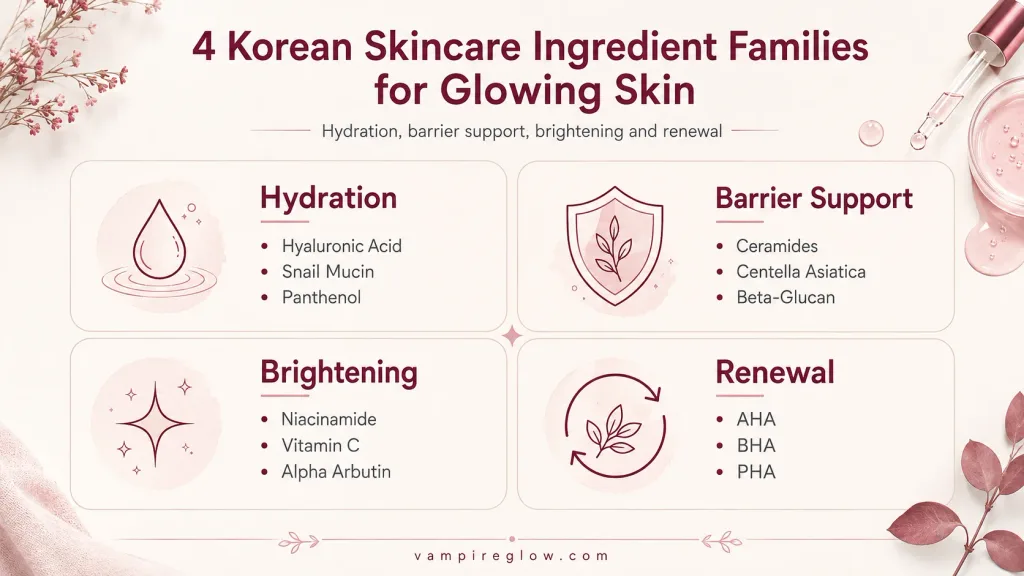
- The Ingredient Categories at a Glance
- How to Layer Glow Ingredients Without Over-Treating
- Which Ingredients Matter Most in Saudi Arabia's Climate
- How Soon Glow Ingredients Show Results
- Aftercare and Usage Tips
- Possible Side Effects and Precautions
- What Do Glow Ingredients Cost at Vampire Glow
- Why Choose Vampire Glow
- FAQs
- Build Your Glow Routine at Vampire Glow
Korean skincare is built around ingredients that deliver all three, which is why K-beauty routines produce the glow that the category is known for. But the ingredient list on a Korean product can run to forty items, and knowing which of those are doing the work is the difference between buying something that changes your skin and buying something that just feels nice.
In Saudi Arabia, this matters more than in most markets. Year-round UV creates pigmentation that dulls the skin. Constant air conditioning strips the hydration that plumpness depends on. Heat and dust congest the surface and roughen the texture. The ingredients that create glow here need to work against all three conditions at once, not just deliver a temporary shine.
This guide covers the Korean skincare ingredients that genuinely contribute to glowing skin, what each one does, who it suits, and how to combine them without over-layering.
What Actually Creates Glowing Skin
Before the ingredient list, it helps to be clear about the mechanism, because it changes what you should be looking for.
Even surface texture. Light reflects off a smooth surface uniformly. It scatters off a rough one. Skin with dead cell buildup, congestion or uneven texture cannot look luminous no matter how much hydration is applied on top, because the light is being broken up before it can reflect back. This is why gentle exfoliation is part of every glow-focused routine.
Genuine hydration at multiple depths. Well-hydrated skin cells are plump and sit flush against each other, creating an even surface. Dehydrated skin cells shrink slightly, which creates micro-texture and a flat, dull appearance. Hydration is not the same as oil. Oily skin can look greasy and still be dehydrated underneath and look dull.
Even tone. Patches of pigmentation, post-acne marks and sun-driven melasma interrupt the uniformity that reads as glow. Brightening ingredients that address pigmentation contribute as much to the glowing effect as hydrating ones.
An intact barrier. All three of the above depend on a functioning skin barrier. A compromised barrier cannot hold hydration, heals texture slowly and inflames more easily. Barrier-supporting ingredients are foundational rather than optional in a glow routine.
Two of these ingredients are easiest to try in a single product: the Mixsoon Bean Essence for soybean extract, and the Reedle Shot 300 sheet mask for centella.
The Hydrating Ingredients
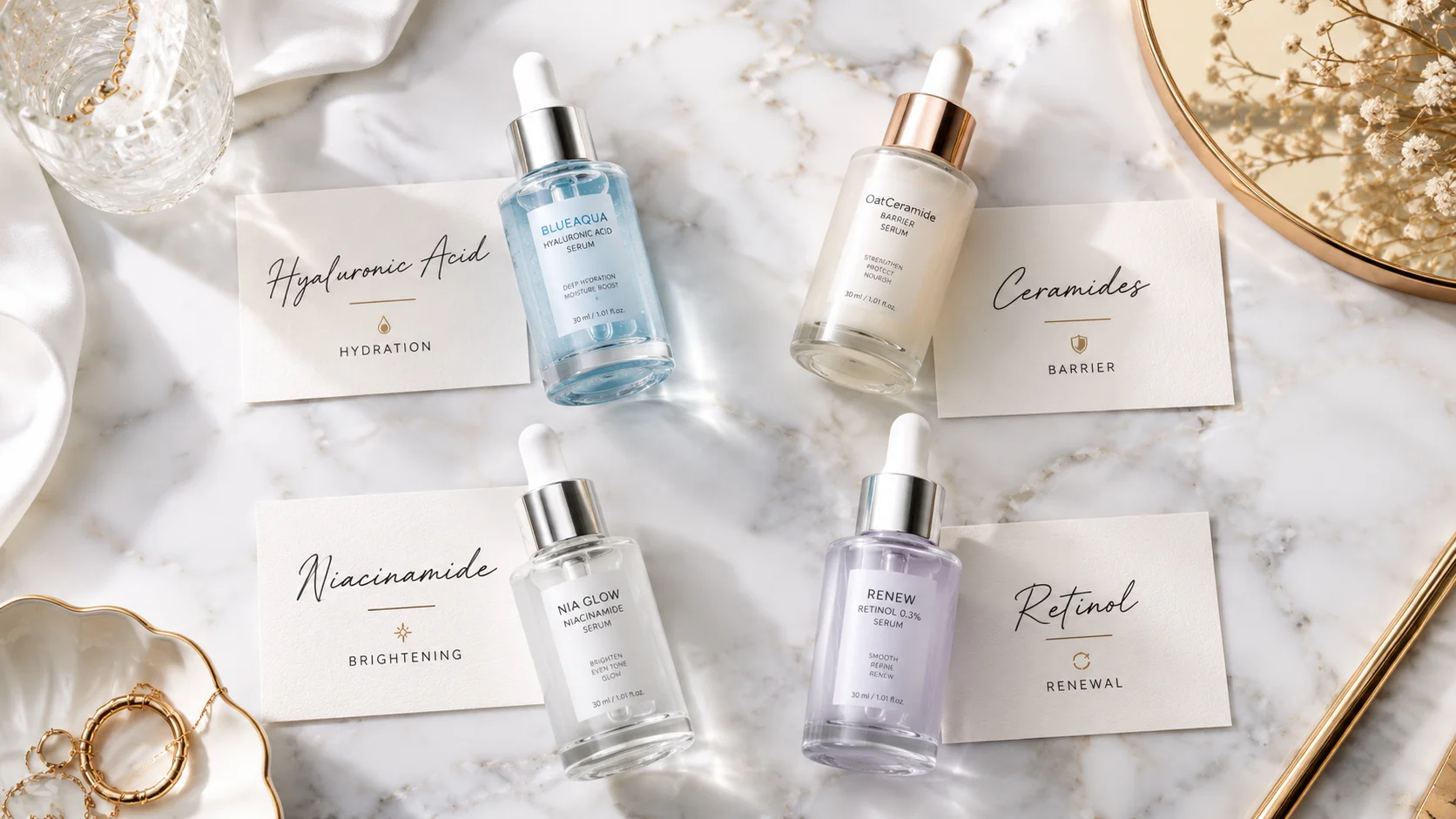
Hyaluronic acid. The most widely used humectant in skincare and the fastest-acting hydration ingredient for a visible plumping effect. It binds water and holds it at the skin surface. Korean formulas often include it at multiple molecular weights so hydration reaches different skin depths rather than sitting entirely on the surface. In Saudi Arabia’s air-conditioned environments, hyaluronic acid must always be sealed with a moisturiser on top, otherwise the water it draws to the surface evaporates into the dry air and can leave skin feeling drier than before.
Snail secretion filtrate (snail mucin). A multi-active complex containing hyaluronic acid, glycoproteins, allantoin, zinc and low-level glycolic acid. It hydrates, supports barrier repair, calms irritation and delivers very mild surface renewal simultaneously. This combination makes it one of the single most efficient glow ingredients available, since it addresses hydration, barrier and texture in one product. Available in formulas from 3W Clinic at Vampire Glow.
Panthenol (provitamin B5). Draws and holds moisture while supporting the skin’s own repair processes. Well tolerated by nearly every skin type including very sensitive skin. A supporting ingredient in most well-formulated Korean hydrating products rather than a headline active.
Beta-glucan. A polysaccharide with significant soothing and hydrating properties. Calms inflammation while delivering moisture, which makes it particularly useful for skin that is both dehydrated and reactive, a common combination in Saudi Arabia’s climate.
The Barrier-Supporting Ingredients
Ceramides. The lipid molecules that physically make up a large part of the skin barrier. Topical ceramides replenish what heat, AC, over-cleansing and over-exfoliation have depleted. Without an intact barrier, skin cannot retain the hydration that glow depends on, which makes ceramides foundational rather than a nice addition. Easy Dew is a Korean medical skincare brand focused specifically on barrier care.
Centella asiatica (cica). Its active compounds, madecassoside and asiaticoside, reduce inflammation and support the skin’s healing processes. For skin dealing with sun stress, post-breakout redness or general reactivity, centella calms the inflammation that makes skin look irritated rather than luminous.
Fermented ingredients. Galactomyces ferment filtrate, bifida ferment lysate and rice ferment filtrate appear widely in Korean essences. Fermentation breaks ingredients into smaller molecules that absorb more readily, and the fermentation process itself produces amino acids, vitamins and antioxidants. These are among the most characteristically Korean glow ingredients and are typically found in the essence step.
The Brightening Ingredients
Niacinamide. Arguably the most versatile ingredient in this entire list. It regulates sebum production, refines the appearance of pores, reduces the transfer of melanin to the skin surface (which fades dark spots over time), supports ceramide production and has anti-inflammatory properties. For glowing skin in Saudi Arabia, where oiliness, pigmentation and congestion all interfere with the glow simultaneously, niacinamide addresses several of those at once. Typically effective at 5 to 10 percent.
Vitamin C (ascorbic acid and derivatives). An antioxidant that neutralises UV-generated free radicals and supports collagen synthesis, while also inhibiting melanin production for a brightening effect. Best used in the morning under SPF, where its antioxidant function adds a protective layer alongside the sunscreen. Korean formulas often use gentler, more stable vitamin C derivatives rather than pure L-ascorbic acid, which suits sensitive skin better.
Tranexamic acid. Blocks the signalling pathway that triggers melanin production in response to UV and inflammation. More targeted than niacinamide for stubborn, UV-driven pigmentation, which describes most dark spots in Saudi Arabia’s conditions. Works well layered with niacinamide since they act at different points in the pigmentation process.
Arbutin. A gentler brightening agent derived from bearberry that inhibits tyrosinase, an enzyme involved in melanin production. Common in Korean brightening serums and well tolerated by most skin types.
The Renewal and Texture Ingredients
AHA (glycolic and lactic acid). Water-soluble acids that loosen the bonds between dead surface cells so they shed more readily, revealing the smoother skin underneath. This is the ingredient category most directly responsible for the light-reflecting surface that glow requires. Glycolic acid is the strongest and fastest-acting. Lactic acid is gentler and has mild hydrating properties, which suits dry or sensitive skin better. Evening use only, with strict SPF the following morning.
BHA (salicylic acid). Oil-soluble, so it penetrates into the pore rather than working only at the surface. Clears the congestion that creates visible texture and blackheads. Most relevant for oily and congested skin, where pore congestion is the primary obstacle to a smooth, glowing surface.
PHA (polyhydroxy acid). A larger molecule that penetrates more slowly than AHA or BHA, producing gentler exfoliation with a significantly lower irritation risk. The right choice for sensitive skin that still needs texture improvement.
PDRN (polydeoxyribonucleotide). A DNA fragment complex that supports the skin’s surface regeneration processes. Increasingly common in Korean treatment serums for texture improvement, barrier recovery and fine line support. Works gradually over weeks rather than delivering an immediate effect.
Retinal (retinaldehyde) and retinol. Vitamin A derivatives that accelerate cell turnover and support collagen production. Retinal converts to the active form of vitamin A more directly than retinol does, which is why it is often described as faster acting. Both are evening-only ingredients and both increase photosensitivity, which makes daily SPF non-negotiable when using them in Saudi Arabia.
The Ingredient Categories at a Glance
| Category | Key Ingredients | What It Does for Glow | Best For |
| Hydration | Hyaluronic acid, snail mucin, panthenol, beta-glucan | Plumps skin cells so the surface sits even and reflects light | All skin types, essential in AC environments |
| Barrier support | Ceramides, centella, fermented extracts | Enables the skin to hold hydration and heal texture | Sensitive, damaged, over-exfoliated skin |
| Brightening | Niacinamide, vitamin C, tranexamic acid, arbutin | Evens tone so light reflects uniformly | Pigmentation, post-acne marks, sun damage |
| Renewal | AHA, BHA, PHA, PDRN, retinal | Smooths surface texture so light reflects rather than scatters | Congestion, rough texture, dullness |
How to Layer Glow Ingredients Without Over-Treating
The most common mistake in a glow-focused routine is using every ingredient in this guide simultaneously. Four active serums layered nightly will irritate the skin rather than brighten it, and irritated skin never looks luminous.
A practical structure looks like this.
Morning: Hydrating toner, then a vitamin C or niacinamide serum, then a lightweight moisturiser, then SPF50+ PA++++. One brightening active is enough for the morning session.
Evening (non-exfoliation nights): Hydrating toner, a snail mucin or fermented essence, then a treatment serum such as PDRN, niacinamide or a peptide formula, then a ceramide moisturiser.
Evening (exfoliation nights, two to three times per week): Hydrating toner, an AHA or BHA product, wait for absorption, then a calming centella or snail mucin essence to restore what exfoliation removed, then a ceramide moisturiser. No retinol on the same night as an acid.
The pairings to keep in separate sessions are vitamin C with retinol, retinol with AHA or BHA, and multiple exfoliating acids in one session.
Which Ingredients Matter Most in Saudi Arabia’s Climate
Not every ingredient on this list is equally relevant here. If a routine has to be narrowed, these four earn their place first.
SPF is the foundation. Every brightening ingredient in this guide works against UV that is continuously creating new pigmentation. Without daily SPF50+ PA++++, brightening actives are clearing marks at the same rate that UV creates them, and visible progress stalls.
Niacinamide addresses oil, pores and pigmentation simultaneously, which are the three most common glow obstacles in this heat.
Ceramides counter the barrier degradation that the daily heat and AC cycle causes, which underpins everything else.
A gentle exfoliant used two to three times a week clears the surface congestion that dust, sweat and sebum create in this environment.
Browse the skin care range at Vampire Glow to compare formulas across these categories, including Mixsoon for minimal essence formulas and Some By MI for treatment-focused products.
How Soon Glow Ingredients Show Results
Hydrating ingredients such as hyaluronic acid and snail mucin produce a visible plumping and softening effect within days, sometimes from the first application.
Exfoliating ingredients improve surface smoothness and light reflection within two to four weeks of consistent use at the appropriate frequency.
Brightening ingredients including niacinamide and tranexamic acid take longer. Initial improvement in tone typically appears at four to six weeks, with more meaningful fading of established dark spots at eight to twelve weeks.
Barrier repair from ceramides and centella becomes noticeable in comfort and reduced reactivity within two to four weeks, though full barrier recovery from significant damage takes longer.
Individual results vary by skin type, concern severity, consistency of use and the level of ongoing UV exposure.
Aftercare and Usage Tips
Do introduce one new active ingredient at a time, allowing two to three weeks before adding another. This makes it possible to identify what is helping and what is causing a reaction.
Do apply hydrating ingredients to slightly damp skin and seal them with a moisturiser. In Saudi Arabia’s AC environments, humectants applied to dry skin in a dry room can draw moisture from deeper skin layers rather than from the air.
Do store products containing vitamin C, fermented extracts and retinal away from heat and direct sunlight. Ambient temperatures in a parked car or near a sunny window degrade these actives before the bottle is finished.
Don’t assume that more actives produce faster results. Four brightening serums layered together are more likely to cause inflammation, and inflamed skin looks dull rather than luminous.
Don’t skip the moisturiser step because a hydrating serum feels sufficient. The serum delivers the hydration, the moisturiser is what keeps it in the skin.
Possible Side Effects and Precautions
Exfoliating acids and retinal or retinol increase photosensitivity, which makes daily SPF50+ essential rather than optional in Saudi Arabia’s UV conditions. Using them without SPF can worsen the pigmentation they are intended to improve.
Snail mucin is derived from an animal source. Anyone with a documented mollusc or shellfish allergy should consult a dermatologist before using it, and anyone following a vegan routine should choose plant-based alternatives.
PDRN is typically derived from salmon or trout DNA. Anyone with a fish allergy should consult a dermatologist before use.
High-percentage vitamin C can sting on compromised or sensitive skin. Korean vitamin C derivatives are generally gentler than pure L-ascorbic acid.
Anyone pregnant or breastfeeding should avoid retinal, retinol and salicylic acid, and should check other actives with a doctor. Anyone on prescription skin treatment should consult a dermatologist before adding new actives. Patch test all new products on the inner arm before applying to the face.
What Do Glow Ingredients Cost at Vampire Glow
Pricing varies by ingredient concentration, formula complexity, brand and product size. Single-active serums and multi-ingredient formulas are priced differently, and a snail mucin essence that covers hydration, barrier and mild renewal in one product often works out more efficiently than three separate single-active serums.
Vampire Glow displays pricing in AED for Gulf shoppers and in USD for other regions. Delivery options for Saudi Arabia and the wider GCC are confirmed at checkout. Live prices are on each product page in the skin care category.
Why Choose Vampire Glow
- Authentic Korean brands with batch codes and expiry dates verified on arrival
- Full ingredient lists on every product page, so the actives in this guide can be identified before buying
- A curated selection chosen for Gulf climate conditions rather than a generic international catalogue
- Cruelty-free brands only
- Delivery across the UAE and the wider GCC, including Saudi Arabia, confirmed at checkout
Prefer the underlying evidence to any brand's word for it? PubMed indexes the published research on cosmeceutical ingredients.
Related reading
- Why centella (cica) dominates Korean skincare
- What snail mucin actually does for skin
- What PDRN serum is, and its side effects
- Rice water for skin, and whether it's worth it
FAQs
What is the most effective Korean skincare product for glowing skin? There is no single most effective product, since effectiveness depends on which obstacle is standing between your skin and the glow. If the issue is dehydration, a hyaluronic acid or snail mucin essence delivers the fastest visible change. If it’s rough texture and congestion, a BHA or AHA product used two to three times a week does more. If it’s uneven tone from sun exposure, a niacinamide or tranexamic acid serum is the right choice. The one product that benefits every glow routine regardless of skin type is a broad-spectrum SPF50+ PA++++, because UV undoes the work of every other ingredient in the routine.
What is in Korean skincare that makes it so good? Three things, and none of them is a single secret ingredient. First, the formulation philosophy prioritises lightweight, layerable textures that let several actives be used together without the heaviness that limits Western routines. Second, Korean skincare has access to and widely uses ingredients that are less common elsewhere, including snail secretion filtrate, fermented extracts such as galactomyces, centella asiatica, PDRN and advanced UV filters not approved in the United States. Third, and most significantly, Korean skincare culture treats the skin barrier as the foundation of everything rather than as an afterthought, and treats daily SPF as non-negotiable. The consistency and the barrier-first approach account for more of the results than any individual ingredient does.
What do Koreans actually use for skincare? The everyday Korean routine is more streamlined than the ten-step reputation suggests. A typical daily routine is a gentle cleanser, a hydrating toner, an essence, a targeted serum, a lightweight moisturiser and SPF in the morning, with a double cleanse and a treatment active replacing SPF in the evening. Exfoliants and sheet masks are used a few times a week rather than daily. The ingredients that appear most consistently across those routines are hyaluronic acid, niacinamide, centella asiatica, snail mucin, fermented extracts and ceramides, with SPF applied every single morning regardless of the weather or season.
What works 11 times faster than retinol? This figure refers to retinal, also called retinaldehyde, another vitamin A derivative. Retinol has to convert through an additional step in the skin before it becomes retinoic acid, the form the skin actually uses, while retinal converts more directly. Research has cited retinal as converting considerably faster than retinol, and the eleven times figure comes from that conversion comparison rather than from a claim that results appear eleven times sooner. In practice, retinal tends to show results somewhat faster than retinol at comparable concentrations, but both still require consistent use over weeks. Bakuchiol is sometimes mentioned in the same conversation as a gentler plant-derived alternative, though it works through a different mechanism and is not a direct equivalent. Retinal and retinol are both evening-only ingredients that increase photosensitivity, which makes daily SPF50+ essential when using either in Saudi Arabia.
What is the number one skincare brand in Korea? No brand holds an official number one position, and claims to that title generally reflect marketing reach rather than verified performance. Different Korean brands lead in different categories: some are known for barrier repair and clinical formulations, others for minimal clean essences, others for treatment-focused acne and texture products. The more useful question is which brand’s formulation approach matches your specific concern. At Vampire Glow, Easy Dew focuses on barrier care, Mixsoon on minimal ingredient essences, and Some By MI on targeted treatment for congestion and texture.
Which Korean ingredient works fastest for glowing skin? For an immediate visible effect, hyaluronic acid and snail mucin produce plumping and softening within days, sometimes from the first use, because they work on hydration rather than on cellular change. For lasting glow, exfoliating acids improve light reflection within two to four weeks, and brightening ingredients such as niacinamide take four to eight weeks to visibly even the tone. The fastest visible result and the most durable result come from different ingredient categories, which is why a complete glow routine includes both a hydrating layer and a longer-acting treatment layer rather than choosing one.
Build Your Glow Routine at Vampire Glow
Glowing skin comes from four things working together: hydration that plumps, a barrier that holds it, gentle renewal that smooths the surface, and brightening that evens the tone. Korean skincare covers all four, and in Saudi Arabia’s climate all four are working against conditions that actively undo them, which makes ingredient choice and daily SPF matter more here than almost anywhere else. Browse the skin care range at Vampire Glow to find formulas built around these ingredients, or email support@vampireglow.com for a recommendation based on which part of the glow equation your skin needs most.
About author