Signs Your Skin Barrier Is Damaged and How to Fix It in Saudi Arabia’s Climate
Most people don’t realise their skin barrier is damaged until it has been damaged for a while. The symptoms creep in gradually. Skin starts stinging during a routine that’s been working for months. A moisturiser that felt comfortable starts feeling like it’s sitting on the surface rather than absorbing. Redness appears around the nose or cheeks without an obvious reason. The forehead looks oily by midday but feels tight an hour later.
Table of Contents
- What Does an Unhealthy Skin Barrier Look and Feel Like
- Why Saudi Arabia's Climate Accelerates Barrier Damage
- The Skin Barrier Damage Spectrum: Mild, Moderate and Severe
- How to Fix a Damaged Skin Barrier in Saudi Arabia's Climate
- What Is the Fastest Way to Heal a Damaged Skin Barrier
- Can Moisturiser Alone Heal a Damaged Skin Barrier
- Choosing the Best Cream to Repair Your Skin Barrier
- Week by Week: What to Expect During Barrier Repair in Saudi Arabia's Climate
- Aftercare and Barrier Damage Prevention in Saudi Arabia
- Mild vs Moderate vs Severe Skin Barrier Damage: Approach and Timeline
- How Korean Skincare Approaches Barrier Repair Differently
- The Best Korean Skincare Ingredients for Barrier Repair
- What to Stop Using During Barrier Repair
- Possible Side Effects and Precautions
- What Does a Barrier Repair Routine Cost at Vampire Glow
- Why Choose Vampire Glow
- FAQs
- Start Repairing Your Skin Barrier Today
In Saudi Arabia’s climate, barrier damage is more common than most skincare advice acknowledges. The daily exposure to outdoor temperatures above 40 degrees followed by hours in cold, dry air conditioning creates a mechanical stress cycle that gradually erodes the barrier’s lipid structure. Add fine environmental dust, high UV intensity year-round, and a skincare market that encourages strong actives and exfoliants to fight oiliness in the heat, and the conditions are close to ideal for compromising the skin’s first line of defence.
The reassuring part is that a damaged skin barrier is fixable. But it requires correct identification first, and then a targeted approach rather than more of what probably caused the problem in the first place. This guide walks through exactly how to identify the signs, understand how serious the damage is, and repair it efficiently with Korean skincare formulas built for the job.
What Does an Unhealthy Skin Barrier Look and Feel Like
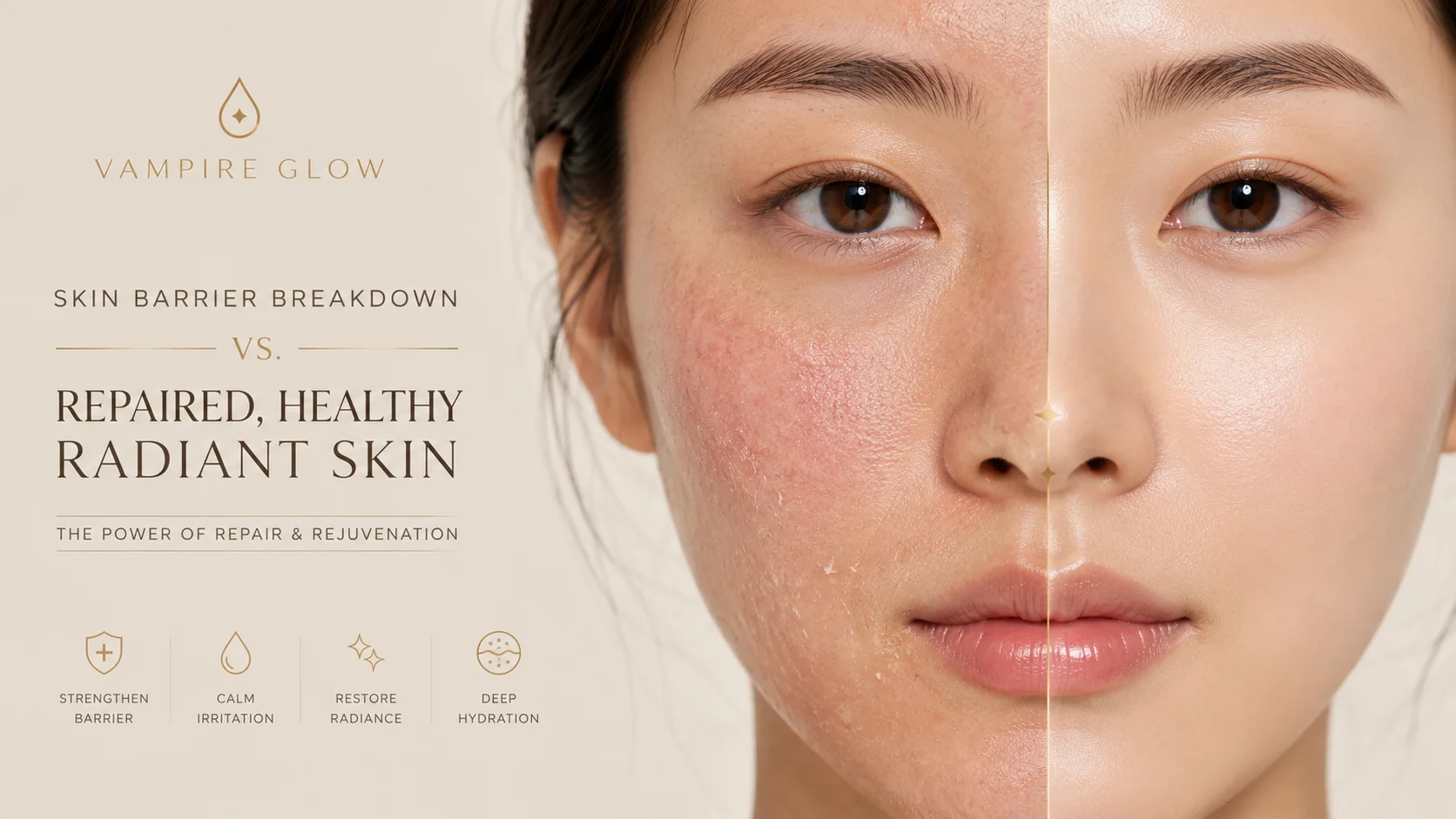
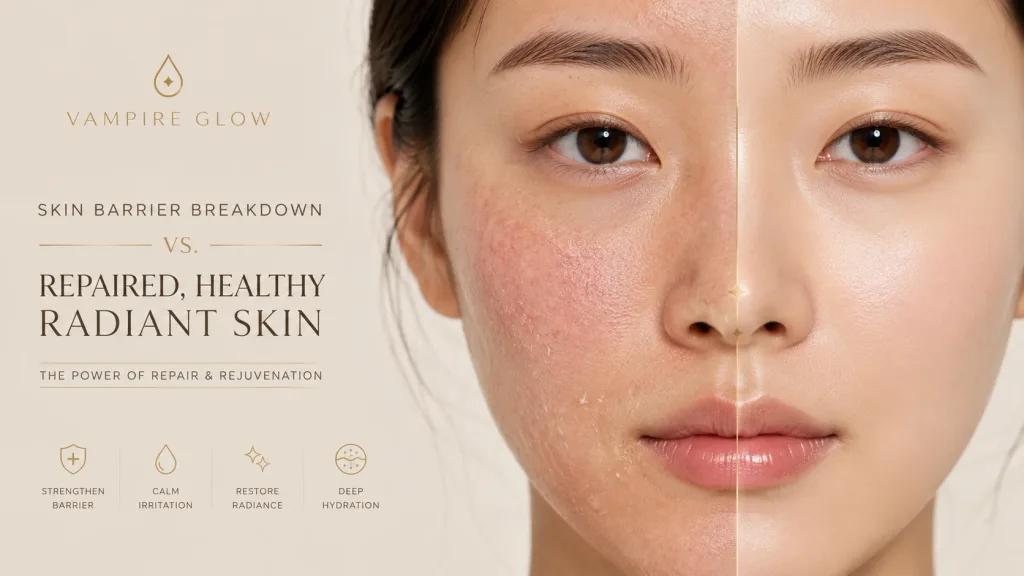
The skin barrier doesn’t announce itself dramatically when it breaks down. The signs are often quiet and easily attributed to the wrong cause. Here is what to actually look and feel for.
Visible redness that doesn’t settle. Persistent, diffuse redness across the cheeks, nose or chin that isn’t related to specific breakouts or a skin condition. The skin looks flushed or irritated at rest, without a clear trigger. This redness is the barrier failing to keep inflammatory signals contained.
Flakiness that doesn’t respond to moisturiser. Dry, flaky patches that appear despite applying moisturiser regularly are a hallmark sign. In a healthy barrier, moisturiser maintains comfort between applications. When the barrier is compromised, it can no longer hold the moisture in and the skin surface dries and flakes regardless of what’s applied on top.
A dull, greyed-out appearance. Healthy skin reflects light evenly. A compromised barrier disrupts this: the surface becomes rough and uneven at a microscopic level, causing light to scatter rather than reflect. Skin looks flat, tired and lacking its normal radiance even when no specific blemishes are present.
Tightness and a paper-thin sensation. Skin that feels thin, papery or uncomfortably tight, particularly in the hour after cleansing, is losing water faster than the barrier can retain it. In Saudi Arabia’s AC environments this feeling can be constant throughout an indoor workday.
Stinging or burning from products that used to feel fine. This is one of the clearest clinical signs. If your normal toner, a gentle cleanser or a product you’ve used for months without issue suddenly causes a stinging or burning sensation, the barrier that was previously filtering out that irritant potential has been compromised.
Skin that is simultaneously oily and dehydrated. Oily on the surface, particularly in the T-zone, but feeling tight or uncomfortable underneath. The barrier isn’t retaining moisture, so the sebaceous glands are overproducing oil to compensate. Both the oiliness and the tightness are symptoms of the same underlying problem.
Increased congestion and slower-healing blemishes. A compromised barrier allows more bacteria and pollutants to penetrate into pores than a healthy one. Breakouts form more easily, and post-blemish marks are darker and slower to clear because the repair mechanism beneath the barrier is also under stress.
Rough, uneven texture without visible blemishes. A rough, bumpy surface texture that doesn’t improve with standard skincare may indicate the barrier’s surface renewal is impaired.
While the barrier is recovering, keep body care simple. The AHA BHA PHA Miracle Calming Body Lotion uses centella alongside gentle acids rather than stripping the skin further.
Why Saudi Arabia’s Climate Accelerates Barrier Damage
The skin barrier is susceptible to damage in any environment, but Saudi Arabia’s climate creates a particularly relentless set of stressors.
The heat and AC cycle. Moving repeatedly between outdoor temperatures that exceed 40 degrees and heavily air-conditioned indoor spaces exposes the barrier to two opposing stresses in rapid succession. Heat causes the skin to perspire and lose water through the surface. Cold, dry AC air then strips residual moisture and causes the barrier lipids to contract. This expansion and contraction cycle weakens the lipid matrix over time in ways that a stable climate never does.
Year-round UV intensity. Saudi Arabia’s UV index remains high throughout the year, not just in summer. UV directly degrades the barrier’s protein and lipid structure, which is why SPF is not a summer product here but a year-round non-negotiable for barrier health.
Fine dust and air quality. Dust particles carry oxidative compounds and potential irritants that deposit on the skin surface throughout the day. When the barrier is intact they stay there until cleansing. When the barrier is compromised, they penetrate more easily and trigger inflammatory responses beneath the surface.
Cultural and seasonal skincare habits. The use of heavy, stripping products to fight oiliness in the heat is common. Harsh foaming cleansers, alcohol-heavy toners and aggressive exfoliation routines used to combat sweat and sebum are among the most frequent causes of barrier damage in Saudi Arabia’s skincare context.
The Skin Barrier Damage Spectrum: Mild, Moderate and Severe
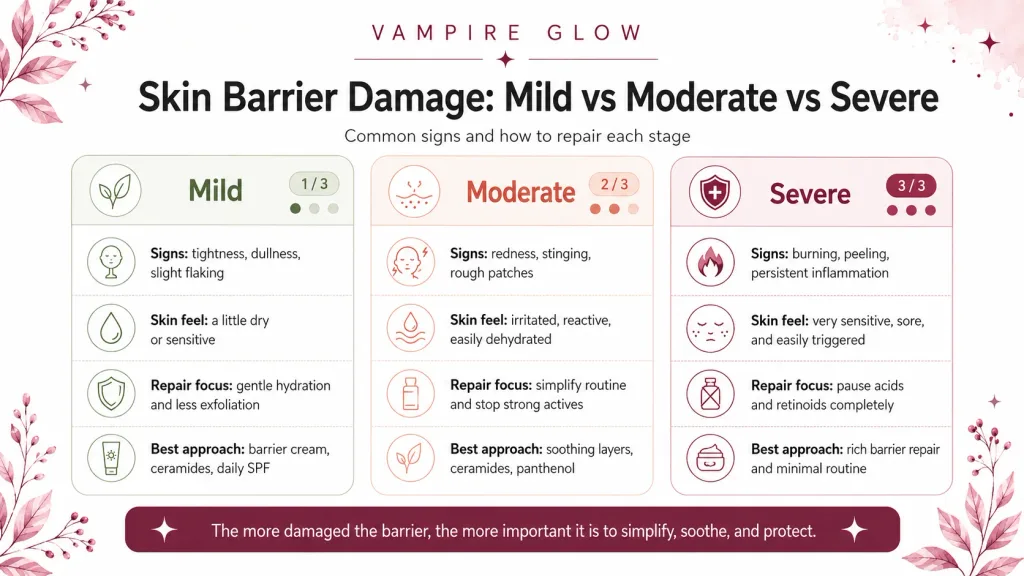
Not all barrier damage looks or feels the same, and the speed and approach to repair depends on where on the spectrum the damage sits.
Mild barrier damage typically involves one or two symptoms appearing recently, usually after a specific trigger such as starting a new exfoliant, switching to a stripping cleanser, or returning from a period of heavy outdoor sun exposure. Skin stings slightly on product application, may feel tighter than usual, and looks slightly more reactive than normal. The cause is usually identifiable. With the right routine adjustments, mild damage begins to resolve within one to two weeks.
Moderate barrier damage presents as several symptoms appearing simultaneously and persisting for several weeks to a few months. Multiple products cause stinging, redness is visible at rest, skin oscillates between oily and dehydrated, and the normal skincare routine has stopped working as expected. The cause may be cumulative rather than a single trigger. Recovery typically takes four to six weeks of a consistent, simplified repair-focused routine.
Severe barrier damage involves a significant number of symptoms that have been present for months, including visible scaling or flaking that doesn’t respond to moisturiser, persistent redness across a large area, a very low threshold for stinging (even plain water or a basic cleanser may sting), and a general breakdown of skin tolerance for nearly all products. Severe barrier damage warrants a dermatologist assessment before any skincare routine change, since the underlying cause may involve a clinical skin condition rather than purely environmental or product-related triggers.
How to Fix a Damaged Skin Barrier in Saudi Arabia’s Climate
The repair approach has two simultaneous tracks: remove what caused the damage and restore what has been lost.
Track one: eliminate the damage triggers.
Stop all chemical exfoliants immediately. AHA, BHA and PHA in any format, toner, serum, rinse-off pad, are paused for the duration of the repair phase.
Stop retinol and retinoid products. These accelerate cell turnover in ways that the compromised barrier cannot manage during recovery.
Switch the cleanser. If the current cleanser leaves skin feeling tight, stripped or uncomfortable, switch to a gentle gel or milk cleanser, or a non-rinse micellar formula in the short term.
Remove all high-fragrance or alcohol-forward products from the routine. Both are common irritants that the compromised barrier can no longer filter effectively.
Track two: restore with targeted ingredients.
Ceramides are the most important restoration ingredient. They are the structural lipids that form the physical matrix of the barrier, and topical ceramide application helps replenish what has been depleted. Look for ceramide-containing barrier creams applied twice daily as the key sealing step.
Centella asiatica and its active compounds (madecassoside, asiaticoside) calm the inflammatory response that accompanies barrier damage and support the skin’s own repair processes.
Panthenol attracts and holds moisture within the skin while supporting surface healing. One of the gentlest and most effective supporting ingredients in a barrier repair serum or cream.
Beta-glucan provides significant calming and hydrating support without introducing any active or potentially irritating compound. Suited to even the most sensitised barrier-damaged skin.
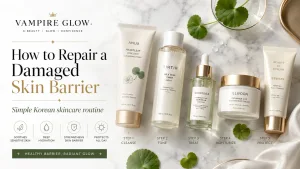
Apply these in the sequence of lightest to heaviest texture, as with any K-beauty routine. Toner, essence or serum, then a ceramide barrier cream to seal everything in. Finish with SPF50+ in the morning.
Easy Dew and Mixsoon are the two most relevant brands at Vampire Glow for this approach. Both carry formulas suited to barrier recovery with minimal active ingredients that could further irritate compromised skin. Browse the skin care range for current barrier repair options.
What Is the Fastest Way to Heal a Damaged Skin Barrier
The fastest route to barrier recovery is the combination of stopping the damaging inputs and applying the right restorative ingredients simultaneously and consistently, not doing one without the other.
The single fastest-acting change most people can make is to immediately apply a ceramide-based barrier repair cream morning and evening, every day, sealed under SPF in the morning. Ceramides are the lipid molecules the barrier is physically made of, and topical application begins restoring the matrix that has been depleted faster than any other topical approach.
The second fastest change is stopping the most damaging product in the routine. If an exfoliant is the primary cause, stopping it immediately allows the barrier to cease losing ground while the repair ingredients begin working. Continuing to exfoliate while applying a barrier cream is like trying to fill a bath with the drain open.
Speed is also affected by environmental factors. Using a humidifier in the bedroom reduces the overnight moisture loss that the AC causes and allows the skin’s repair cycle during sleep to proceed with better conditions. Drinking adequate water through the day supports the barrier’s ability to hold moisture from the inside.
What doesn’t speed up recovery is applying more products. More layers, more actives, or switching products every few days all destabilise the repair process. Fewer, better-chosen products applied consistently outperform a complicated routine during the repair phase every time.
Can Moisturiser Alone Heal a Damaged Skin Barrier
A standard moisturiser relieves the symptoms of a damaged barrier, particularly tightness and surface dryness, but it doesn’t repair the damage itself unless it contains the right ingredients in meaningful concentrations.
Standard moisturisers typically contain humectants (ingredients that draw water to the surface, such as glycerin or hyaluronic acid) and some occlusive agents (ingredients that slow water loss, such as petroleum-derived compounds). These make skin feel more comfortable and reduce transepidermal water loss temporarily, but they don’t rebuild the ceramide and fatty acid matrix that was structurally compromised.
A barrier repair cream that contains ceramides, fatty acids and cholesterol alongside calming actives goes further: it provides the skin with the lipid building blocks it needs to reconstruct the physical barrier structure, not just a surface seal over damaged tissue.
The distinction matters in Saudi Arabia’s climate particularly. A standard moisturiser applied in a heavily air-conditioned room will relieve tightness for a couple of hours and then the barrier will lose moisture again. A ceramide barrier cream maintains the seal more durably and supports the skin in rebuilding its own retaining capacity over time.
So yes, a well-chosen barrier repair moisturiser is central to fixing barrier damage. No, a generic hydrating cream is not the same thing as a targeted barrier repair formula. The ingredients list tells you which you’re working with.
Choosing the Best Cream to Repair Your Skin Barrier
The most effective barrier repair cream for Saudi Arabia’s skin conditions will meet these criteria.
Ceramides listed in the first half of the ingredient list. Ceramide NP, ceramide AP and ceramide EOP are the most commonly used cosmetic ceramides. If ceramides appear near the end of the ingredient list, they are present in trace amounts.
Supporting lipids: fatty acids and cholesterol. The barrier lipid matrix requires all three: ceramides, fatty acids and cholesterol. A formula with all three is more structurally comprehensive than one with ceramides alone.
Centella asiatica, panthenol or beta-glucan. These calming ingredients reduce the inflammation that both accompanies and worsens barrier damage, and support the skin’s own repair rate.
Fragrance-free or near-fragrance-free. A compromised barrier cannot filter out fragrance compounds as effectively as healthy skin. Fragrance in a barrier repair cream can prolong irritation rather than resolve it.
Non-comedogenic. Particularly important in Saudi Arabia’s heat where pores are already more active. A barrier repair cream that traps sebum worsens congestion alongside trying to repair the barrier.
Appropriate texture for the climate. A rich, waxy cream may suit severely dry or cold-weather barrier damage. In Saudi Arabia’s heat, a gel-cream or water-light ceramide formula that absorbs fast and sits flat under SPF is more practical and more likely to be worn consistently.
Week by Week: What to Expect During Barrier Repair in Saudi Arabia’s Climate
Week 1 and 2. The most immediate changes are usually a reduction in stinging on product application and some reduction in redness. Skin may still feel tight and uncomfortable in heavily AC environments. The barrier is still depleted but is no longer being actively worsened if the damaging triggers have been removed. Continue the simplified routine without introducing any actives.
Week 3 and 4. Surface texture begins to improve. The simultaneous oily-dry pattern starts to moderate as the barrier’s moisture retention function improves. Products absorb more normally. Redness continues to reduce. Do not reintroduce actives yet.
Week 5 and 6. Skin should be returning to its normal tolerance. Products that previously caused stinging should feel neutral again. This is the point at which one gentle active, such as niacinamide at five percent, can cautiously be reintroduced. Allow two weeks before adding a second active.
Beyond week 6. Continue building the routine back gradually. BHA exfoliants, if used, return at one session per week to start rather than two to three. Retinol comes last and starts at one evening per week with no stacking.
Individual timelines vary. Skin that has been damaged for several months takes longer to recover. Skin in more severe AC exposure, or with ongoing heavy UV exposure without SPF, recovers more slowly.
Aftercare and Barrier Damage Prevention in Saudi Arabia
Do apply SPF50+ PA++++ every morning from day one of the repair routine. Saudi Arabia’s UV continues creating new barrier stress regardless of what repair work is happening at the same time. SPF is not a final step after recovery, it is part of the repair protocol from the beginning.
Do use a small portable humidifier in the bedroom during the repair phase. The skin does most of its regeneration during sleep, and heavily air-conditioned sleeping environments reduce the ambient moisture that supports this process. Even moderate humidification makes a measurable difference overnight.
Do introduce any returning actives slowly and one at a time. The most common reason for barrier repair relapse is reintroducing everything that was stopped all at once, the moment the skin feels stable again.
Don’t gauge recovery by how skin feels on one good day. The skin barrier varies day to day with heat exposure, AC duration, hydration and sleep quality. Assess across a full week rather than a single morning before deciding to reintroduce actives.
Don’t use physical exfoliants when returning to a normal routine after barrier repair. Chemical exfoliants used at appropriate frequency are a more controlled and less abrasive option for maintaining smooth skin without re-damaging the barrier.
Mild vs Moderate vs Severe Skin Barrier Damage: Approach and Timeline
| Mild Barrier Damage | Moderate Barrier Damage | Severe Barrier Damage | |
| Typical signs | 1 to 2 symptoms, recent onset, identifiable trigger | Multiple symptoms persisting weeks to months | Many symptoms for 3+ months, very low product tolerance |
| Common cause | One new exfoliant or harsh product | Cumulative over-exfoliation, climate stress, multiple actives | Long-term cumulative damage or possible underlying condition |
| Routine simplification needed | Remove the triggering product | Pause all actives, simplify to 4 to 5 steps | Reduce to absolute minimum: gentle cleanser, ceramide cream, SPF |
| Key ingredients | Ceramides, panthenol, centella | Ceramides, panthenol, centella, beta-glucan | Ceramides only, then add others as tolerance returns |
| SPF during repair | Yes, daily SPF50+ | Yes, mineral or hybrid preferred | Yes, mineral preferred, chemical filters may sting |
| Expected recovery | 1 to 2 weeks | 4 to 6 weeks | 8 to 12 weeks or longer |
| See a dermatologist | If no improvement in 3 to 4 weeks | If no improvement in 6 to 8 weeks | Before starting any new routine, concurrent dermatological care recommended |
| Reintroduce actives | After 2 weeks of stable, stinging-free skin | After 4 weeks of stable, stinging-free skin | Only after full recovery confirmed by a dermatologist |
How Korean Skincare Approaches Barrier Repair Differently
Western skincare often treats barrier damage reactively, reaching for a heavy cream or stopping all actives temporarily. Korean skincare’s approach is more structured and more proactive, based on a decades-long understanding of the barrier as the foundation of all effective skincare rather than a secondary concern.
The K-beauty barrier repair approach rests on four principles.
Eliminate what’s causing the damage first. Before adding repairing ingredients, remove what is continuing to harm the barrier. This usually means stopping all exfoliants, strong actives and any stripping products until the barrier has stabilised.
Restore with the right ingredients in the right sequence. Ceramides, panthenol, centella asiatica and beta-glucan are the core barrier repair actives in K-beauty. Applied in a simplified, layered routine, they restore the lipid matrix and calming environment the barrier needs to recover.
Simplify the routine during repair. A damaged barrier cannot tolerate a ten-step active-heavy routine. Fewer products, simpler formulas, no active treatment ingredients until the barrier signals it has recovered.
Protect throughout the repair process. SPF every morning, no exceptions. A recovering barrier is more vulnerable to UV damage than a healthy one, and unprotected sun exposure during barrier repair actively undoes the repair work.
Easy Dew at Vampire Glow is a Korean medical skincare brand built specifically around barrier care. Mixsoon carries clean, minimalist formulas suited to sensitised, barrier-recovering skin. Browse the skin care range for current barrier repair product options.
The Best Korean Skincare Ingredients for Barrier Repair
Ceramides. The most direct barrier repair ingredient available. Ceramides are the lipid molecules that make up a significant portion of the barrier’s structural matrix. Topically applied ceramides help replenish what has been stripped away by over-exfoliation, harsh cleansers and environmental stress. Look for them in moisturisers and barrier repair creams specifically formulated to restore the skin’s lipid layer.
Centella asiatica (cica). One of the most important calming and barrier-supporting ingredients in K-beauty. The active compounds in centella, including madecassoside and asiaticoside, reduce inflammation, support wound healing and help the barrier recover from stress. Widely found in Korean toners, serums and creams designed for sensitised or damaged skin.
Panthenol (provitamin B5). Attracts and holds moisture in the skin while supporting the skin’s natural repair processes. Well tolerated by virtually all skin types, including the most sensitised and reactive. One of the gentlest effective barrier repair ingredients available.
Beta-glucan. A polysaccharide with powerful soothing and hydrating properties. Supports the skin’s immune response and calms inflammation associated with a damaged barrier. Common in Korean toners and essences designed for stressed skin.
Allantoin. Calms irritated, reactive skin and supports barrier recovery. Found in many K-beauty formulas alongside centella and ceramides for comprehensive barrier support.
Hyaluronic acid. Restores surface hydration and helps the skin maintain the water content the barrier needs to function. Apply on damp skin and follow with a barrier cream or ceramide moisturiser immediately on top.
Niacinamide at 5 percent. Strengthens the barrier by supporting ceramide production and reduces the transepidermal water loss associated with a compromised barrier. At moderate concentrations, it is appropriate for barrier repair. At higher concentrations or when skin is very reactive, introduce gradually after the barrier has begun to stabilise.
What to Stop Using During Barrier Repair
Stop all chemical exfoliants, including AHA, BHA and PHA, until the barrier has visibly stabilised and stinging on product application has resolved completely.
Stop retinol and retinoids until the barrier is recovered. Reintroduce very gradually, starting at one evening per week rather than nightly.
Stop all physical scrubs permanently, or limit to very occasional gentle use only after the barrier is healthy.
Stop using high-strength vitamin C (L-ascorbic acid at 15 to 20 percent), which can sting significantly on a compromised barrier.
Stop layering multiple actives. During repair, the routine should have one to two active steps at most, not six.
Possible Side Effects and Precautions
Some people find that even ceramide creams cause a mild initial sensation of heaviness or temporary congestion, particularly if they’re switching from a lighter gel moisturiser. This usually resolves in one to two weeks as the skin adjusts. If congestion (milia or clogged pores) develops and doesn’t clear, a lighter-textured ceramide formula is worth trying.
Anyone whose barrier damage symptoms include significant itch, weeping, visible scaling or symptoms consistent with eczema, psoriasis, rosacea or contact dermatitis should seek a dermatologist assessment before making routine changes. These conditions require clinical diagnosis and in some cases prescription treatment alongside any topical skincare routine.
Patch test all new products on the inner arm before applying to the face, especially during the repair phase when the skin is more reactive. Anyone pregnant, breastfeeding or on prescription skin treatment should consult a doctor before changing their routine.
What Does a Barrier Repair Routine Cost at Vampire Glow
The investment is typically modest during the barrier repair phase because the routine is simplified. Fewer products, no expensive actives. The core investment is in a good ceramide barrier cream and a lightweight Korean SPF.
Pricing at Vampire Glow varies by brand, formula, bottle or jar size and currency. AED pricing is shown for Gulf shoppers, USD for other regions. Delivery options and costs for Saudi Arabia and the wider GCC are confirmed at checkout.
Browse live prices on each product page in the skin care category.
Why Choose Vampire Glow
- Authentic Korean brands with batch codes and expiry dates verified on arrival
- A curated edit that includes medical-grade and clinical barrier-repair formulas suited to Saudi Arabia’s specific climate stressors
- Cruelty-free brands only
- Delivery across the UAE and the wider GCC, including Saudi Arabia, confirmed at checkout
- Full ingredient lists and usage guidance on every product page
For the general dermatological guidance that sits underneath any routine, the American Academy of Dermatology publishes its own advice on relieving dry, compromised skin.
Related reading
- Why centella (cica) dominates Korean skincare
- Snail mucin vs hyaluronic acid for dry skin
- The best Korean skincare for oily skin in hot weather
- How morning and night routines should differ
FAQs
How long does it take to repair a skin barrier? The timeline depends entirely on the severity of the damage. Mild barrier damage where stinging and sensitivity have appeared recently after one specific trigger typically begins to resolve within one to two weeks of stopping the cause and applying a ceramide-focused repair routine. Moderate damage that has been building over several months takes four to six weeks. Severe long-term barrier damage takes eight to twelve weeks or longer, and a dermatologist assessment is advisable if symptoms are not improving after six to eight weeks of a simplified routine. Saudi Arabia’s specific stressors, the daily heat and AC cycle, high UV and environmental dust, can extend these timelines compared to milder climates unless SPF is applied consistently and the AC environment is actively managed with humidification during the repair phase.
What is the fastest way to heal a skin barrier? The two fastest simultaneous actions are stopping everything that’s causing the damage and immediately applying a ceramide-based barrier repair cream twice daily. Stopping an exfoliant that has been over-stripping the skin removes the active cause. Applying a ceramide cream with centella and panthenol gives the barrier the lipid building blocks and calming environment it needs to begin rebuilding. Adding a humidifier to the sleeping environment noticeably accelerates overnight repair in Saudi Arabia’s dry AC conditions. Speed is not about adding more products. It’s about removing the wrong ones and consistently applying the right few.
What does an unhealthy skin barrier look like? Visually, a compromised skin barrier typically presents as persistent redness or a flushed appearance across the cheeks and nose, skin that looks dull and flat rather than naturally luminous, flaky patches that don’t resolve with moisturiser, and a rough or uneven surface texture. The skin can look visibly stressed or exhausted without any specific blemishes being the cause. To the touch it may feel thin, papery, tight or uncomfortable. Products that absorb normally on healthy skin may sit on the surface or cause a stinging sensation. Oiliness and tightness present simultaneously rather than alternating between them in different areas.
Can moisturiser heal a damaged skin barrier? A standard moisturiser temporarily relieves the discomfort of barrier damage by reducing transepidermal water loss at the surface and drawing water to the skin. It doesn’t repair the underlying barrier structure unless it contains the right ingredients. A ceramide-containing barrier repair cream goes further than a standard moisturiser because it provides the lipid building blocks the barrier needs to physically reconstruct its matrix, not just a surface seal over damaged tissue. In Saudi Arabia’s AC environments, the difference between a standard moisturiser and a ceramide repair cream is the difference between temporary relief and genuine recovery. Moisturiser alone, without stopping the cause of the damage, also provides only partial and temporary benefit regardless of its formulation.
What is the best cream to repair skin barriers? The best barrier repair cream leads with ceramides in the ingredient list, includes supporting lipids such as fatty acids and cholesterol, contains calming actives like centella asiatica or panthenol, is fragrance-free or very low-fragrance, and is non-comedogenic. In Saudi Arabia’s heat, a gel-cream texture that absorbs fast and sits flat under SPF is more consistently wearable than a rich, waxy cream. Easy Dew is a Korean medical skincare brand built specifically around barrier care and is the most targeted option at Vampire Glow for this purpose. Browse the skin care range for current barrier repair cream options.
Should I stop all skincare when my skin barrier is damaged? Not all skincare, but all actives. The routine shouldn’t be abandoned entirely, since a gentle cleanser, calming toner, barrier repair serum and ceramide cream plus SPF are all essential during the repair phase. What gets stopped is anything with exfoliating, brightening or resurfacing properties: AHA, BHA, PHA, retinol, high-percentage vitamin C and any formula that has been causing stinging. A simplified four to five step routine of only supportive, non-active products is the appropriate response. Stopping all skincare including the barrier repair cream and SPF would remove the two most important tools for recovery.
Start Repairing Your Skin Barrier Today
A damaged skin barrier in Saudi Arabia’s climate isn’t a niche problem. The combination of heat, AC, UV and the reactive skincare choices many people make to combat oiliness makes it one of the most common skin concerns in the region. The good news is that the K-beauty approach to barrier repair, with ceramides, centella and a simplified routine, is exactly what the skin needs to rebuild and to stay rebuilt. Shop the skin care range at Vampire Glow, start with the Easy Dew and Mixsoon brand pages for barrier-focused formulas, and build the repair routine from the ground up. For a personalised product recommendation, email the team at support@vampireglow.com.

About author