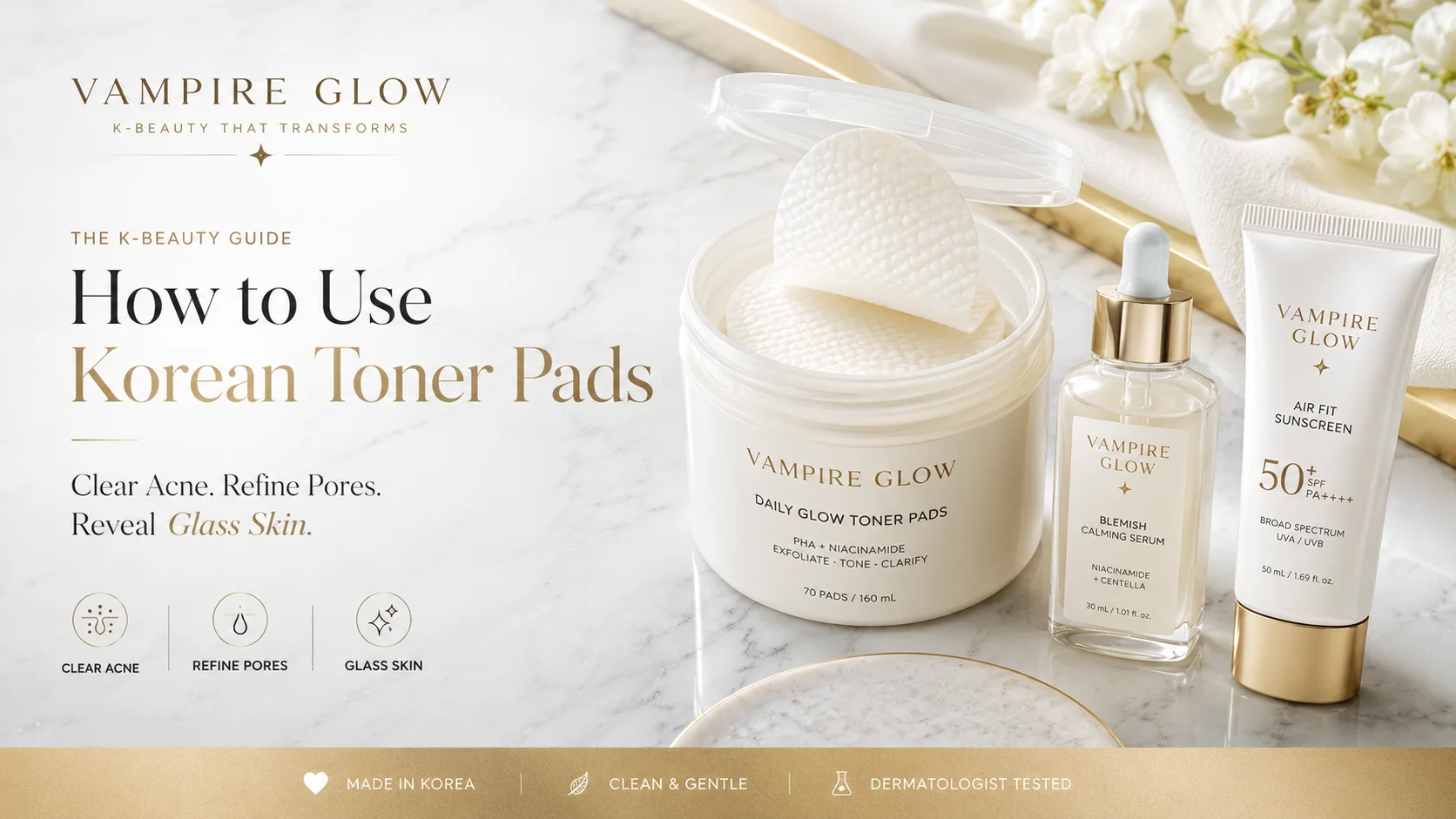
How to Use Korean Toner Pads for Acne, Pores & Glass Skin
Korean toner pads have become one of the most practical and widely used treatment products in K-beauty, and for good reason. They do the work of a leave-on chemical exfoliant in the time it takes to sweep a pre-soaked pad across the face. No measuring out a product, no waiting for a separate application step, no guessing whether you’ve applied enough. The solution, the active ingredients and the application surface are all together in a jar, ready to use.
Table of Contents
- What Makes Korean Toner Pads Different
- Understanding the Three Concerns: Acne, Pores and Glass Skin in Saudi Arabia
- Korean Toner Pad Ingredients: Which Do What
- How to Use Korean Toner Pads for Acne
- How to Use Korean Toner Pads for Pores
- How to Use Korean Toner Pads for Glass Skin
- What to Do After Using Toner Pads
- How Long Should I Leave Toner Pads on My Face
- Korean Toner Pads by Concern: Which Type to Choose
- Do Korean Toner Pads Work
- Frequency Guide: How Often to Use Korean Toner Pads
- Aftercare Tips for Korean Toner Pads in Saudi Arabia's Climate
- Possible Side Effects and Precautions
- What Does a Korean Toner Pad Cost at Vampire Glow
- Why Choose Vampire Glow
- FAQs
- Shop Korean Toner Pads at Vampire Glow
But the results you get from toner pads depend almost entirely on choosing the right type for your skin concern and using it correctly for that concern. A BHA pad used for pore congestion works differently from an AHA pad used for glass skin texture. A once-a-week approach suits one skin type while a twice-weekly routine suits another. Applied in the wrong order or without the right follow-up steps, even a well-formulated toner pad underperforms.
This guide covers the three concerns where Korean toner pads make the most difference in Saudi Arabia’s climate: acne and breakouts, enlarged pores and congestion, and the glass skin finish. For each one, you’ll find which ingredients to look for, how to apply the pads correctly and what to do immediately after.
What Makes Korean Toner Pads Different
A Korean toner pad isn’t the same product as a flat cotton pad you soak yourself with toner. Korean toner pads are purpose-designed: the pad surface is typically textured on one or both sides, specifically engineered to provide controlled mild physical exfoliation as part of the application, while the soaked solution delivers active ingredients at leave-on concentrations calibrated for daily and multi-weekly use.
The pre-soaked format is also more consistent than a manually soaked pad, since each pad carries the same amount of solution at the same concentration. This consistency matters when the active ingredient is a chemical exfoliant like BHA or AHA, where more solution does not mean better results and can mean over-treatment.
Korean toner pads at Vampire Glow include formulas from Some By MI, a K-beauty brand known specifically for its active-ingredient toning pad lines. Browse the skin care range for current options.
Understanding the Three Concerns: Acne, Pores and Glass Skin in Saudi Arabia
All three concerns are heightened in Saudi Arabia’s climate.
Acne in Saudi Arabia is driven by heat-accelerated sebum production, environmental dust and sweat that settle on skin through the day, and the inflammatory response that results when pores become congested in these conditions. Post-acne marks are also a more persistent concern here because UV exposure darkens every mark left behind.
Enlarged pores appear more prominent in heat because sebum production increases, pores widen to release excess oil and the surface of the skin is more congested throughout the day. Fine dust and pollution settle into open pores and contribute to blackheads and visible congestion.
Glass skin requires smooth, even texture and well-managed hydration. Both are challenging in Saudi Arabia. Constant air conditioning strips moisture continuously, and rough or congested skin texture prevents the light-reflecting, translucent finish that defines the glass skin look.
Korean toner pads address all three concerns, but with different ingredients, different frequencies and different follow-up steps for each.
Korean Toner Pad Ingredients: Which Do What
Before selecting a toner pad for a specific concern, knowing which actives are in the solution is the deciding factor.
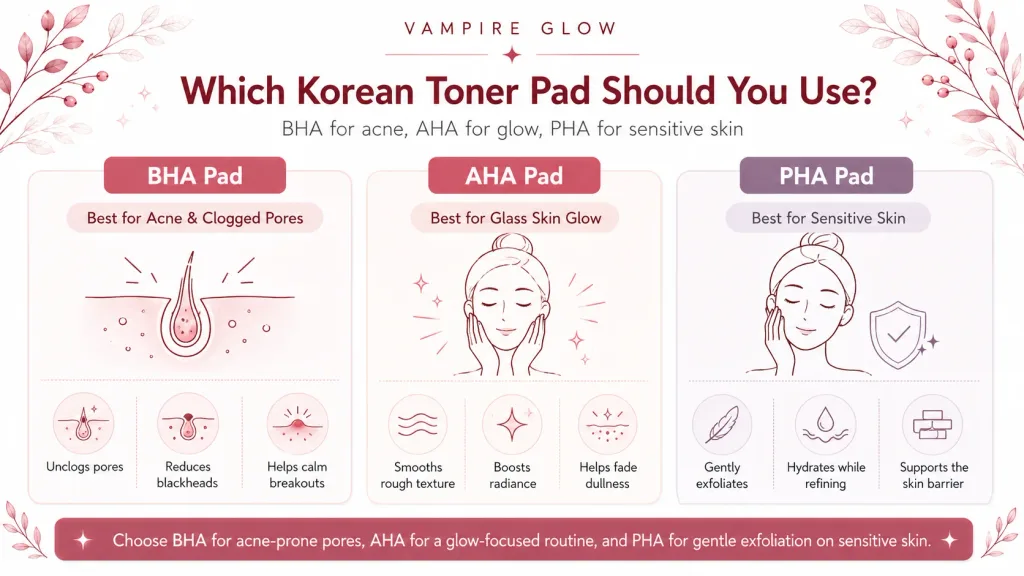
BHA (betahydroxy acid, typically salicylic acid): Oil-soluble. Gets into pores rather than working only on the surface. The most effective ingredient in a toner pad for acne-prone skin and visible pore congestion. Dissolves the sebum and dead cell plug inside the pore that leads to blackheads, whiteheads and cystic congestion underneath. Best used in the evening, two to three times a week.
AHA (alpha hydroxy acids, typically glycolic or lactic acid): Water-soluble, works at the skin surface. Loosens the bonds between dead skin cells and encourages them to shed, revealing smoother skin underneath. The glass skin ingredient in toner pad form. Supports a more even, reflective surface texture over consistent use. Glycolic acid is the strongest and fastest-acting AHA; lactic acid is gentler and better for drier or more sensitive skin. Evening use only, strict SPF the following morning.
PHA (polyhydroxy acid): The gentlest exfoliant in the group. Larger molecular size means slower penetration and a lower irritation profile than AHA or BHA. Effective for mild texture improvement, hydration support and a gentle first step into chemical exfoliation for sensitive or dry skin. More suitable for daily or near-daily use than AHA or BHA.
Niacinamide: In a toner pad solution, niacinamide reduces sebum production, minimises pore appearance and reduces the inflammation that makes acne look angrier and post-acne marks more visible. Often combined with BHA or AHA in targeted K-beauty toner pad formulas.
Centella asiatica and calming actives: Found in hydrating and recovery toner pads. Calms inflammation, supports barrier recovery and is appropriate for use after a BHA or AHA pad evening as a recovery step.
How to Use Korean Toner Pads for Acne
What to look for: A BHA-containing pad, ideally paired with niacinamide or centella in the solution. BHA is oil-soluble and gets into the pore itself, which is where the congestion causing acne forms.
When to use: Evening, after cleansing. Acne-targeting BHA pads are an evening treatment step. Morning use adds photosensitivity risk on top of already sensitised, breakout-prone skin.
Step by step:
Step 1: Double cleanse in the evening. An oil cleanser to remove SPF and makeup, followed by a gentle water-based cleanser. The pore must be clean before the BHA in the toner pad can do its work. BHA applied on top of makeup residue, SPF or heavy sebum won’t penetrate effectively.
Step 2: Remove one toner pad and reseal the jar immediately. Close the lid after every use to prevent the remaining pads from drying out, which is a real concern in Saudi Arabia’s warm, sometimes low-humidity indoor air.
Step 3: Sweep the textured side of the pad across the face. Use gentle, consistent outward strokes from the nose across the cheeks, from the forehead down to the chin. Do not press hard. The pad surface provides its physical component with light contact, heavy pressure doesn’t improve the result and irritates active breakouts.
Step 4: Give active breakouts extra care. On areas with active inflammation, sweep once only and don’t revisit with the same pad. Over-applying on inflamed skin can worsen irritation rather than treating the acne.
Step 5: Leave the solution on. Korean toner pads are leave-on products. Do not rinse. Allow the skin to absorb the solution for 15 to 20 minutes before applying the next step.
Step 6: Apply a calming hydrating toner or centella essence after the pad. Exfoliation removes some of the surface moisture buffer. A calming hydrating step restores it and supports the skin’s barrier while the BHA works overnight.
Step 7: Follow with a light, non-comedogenic gel-cream to seal the routine.
Step 8: The following morning, apply SPF50+ PA++++ as the last step before leaving the house. This is non-negotiable when using any active toner pad in the routine.
Frequency for acne-prone skin: Start at two evenings per week, separated by at least two days. Increase to three evenings per week only after the skin has shown no reaction over four to six weeks of regular use.
How to Use Korean Toner Pads for Pores
What to look for: BHA for deeper pore clearing, or a niacinamide-forward toner pad for pore appearance minimisation. BHA gets inside the pore. Niacinamide reduces the appearance of pore size over time by regulating sebum and supporting skin elasticity.
When to use: Evening for BHA pads. Morning or evening for niacinamide pads, since niacinamide is not photosensitising.
Step by step:
Step 1: Cleanse thoroughly. In Saudi Arabia’s dusty environment, pores collect particles throughout the day. A proper double cleanse in the evening removes the day’s accumulation before the pad works on what’s embedded inside.
Step 2: Sweep the pad across the nose, chin and forehead (the T-zone where pores are typically most visible) with outward strokes. If the cheeks don’t have visible pore concerns, you can limit the pad sweep to the areas of active concern rather than treating the full face.
Step 3: Allow 15 to 20 minutes for the solution to absorb before continuing the routine. For pore concerns specifically, this contact time matters. Moving immediately to the next product can dilute the BHA’s contact with the pore surface.
Step 4: Follow with a niacinamide serum if not already in the toner pad solution. Niacinamide applied after a BHA pad is an effective combination for visible pore improvement, since BHA clears what’s inside the pore while niacinamide addresses the pore size appearance at the surface level.
Step 5: Lightweight gel moisturiser, then SPF50+ the following morning.
Frequency for pore concerns: Two to three times per week in the evening. Daily use will over-exfoliate without producing faster pore results, since the skin needs recovery time between exfoliation sessions.
How to Use Korean Toner Pads for Glass Skin
What to look for: AHA pads, particularly lactic acid for a gentle glow, or a combined AHA and hydrating formula that exfoliates and hydrates simultaneously. Glass skin is about smooth, even, light-reflecting texture. AHA pads resurface the top layer of skin to reveal the smoother skin beneath.
When to use: Evening only. AHA is the most photosensitising of the toner pad actives. The following morning SPF50+ is required.
Step by step:
Step 1: Cleanse as usual. On glass skin evenings, the skin should be completely clean and free of residue before the AHA pad goes on.
Step 2: Sweep the AHA pad across the full face using gentle outward strokes. AHA works at the skin surface rather than inside pores, so full-face application is appropriate for glass skin concerns. Include the jaw and the neck if the texture concern extends there.
Step 3: Leave the solution on the skin. Do not rinse. Allow 15 to 20 minutes to absorb fully before proceeding.
Step 4: After the 15 to 20 minute absorption window, apply a hydrating toner or hyaluronic acid essence. The glass skin routine needs this step specifically after an AHA pad, since AHA-assisted cell turnover benefits significantly from a subsequent hydration layer that penetrates freshly cleared skin more efficiently.
Step 5: Snail mucin essence or a PDRN serum goes here if they’re in the routine. Freshly exfoliated skin absorbs these treatment actives more effectively.
Step 6: Gel moisturiser or a glass-skin-focused gel-cream to seal the hydration in.
Step 7: A sleeping mask two to three times a week after the moisturiser intensifies the overnight glass skin effect when used on evenings that include an AHA pad.
Step 8: SPF50+ PA++++ every single morning. Glass skin achieved through AHA exfoliation is immediately vulnerable to UV darkening and sun stress without daily SPF. In Saudi Arabia’s UV conditions, skipping SPF while using AHA pads reverses every surface improvement the pads create.
Frequency for glass skin: Two evenings per week for AHA pads. Glass skin is about consistent gentle resurfacing, not aggressive weekly exfoliation. More is not faster, and over-exfoliation destroys the glass skin finish rather than creating it.
What to Do After Using Toner Pads
What comes immediately after a toner pad is one of the most important variables in whether the pad produces the results it should.
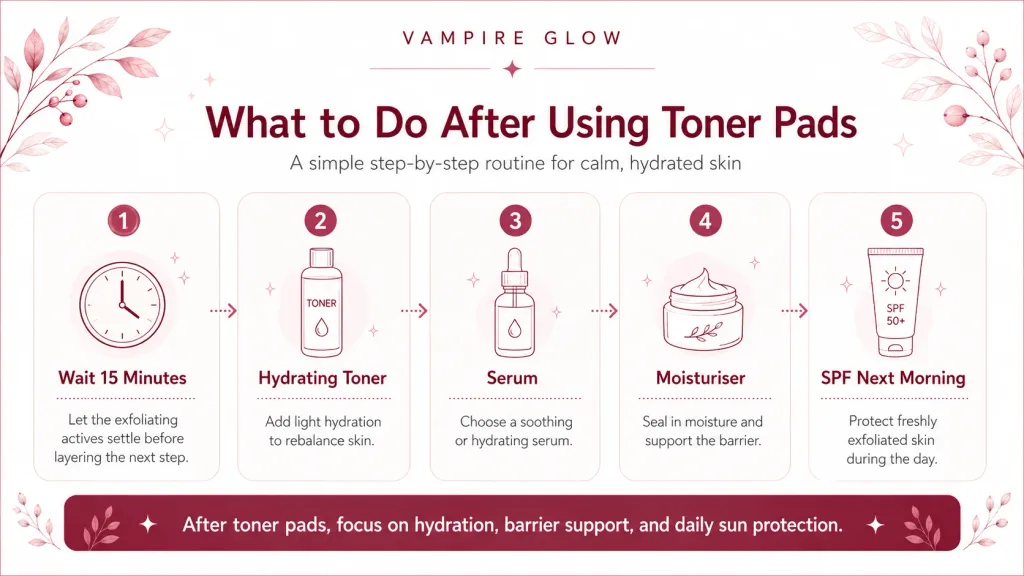
After a BHA or AHA toner pad: Allow 15 to 20 minutes before applying the next product. Then apply a calming hydrating toner or centella essence as the next step. This is the recovery layer that replaces moisture removed by the exfoliation and protects the skin barrier from feeling stripped. Follow with serum, gel moisturiser. The barrier is slightly more permeable after exfoliation, which means serums applied after absorb more efficiently. In the morning after, SPF50+ as the final step before leaving the house.
After a PHA or hydrating toner pad: The gentle exfoliation means the follow-up sequence is more flexible. Apply a hydrating toner or essence immediately after without the 15-minute wait. Continue the routine normally.
The one thing not to do after any toner pad: Do not apply another exfoliating product on the same occasion. No physical scrub, no dedicated AHA serum, no BHA cleanser in the same session. One exfoliating step per session is the limit. Stacking exfoliants is the fastest way to damage the skin barrier and negate the benefits of the pad.
How Long Should I Leave Toner Pads on My Face
Korean toner pads are leave-on products. The solution is formulated to stay on the skin rather than be rinsed off, unlike rinse-off exfoliating masks or cleansers with acid content.
For BHA and AHA exfoliating toner pads, the approach is:
- Sweep across the face with the pad
- Leave the solution on the skin
- Wait approximately 15 to 20 minutes before applying the next product
- Do not rinse
Some people leave the physical cotton pad itself pressed onto specific areas, such as a clogged nose patch or a congested cheek, for three to five minutes as an improvised targeted treatment before sweeping to the rest of the face. This intensifies localised contact time for stubborn congestion. Three to five minutes is sufficient for this approach. Leaving a BHA or AHA pad pressed to the skin for 20 minutes or more is not more effective and can cause localised over-exfoliation in the target area.
For hydrating or PHA pads with no strong actives, a three to five minute pressed leave-on to targeted areas is completely safe and can be done as a mild masking step.
Korean Toner Pads by Concern: Which Type to Choose
| BHA Toner Pads | AHA Toner Pads | PHA Toner Pads | Hydrating Toner Pads | |
| Primary concern | Acne, pore congestion, blackheads | Glass skin, surface texture, dull tone | Sensitive skin, gentle exfoliation | Hydration, barrier prep |
| Key active | Salicylic acid | Glycolic or lactic acid | Gluconolactone or lactobionic acid | Centella, hyaluronic acid, panthenol |
| Penetrates pores | Yes | No, works at surface | No, works at surface | No |
| Speed of visible results | 4 to 6 weeks for congestion improvement | 2 to 4 weeks for surface glow | 4 to 6 weeks | Immediate hydration |
| Suitable for sensitive skin | With caution | Not typically | Yes | Yes |
| Frequency | 2 to 3 evenings per week | 2 evenings per week | 1 to 3 times per week | Daily |
| Time of day | Evening only | Evening only | Morning or evening | Morning and evening |
| SPF required next morning | Yes, non-negotiable | Yes, non-negotiable | Recommended | Not required, but always beneficial |
| Saudi Arabia climate suitability | Excellent for oiliness and congestion in heat | Excellent for glass skin and texture | Excellent for sensitive skin in AC environments | Excellent for daily moisture in AC environments |
Do Korean Toner Pads Work
Yes, when matched to the right concern and used at the right frequency. The published research on the primary actives in Korean toner pads, salicylic acid for acne and pore congestion, glycolic and lactic acid for surface exfoliation and texture, niacinamide for pore appearance and oil regulation, supports their efficacy in these specific applications.
What changes the result is the consistency of use. A BHA toner pad used twice a week for eight weeks produces a meaningfully different outcome than the same pad used inconsistently over the same period. Glass skin from AHA pads requires committed, consistent use alongside a hydrating routine and daily SPF. Neither works on the timeline of one session.
It is also worth being clear about the scope of what toner pads can achieve as cosmetic products. They improve surface skin quality, manage sebum and congestion, support a smoother and clearer complexion over time. They are not medical treatments for acne conditions requiring prescription care, and individual results vary by skin type, severity of the concern and routine consistency.
Frequency Guide: How Often to Use Korean Toner Pads
| Skin Type | BHA Pads | AHA Pads | PHA Pads |
| Oily, acne-prone | 2 to 3 times per week | 1 to 2 times per week | Daily if no AHA or BHA in routine |
| Combination | 2 times per week | 1 to 2 times per week | 2 to 3 times per week |
| Normal | 1 to 2 times per week | 1 to 2 times per week | Daily to every other day |
| Dry | Once per week maximum | Once per week | Every other day |
| Sensitive | Once per week or avoid | Avoid or lactic acid only, once per week | Once every few days, build up slowly |
| Barrier-damaged | Avoid entirely until repaired | Avoid entirely until repaired | Avoid entirely until repaired |
Aftercare Tips for Korean Toner Pads in Saudi Arabia’s Climate
Do seal the pad jar every single time after use. Saudi Arabia’s ambient warmth and variable humidity can dry out pre-soaked pads left in an improperly closed jar, reducing both their saturation and active ingredient concentration. A dried-out pad is both less effective and potentially more abrasive on the skin.
Do store the pad jar away from direct sunlight. UV exposure can degrade the active ingredients in the solution before you even reach the last pad in the jar. A cool drawer, cabinet or skincare fridge is ideal.
Do apply a hydrating toner or centella essence immediately after the 15-minute post-pad window. This is the recovery step that makes the difference between skin that feels smooth after a toner pad session and skin that feels stripped and tight.
Don’t use toner pads on skin that is currently experiencing a compromised barrier, active eczema, a reaction or significant widespread redness. These conditions require a simplified, active-free repair routine first.
Possible Side Effects and Precautions
Over-exfoliation is the most common adverse effect and is almost always caused by using exfoliating toner pads too frequently rather than the product being unsuitable. If skin becomes redder, more sensitive or tighter after starting toner pads, reduce frequency immediately rather than continuing and hoping the skin adjusts.
AHA pads meaningfully increase photosensitivity. In Saudi Arabia’s UV conditions this is a significant consideration. Daily SPF50+ PA++++ the morning after an AHA pad session is required, not optional.
Anyone with a diagnosed skin condition such as rosacea, eczema, active dermatitis or psoriasis should not introduce exfoliating toner pads without dermatologist clearance. The textured pad surface and chemical actives combined are too irritating for actively inflamed or clinically compromised skin.
Anyone pregnant or breastfeeding should avoid salicylic acid (BHA) pads and check with their doctor before using AHA or other active formulas. Patch test any new toner pad on the inner arm before using on the face.
What Does a Korean Toner Pad Cost at Vampire Glow
Toner pad pricing varies by brand, active ingredient type, pad count per jar and formula complexity. The per-use cost of toner pads used two to three times a week is generally competitive with comparable leave-on exfoliant serums, though the format and convenience differ. Vampire Glow displays pricing in AED for Gulf shoppers and in USD for other regions. Delivery options for Saudi Arabia and the GCC are confirmed at checkout. Browse live pricing in the skin care category.
Why Choose Vampire Glow
- Authentic Korean brands verified on arrival with batch codes and expiry dates checked
- Treatment-focused toner pads stocked alongside the supporting routine products that make them work correctly
- Cruelty-free brands only
- Delivery across the UAE and the wider GCC, including Saudi Arabia, confirmed at checkout
- Full ingredient lists and usage guidance on every product page
For the general dermatological guidance that sits underneath any routine, the American Academy of Dermatology publishes its own guidance on treating acne.
Related reading
- The best Korean toner pads for each skin type
- The difference between toner pads and toner
- The best Korean skincare for acne-prone skin
- How to get glass skin without looking oily
FAQs
Do I use toner pads before or after toner? Exfoliating toner pads containing BHA, AHA or PHA go before the hydrating toner. Sweep the pad on cleansed skin, allow 15 to 20 minutes for absorption, then apply the hydrating toner as the recovery and moisture step above it. The pad clears and treats first, the hydrating toner restores moisture second. Applying the hydrating toner first and then the pad on top means the active solution in the pad has to work through the moisture layer, reducing its contact with the skin. Hydrating toner pads with no significant actives can be used in place of a liquid toner at the same routine step.
Do Korean toner pads work? Yes, when matched to the right concern and used consistently at the right frequency. The key actives in Korean toner pads, BHA for acne and congestion, AHA for glass skin texture, PHA for gentle exfoliation, niacinamide for pore appearance and oil control, all have published research supporting their efficacy in topical application. Results build over consistent use and are not immediate after a single session. Matching the pad type to the specific concern, BHA for acne and pores, AHA for glass skin, using the correct frequency for your skin type and supporting the pads with SPF are the factors that determine whether they work as expected or underperform.
Do I use toner pads daily? Hydrating toner pads with no exfoliating actives can be used daily. Exfoliating toner pads containing BHA, AHA or PHA should not be used daily for most skin types. Daily exfoliating pad use leads to over-exfoliation, which damages the skin barrier, increases sensitivity and worsens the concerns the pads were meant to address. BHA and AHA pads are typically used two to three times per week. PHA pads are gentler and can be used more frequently, though every other day is a safer starting point than daily. Always build up gradually from a lower frequency before increasing.
What to do after using toner pads? Wait 15 to 20 minutes after using an exfoliating BHA or AHA toner pad before applying the next product. Then apply a calming hydrating toner or centella essence as the recovery step. This restores the moisture that exfoliation temporarily reduces and calms the skin before the subsequent layers go on. Follow with any targeted serums (snail mucin, niacinamide, PDRN), then gel moisturiser. The following morning, apply SPF50+ PA++++ as the last step. Do not apply another exfoliating product after a toner pad in the same session. One exfoliation source per session is the maximum.
How long should I leave toner pads on my face? Korean toner pads are leave-on products. Sweep the pad across the face, leave the solution on and allow 15 to 20 minutes to absorb before applying the next step. Do not rinse. If using the physical pad itself pressed to a specific area, such as the nose or a heavily congested cheek, three to five minutes is sufficient for a targeted intensified contact approach. Leaving an AHA or BHA-saturated pad pressed to the skin for longer than five minutes in one spot is not more effective and can cause localised irritation. The solution continues working after the pad is removed, so removing the pad doesn’t end the treatment.
Can toner pads help with acne scars and post-acne marks? Toner pads can support the fading of post-inflammatory hyperpigmentation, the dark or red marks left after a breakout heals, over consistent use. AHA pads support surface cell turnover, which gradually brings newer, less-pigmented skin cells to the surface. Niacinamide in a toner pad solution reduces melanin transfer and can visibly fade post-acne marks over six to eight weeks of consistent use. Both require strict daily SPF in Saudi Arabia’s UV conditions for any meaningful fading to occur, since UV exposure directly darkens post-acne marks and counteracts the fading process. Toner pads do not address deeper acne scarring (indented or textured scars from severe acne), which requires clinical treatment.
Shop Korean Toner Pads at Vampire Glow
Whether the concern is acne, visible pores or the glass skin finish, the right Korean toner pad in the right routine makes a meaningful difference over consistent use. Browse the current skin care range at Vampire Glow for toner pad and supporting routine product options, including formulas from Some By MI. For a recommendation based on your specific skin concern, email support@vampireglow.com.
About author