
Niacinamide vs Tranexamic Acid for Dark Spots: Which Is Better?
Dark spots in Saudi Arabia are a different challenge from dark spots in more temperate climates. The sun here is relentless year-round, not just in summer, and UV exposure is the primary driver of both hyperpigmentation and the darkening of existing marks. Every post-acne mark, every patch of uneven tone, every spot that forms from shaving, waxing or sun damage, sits under a UV index that makes it darker, slower to fade and more likely to return after it’s gone, unless the skincare routine actively addresses both the existing pigmentation and the ongoing UV exposure creating more of it.
Table of Contents
- Why Dark Spots Are More Stubborn in Saudi Arabia
- How Niacinamide Works on Dark Spots
- How Tranexamic Acid Works on Dark Spots
- Niacinamide vs Tranexamic Acid for Dark Spots
- Which One Is Better for Dark Spots in Saudi Arabia
- Can Niacinamide and Tranexamic Acid Be Used Together
- How to Use Each in Your Routine
- How Soon Does Each Show Results
- How Often to Use Each
- Aftercare Tips for Treating Dark Spots in Saudi Arabia
- Possible Side Effects and Precautions
- What Do Niacinamide and Tranexamic Acid Serums Cost
- Why Choose Vampire Glow
- FAQs
- Build Your Dark Spot Routine at Vampire Glow
Two ingredients dominate the Korean skincare approach to dark spots: niacinamide and tranexamic acid. Both are well-researched, both appear widely in K-beauty serums and toners, and both are relevant for the kind of pigmentation that Saudi Arabia’s sun creates. But they’re not interchangeable. They work through different mechanisms, address pigmentation at different stages, and suit different skin types and concern levels.
This guide puts them side by side so you can make a genuinely informed decision about which belongs in your routine, whether you need both, and what to expect from each.
Why Dark Spots Are More Stubborn in Saudi Arabia
Before comparing the two ingredients, it helps to understand what makes hyperpigmentation particularly persistent in Saudi Arabia’s climate.
UV is the primary trigger and amplifier. Melanin production is the skin’s natural UV defence, and Saudi Arabia’s year-round high UV index means the skin’s melanin-producing cells, melanocytes, are in a near-constant state of activation. New dark spots form more readily, existing ones deepen faster, and marks that would fade within a few weeks in lower-UV climates persist for months or longer.
Post-inflammatory hyperpigmentation (PIH) is more intense here. Any inflammation on the skin, from acne, ingrown hairs, waxing, friction or minor injury, triggers localised melanin production as part of the healing process. In high-UV environments, that inflammatory response is amplified, and the resulting pigmentation is both darker and more resistant to fading. This is why dark spots after a breakout can take many months to clear in Saudi Arabia without targeted treatment and strict daily SPF.
Melasma is common and challenging. Melasma, a condition causing larger patches of hyperpigmentation on the cheeks, forehead and upper lip, is triggered by UV, heat and hormonal factors. All three are present in intensity across Saudi Arabia. Melasma is notoriously difficult to treat and should be managed with a dermatologist for clinical-level care alongside any topical skincare routine.
If you are treating marks on the body as well, the Gluta Whitening Oil covers larger areas than a facial serum sensibly can.
How Niacinamide Works on Dark Spots
Niacinamide is a form of vitamin B3. For dark spots specifically, it works by inhibiting the transfer of melanosomes (melanin-containing particles) from melanocytes, the pigment-producing cells, to keratinocytes, the surface skin cells where pigment becomes visible. By reducing this transfer, niacinamide gradually decreases the visible pigmentation at the skin surface without interfering with melanin production itself.
This mechanism makes niacinamide effective for existing dark spots that are already in the surface layers of the skin. It also makes it well-suited to post-inflammatory hyperpigmentation, the type most common after breakouts, waxing and shaving in Saudi Arabia.
Beyond dark spots, niacinamide is a multi-functional active. It regulates sebum production, refines pore appearance, reduces redness and has anti-inflammatory properties that help calm the skin conditions that cause PIH in the first place. For acne-prone skin with dark spots, this dual function makes niacinamide particularly valuable. It addresses the marks left behind while also helping prevent new ones forming through ongoing breakouts.
How Tranexamic Acid Works on Dark Spots
Tranexamic acid has a different mechanism entirely. Originally used as an oral medication to reduce excessive bleeding, dermatologists noticed that patients taking it orally developed noticeably more even skin tone as a secondary effect. This led to its development as a topical skincare active, and it is now one of the most studied brightening ingredients in Korean skincare.
Topical tranexamic acid works by disrupting the communication pathway between keratinocytes (surface skin cells) and melanocytes (pigment-producing cells). Specifically, it blocks the plasminogen activator pathway, a signalling mechanism that triggers melanin production in response to UV exposure and inflammation. By blocking this trigger signal, tranexamic acid works closer to the source of pigmentation than niacinamide does.
This makes tranexamic acid particularly effective for stubborn, deeply pigmented spots and for pigmentation that is actively being driven by ongoing UV exposure, which describes most dark spots in Saudi Arabia. It is also one of the better-researched topical actives for UV-driven pigmentation specifically, and some dermatological studies have found it comparable in effect to lower concentrations of hydroquinone for certain types of hyperpigmentation, without hydroquinone’s associated irritation risks.
Browse the current skin care range at Vampire Glow for niacinamide and tranexamic acid serums and treatment products.
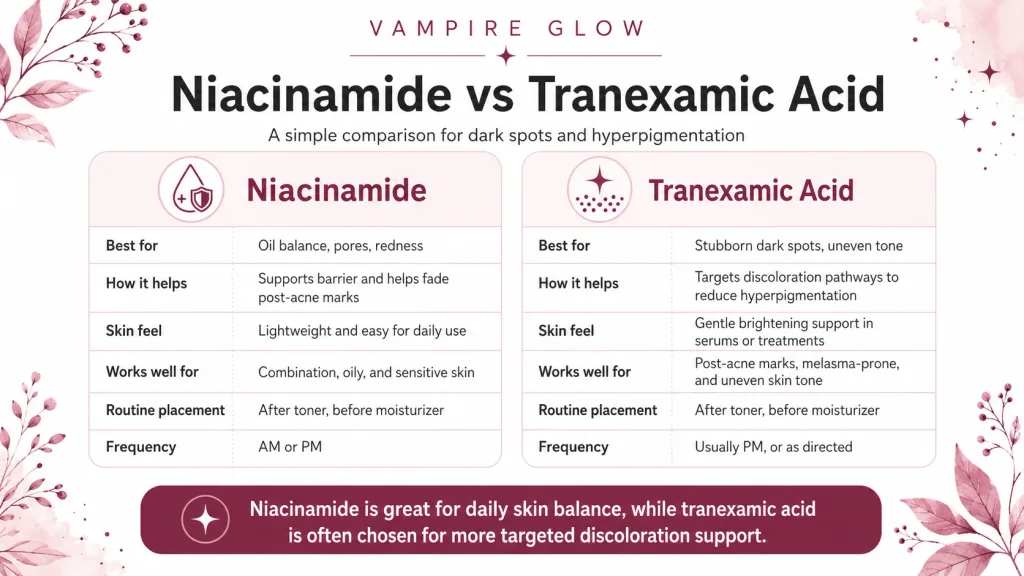
Niacinamide vs Tranexamic Acid for Dark Spots
| Niacinamide | Tranexamic Acid | |
| Mechanism | Inhibits melanin transfer to surface skin cells | Blocks the UV and inflammation trigger signal that causes melanin production |
| Best for | Post-acne marks, general uneven tone, mild sun spots, sebum regulation | Stubborn dark spots, UV-driven hyperpigmentation, melasma support, resistant pigmentation |
| Works at | Surface skin level | Closer to the melanin production trigger |
| Additional skin benefits | Pore refinement, sebum regulation, anti-inflammatory, barrier support | More targeted to pigmentation, fewer secondary benefits |
| Speed of visible results | 4 to 8 weeks for initial improvement | 4 to 8 weeks, with some studies showing meaningful improvement at 8 to 12 weeks |
| Suitability for sensitive skin | Excellent, very well tolerated at 5 to 10 percent | Good, generally well tolerated |
| Compatible with SPF | Yes, use morning and evening, SPF essential above it | Yes, SPF is essential alongside for any meaningful effect |
| Saudi Arabia UV environment | Effective when used with strict SPF, but UV can continue creating new spots faster than niacinamide clears existing ones without SPF | Strong fit for UV-driven pigmentation when used consistently with SPF50+ |
| Can they be used together | Yes | Yes |
| Concentration to look for | 5 to 10 percent on the ingredient label | 2 to 5 percent in most topical formulas |
Which One Is Better for Dark Spots in Saudi Arabia
The honest answer depends on the type and severity of dark spots you’re addressing.
For mild to moderate post-acne marks, recent sun spots and general uneven tone, niacinamide is often enough on its own, particularly when used consistently with daily SPF. It is gentler, more multi-functional, and easier to layer with other actives.
For stubborn dark spots that have been present for more than a few months, deeper pigmentation or hyperpigmentation that keeps returning despite topical treatment, tranexamic acid’s upstream mechanism makes it the more targeted choice. It addresses why the pigmentation keeps forming rather than just clearing what’s already visible at the surface.
For most people in Saudi Arabia dealing with ongoing UV-driven dark spots, the most effective approach is both together. Tranexamic acid at the trigger level and niacinamide at the melanin-transfer level is a more comprehensive strategy than either alone, and the two are fully compatible in a K-beauty layering routine.
The single most important factor for either ingredient’s effectiveness in Saudi Arabia, however, is SPF. Without daily SPF50+ PA++++ applied every morning and reapplied during prolonged outdoor exposure, new pigmentation is forming faster than either ingredient can clear existing marks. SPF is not the support act to these ingredients. It is the foundation that lets them work.
Can Niacinamide and Tranexamic Acid Be Used Together
Yes, and for stubborn pigmentation in high-UV climates like Saudi Arabia’s, using both is more effective than choosing between them.
They work on different parts of the same process. Tranexamic acid blocks the production trigger. Niacinamide reduces the transfer of melanin to visible skin layers. Together they create a two-point approach to dark spots rather than addressing only one part of the mechanism.
The layering order in a K-beauty routine follows texture from thin to thick. Most tranexamic acid and niacinamide formulas are both serums. Apply the lighter-textured one first, allow absorption for 30 to 60 seconds, then apply the second. If both have similar textures, either order is acceptable, since there are no known compatibility issues between the two actives.
How to Use Each in Your Routine
Niacinamide is suitable for morning and evening use. It is stable in most formula types and doesn’t require special handling or sun avoidance. Apply after toner and before moisturiser as part of the serum step. It layers cleanly with hyaluronic acid, centella, tranexamic acid, peptides and most other K-beauty actives.
Tranexamic acid is generally used morning and evening, though some formulas are positioned for evening use specifically. Apply in the serum step after toner. Strict daily SPF50+ in the morning is not optional when using tranexamic acid, since it’s working on UV-triggered pigmentation pathways, and unprotected sun exposure directly counteracts its mechanism.
SPF50+ PA++++ every morning as the final step, before makeup if worn. This is non-negotiable for both ingredients to perform in Saudi Arabia’s UV conditions.
Some By MI and Mixsoon are verified brands at Vampire Glow with treatment-focused serums worth comparing for brightening concerns.
How Soon Does Each Show Results
Both niacinamide and tranexamic acid are gradual actives. The skin’s surface renewal cycle takes approximately four weeks, so meaningful visible improvement in dark spots generally begins after four to six weeks of consistent daily use. More significant fading and an improvement in overall tone evenness is typically apparent after eight to twelve weeks.
Deep or longstanding pigmentation takes longer, and spots that have been present for a year or more respond more slowly than recent marks. Consistency is the defining factor. Stopping and restarting extends every timeline.
Individual results vary significantly based on skin tone, the depth of the pigmentation, how much UV exposure continues during treatment and whether strict SPF is part of the routine. For any pigmentation that doesn’t respond to topical skincare after three to four months of consistent use, a dermatologist consultation is the appropriate next step.
How Often to Use Each
Both niacinamide and tranexamic acid are suitable for daily use for most skin types. Morning and evening application consistently produces better results than once-daily use. There is no standard cycle-off period required for either ingredient at cosmetic concentrations.
For those new to both, introducing them one at a time rather than simultaneously makes it easier to identify if any reaction occurs. Establish niacinamide in the routine first for two weeks, then add tranexamic acid once the skin has shown no adverse response.
Aftercare Tips for Treating Dark Spots in Saudi Arabia
Do apply SPF50+ PA++++ every morning without exception. This is the most impactful single action for treating and preventing dark spots in Saudi Arabia’s UV environment. Even on overcast days, UV passes through clouds. Even indoors near windows, UV passes through glass.
Do reapply SPF if you’re spending significant time outdoors. Sunscreen degrades with UV exposure and sweat. Reapplication every two hours of outdoor time gives the ingredients underneath the conditions they need to work.
Do be patient with both ingredients. Trying a product for two weeks and concluding it isn’t working is the most common reason people cycle through actives without seeing results. Four weeks is the minimum. Eight to twelve weeks is the realistic timeline for meaningful change.
Don’t use a physical exfoliant (scrub) alongside niacinamide and tranexamic acid treatment. It doesn’t accelerate results and introduces irritation that can trigger more PIH in Saudi Arabia’s heat, creating the opposite of the intended outcome.
Don’t apply niacinamide and pure ascorbic acid (vitamin C) together directly in the same session. They can interact to form nicotinic acid, which causes flushing and redness in some people. Apply vitamin C in the morning and niacinamide in the evening, or choose a product that combines them in a stabilised formula. Note that this interaction is more of a concern at high concentrations of both and is not universal, but separating them is the straightforward approach.
Possible Side Effects and Precautions
Niacinamide: Generally very well tolerated. At concentrations above 10 percent, occasional flushing or mild irritation can occur. Most Korean skincare formulas use niacinamide at 5 to 10 percent, within a well-tolerated range for most skin types. If flushing occurs, switch to a lower-concentration formula.
Tranexamic acid: Also well tolerated at topical concentrations. Some people experience mild sensitivity when first introducing it. Patch test on the inner arm before applying to the face. At cosmetic concentrations in topical formulas, the side effect profile is low.
For both: Neither ingredient treats melasma as a primary clinical intervention. Melasma requires dermatological assessment and may involve prescription-strength treatments, chemical peels or in-clinic procedures alongside topical care. Anyone with suspected melasma should see a dermatologist rather than relying solely on over-the-counter actives.
Anyone pregnant or breastfeeding should consult a doctor before using products with active brightening ingredients, including tranexamic acid. Patch test all new products before full facial application.
What Do Niacinamide and Tranexamic Acid Serums Cost
Pricing at Vampire Glow varies by formula complexity, product size, brand and whether the product is a dedicated single-active or a multi-ingredient serum where niacinamide or tranexamic acid is one of several headline actives. Currency and region affect the displayed price: AED for Gulf shoppers, USD for other regions. Delivery options and costs for Saudi Arabia and the wider GCC are confirmed at checkout.
Live pricing is on each product page and updates regularly. Browse the skin care range to compare current options.
Why Choose Vampire Glow
- Authentic Korean brands with batch codes and expiry dates verified on arrival
- Treatment-focused serums stocked alongside core routine products, so the full brightening routine can be built in one place
- Cruelty-free brands only
- Delivery across the UAE and the wider GCC, including Saudi Arabia, confirmed at checkout
- Full ingredient lists and usage guidance on every product page
Prefer the underlying evidence to any brand's word for it? PubMed indexes the published research on tranexamic acid and melasma.
Related reading
- The best Korean dark spot serums for hyperpigmentation
- What glutathione tablets can and can't do for skin tone
- Which Korean skincare ingredients actually work
- The best Korean skincare for acne-prone skin
- Glutathione vs vitamin C for skin brightening
FAQs
How long does niacinamide take to remove dark spots? Niacinamide doesn’t remove dark spots immediately, and “remove” isn’t quite the right word for how it works. It inhibits the transfer of melanin to the skin’s surface, which gradually fades existing dark spots over time. Most people begin to see initial improvement after four to six weeks of consistent daily use. More meaningful fading and tone evening typically requires eight to twelve weeks. Deep or longstanding marks take longer. Individual results vary by skin tone, the depth of the pigmentation, how consistently the routine runs and whether strict daily SPF is in place. Without SPF, niacinamide is clearing existing marks while UV is creating new ones, which slows or stalls visible progress regardless of how consistently the serum is applied.
What happens if I use niacinamide every day? Daily use of niacinamide is appropriate for most skin types and produces the best cumulative results. Used consistently morning and evening, niacinamide gradually fades dark spots, refines pore appearance, regulates sebum and provides anti-inflammatory support. There is no standard tolerance ceiling, purging phase or required cycle-off period for niacinamide at cosmetic concentrations. The only situations requiring more caution are very high concentrations above 10 percent for sensitive skin, or combining it with pure ascorbic acid in the same session. For acne-prone skin in Saudi Arabia’s climate, twice-daily niacinamide use is one of the most consistently beneficial additions a routine can have.
Does niacinamide take away dark spots? Niacinamide can significantly reduce the visible appearance of dark spots over consistent use, but results vary by skin type, spot depth and how long the pigmentation has been present. It works by slowing the transfer of melanin to the skin’s surface, which makes existing spots gradually less visible. It does not eliminate melanin from the skin or provide a permanent reduction in the skin’s ability to produce pigment. Recent, shallower marks respond more quickly than longstanding or deep ones. For stubborn spots that haven’t responded to niacinamide after three to four months of consistent use, tranexamic acid as an additional active, or a dermatologist consultation, is the appropriate next step.
Does niacinamide lighten skin permanently? No. Niacinamide doesn’t permanently lighten skin tone or interfere with the skin’s melanin-producing cells. It reduces the transfer of melanin to the surface skin layer, which over time reduces the appearance of dark spots and uneven tone. The skin’s melanin production itself continues normally. Stop using niacinamide, and the skin will return to its natural melanin behaviour. Continue UV exposure without SPF, and dark spots will return regardless of how consistently niacinamide has been used. The results are maintained through consistent use alongside daily SPF, not permanent after a course of treatment. Anyone seeking permanent skin lightening should be aware that no cosmetic topical product provides this outcome, and any product marketed to do so should be approached with caution.
Why is my skin getting darker after using niacinamide? The most common reason is that new UV-driven pigmentation is forming faster than niacinamide is fading existing marks. If SPF isn’t being applied daily, Saudi Arabia’s UV creates new dark spots continuously. Niacinamide slows melanin transfer but doesn’t block new UV-triggered melanin production, which is tranexamic acid’s function. The solution is adding strict daily SPF50+ PA++++ before anything else. A second possible cause is combining niacinamide with a vitamin C (ascorbic acid) formula in the same session. The two can form a nicotinic acid compound that causes visible flushing and temporary redness in some people, which can be misread as darkening. Separate them into morning (vitamin C) and evening (niacinamide) sessions. A third possibility is that the product causing darkening isn’t the niacinamide itself but another ingredient in the formula. Check the full ingredient list for any photosensitising actives that require strict sun protection to avoid hyperpigmentation.
Which is better for dark spots: niacinamide or tranexamic acid? For mild to moderate recent dark spots and post-acne marks, niacinamide is often sufficient and has the added benefit of addressing the acne and oil that cause PIH in the first place. For stubborn, deep or longstanding dark spots, and for pigmentation that keeps returning despite topical treatment, tranexamic acid’s upstream mechanism makes it the more targeted choice. For the most comprehensive approach to dark spots in Saudi Arabia’s UV environment, using both is more effective than choosing one. They work on different points in the pigmentation process and are fully compatible in a layered routine. Without daily SPF50+ alongside either ingredient, neither will deliver meaningful results in Saudi Arabia’s UV conditions.
Build Your Dark Spot Routine at Vampire Glow
For dark spots in Saudi Arabia’s year-round UV, niacinamide and tranexamic acid are the two most relevant brightening actives available in K-beauty, and they work best together. The foundation under both of them is SPF50+ PA++++ every morning without exception. That combination, consistently maintained, is how pigmentation fades and stays faded in this climate. Browse the skin care range at Vampire Glow for current brightening serum options, including formulas from Some By MI and the full shop. For a personalised recommendation based on your dark spot type, email support@vampireglow.com.


About author