Toner Pads vs Toner: What’s the Difference and Which Is Better?
If you’ve spent any time building a Korean skincare routine, you’ve encountered both toner and toner pads, and you’ve probably wondered whether they’re essentially the same thing in a different format, whether you need both, or whether one replaces the other entirely.
Table of Contents
- What Is a Toner in Korean Skincare
- What Are Toner Pads
- The Core Difference Between Toner and Toner Pads
- Who Should Use a Standard Toner
- Who Should Use Toner Pads
- Should I Use Toner Pads Before or After Toner
- What Is the Correct Way to Apply Toner
- How to Use Toner Pads Correctly
- Can You Use Toner Pads Every Day
- Which Is the Best Time to Apply Toner
- Toner vs Toner Pads: Full Comparison
- Can You Use Both a Toner Pad and Toner in the Same Routine
- Aftercare Tips for Toner and Toner Pad Users in Saudi Arabia
- Possible Side Effects and Precautions
- What Do Toners and Toner Pads Cost at Vampire Glow
- Why Choose Vampire Glow
- FAQs
- Shop Toners and Toner Pads at Vampire Glow
The confusion is understandable because the marketing language around both products often overlaps. Both sit after cleansing. Both are associated with cleansing, balancing and prepping the skin. But they’re not interchangeable, and for most skin types in Saudi Arabia’s climate, they serve genuinely different purposes in the routine.
This guide breaks down exactly what each product is, what it does, how to apply it correctly, and which one, or which combination, makes sense for your skin and your specific concerns in the Gulf climate.
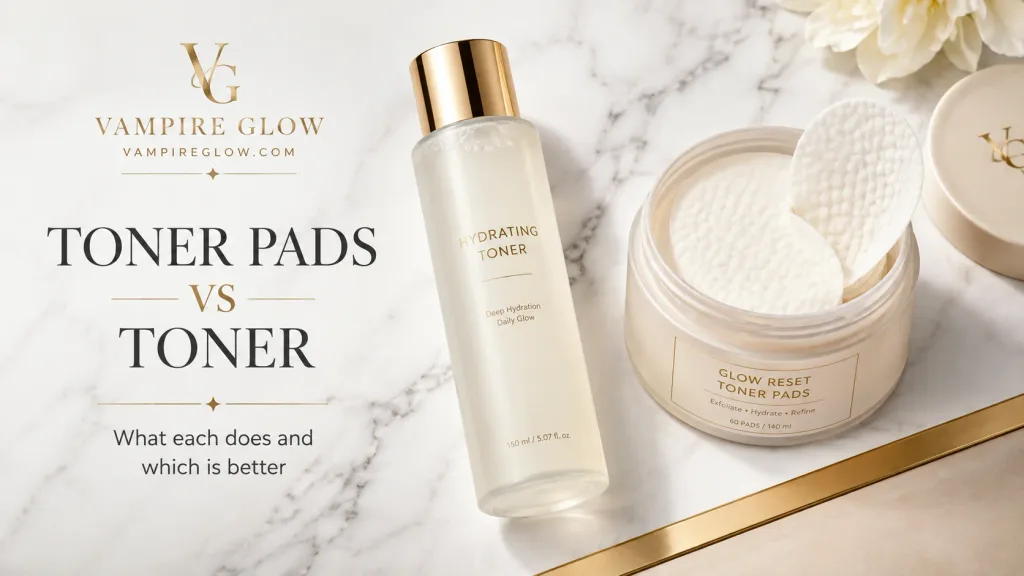
What Is a Toner in Korean Skincare
The Korean toner is not the same product as what most Western skincare lines have historically sold under the same name. Western toners were traditionally astringent formulas designed to remove residual oil and cleanse pores, often containing high concentrations of alcohol. They stripped the skin and left it feeling tight.
Korean toners started from a different premise. They were designed to rebalance the skin’s pH after cleansing and deliver the first layer of meaningful hydration before the rest of the routine followed. Over the last decade, Korean toners have evolved further into three distinct categories.
Hydrating toners are the most widely used. They’re watery, lightweight formulas that deliver a first layer of moisture, sometimes including hyaluronic acid, panthenol, centella or glycerin. Applied after cleansing, they prep the skin to absorb the products that come next.
Treatment toners include active ingredients such as low-percentage AHA, BHA or niacinamide. They hydrate while also beginning to address a specific skin concern. The treatment is gentler than a dedicated serum but more active than a basic hydrating toner.
Essence toners are the thickest of the three, crossing into the essence category in texture. They provide significant hydration and are often used in the layering-method approach popular in K-beauty, where the same toner-essence is applied in multiple thin layers to build moisture.
What Are Toner Pads
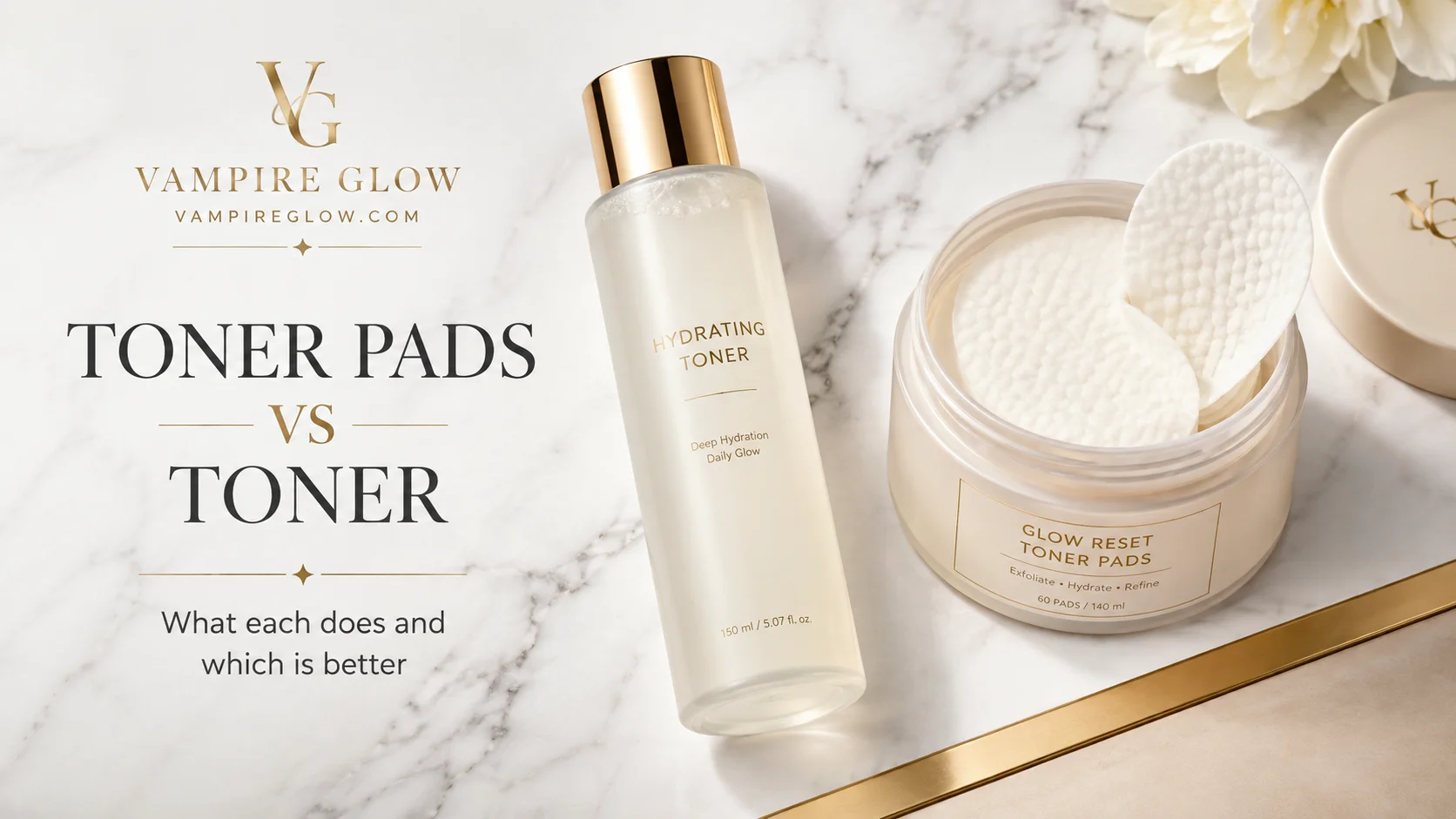
Toner pads are pre-soaked cotton pads, typically with a textured surface on one or both sides, saturated with a toning or treatment solution. They come sealed in a jar or airtight container that keeps them moist and ready to use.
Unlike a liquid toner applied by hand or on a separate cotton pad, toner pads combine two actions in one product. The physical texture of the pad provides a mild physical component as you sweep it across the skin. The solution soaked into the pad delivers the active or hydrating ingredients at the same time.
Korean toner pads are typically positioned as treatment products rather than pure hydration steps. Many contain BHA (salicylic acid), AHA (glycolic or lactic acid), PHA or niacinamide as active ingredients, making them more targeted than a standard hydrating toner. Some By MI is a well-known K-beauty brand that carries toning pads formulated for this kind of targeted use. Browse the skin care range at Vampire Glow for current toner and toner pad options.
The Core Difference Between Toner and Toner Pads
The most important distinction is function. A standard hydrating toner primarily delivers moisture and prepares the skin for the next routine step. A toner pad typically exfoliates, clarifies or treats the skin simultaneously with the application of its solution.
Purpose. Hydrating toner: prepare skin, deliver first moisture layer. Toner pads: exfoliate, clarify pores, treat a specific concern (oil control, acne, uneven texture) while applying the solution.
Mechanism. Toner: absorbed into skin through hand-patting or gentle cotton wiping. Toner pads: physical contact of the textured pad surface loosens dead cells and surface buildup while the soaked solution simultaneously works on the skin.
Active ingredient concentration. Most hydrating toners are low in strong actives. Toner pads frequently contain active percentages of BHA or AHA that make them more treatment-focused than a standard toner.
Usage frequency. Hydrating toners are typically used morning and evening as a daily baseline step. Toner pads containing exfoliating actives are generally used two to three times per week for most skin types, not daily, since over-exfoliation from daily pad use can damage the skin barrier, particularly in Saudi Arabia’s already stressful climate.
Physical exfoliation element. Toners applied by hand have none. Toner pads have a degree of physical component depending on the texture of the pad surface, which contributes to their exfoliating effect.
Who Should Use a Standard Toner
A hydrating, alcohol-free Korean toner suits nearly every skin type and is one of the most universally beneficial steps in a K-beauty routine.
Dry and dehydrated skin benefits most. In Saudi Arabia’s AC environments, where moisture loss is continuous throughout the day, starting the routine with a hydrating toner creates the first moisture layer that everything else builds on.
Sensitive and barrier-damaged skin benefits from a calming, simple hydrating toner with centella, panthenol or beta-glucan. It doesn’t add any actives that could further irritate sensitised skin.
Oily and combination skin also benefits from a hydrating toner, since dehydration often underlies oiliness. A lightweight, water-based toner adds moisture without adding sebum. Those with very oily skin may prefer a treatment toner containing low-percentage niacinamide or a gentle acid.
Who Should Use Toner Pads
Toner pads are best suited to specific skin types and concerns.
Oily, congested and acne-prone skin benefits most from BHA-containing toner pads, since salicylic acid is oil-soluble and penetrates pores to clear congestion. In Saudi Arabia’s heat, where pore congestion is a daily challenge, a BHA toner pad two to three evenings a week is a practically convenient and effective treatment step.
Dull or rough-textured skin benefits from AHA toner pads, which encourage surface cell turnover and smooth texture over time without requiring a separate dedicated exfoliant in the routine.
Combination skin can use toner pads selectively. A BHA or PHA pad on the T-zone where congestion is an issue, without sweeping across drier or more sensitive areas, gives targeted treatment rather than applying the same exfoliation across the full face uniformly.
Very dry or sensitised skin should approach exfoliating toner pads with caution. PHA pads are the gentlest available and may be a tolerable starting point for dry or sensitive skin types, one to two times per week only.
Should I Use Toner Pads Before or After Toner
The sequence depends on what type of toner pad you’re using.
Treatment or exfoliating toner pads (BHA, AHA, PHA): These go after cleansing but before your hydrating toner. The exfoliating pad clears the surface of dead cells and excess sebum first, which then allows the hydrating toner applied after to absorb more efficiently into freshly cleared skin. The sequence is: cleanse, exfoliating toner pad, hydrating toner, then the rest of the routine.
Hydrating toner pads: These are sometimes called essence pads or moisturising pads and contain no significant actives. They can be used in place of a hydrating toner or at the same point in the routine, since they perform the same function in a pre-soaked format.
The practical rule is: if the pad exfoliates, it comes first. If it hydrates, it replaces or accompanies the toner step at the same point.
What Is the Correct Way to Apply Toner
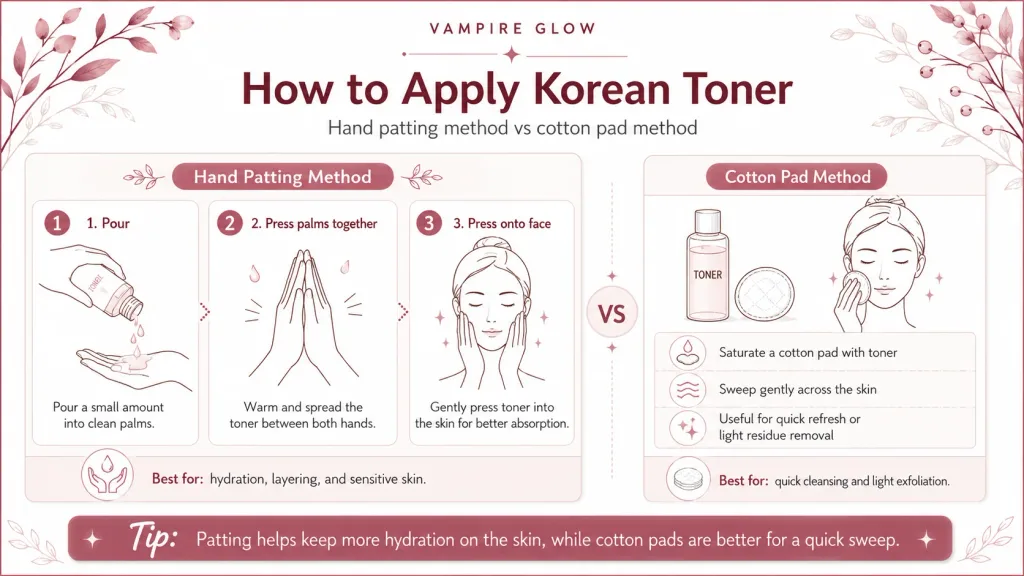
Applying toner by hand (the Korean method):
Pour a small amount, typically five to seven millilitres, into clean palms. Cup the hands together and press them gently onto the face, starting at the centre and working outward across the cheeks, forehead and chin. Hold each section for a moment before moving to the next. The warmth and gentle pressure from the hands encourages absorption better than wiping or rubbing. Repeat the pressing motion two to three times if the toner has been fully absorbed and the skin wants more.
Applying toner with a cotton pad:
Pour the toner onto a flat cotton pad until saturated but not dripping. Swipe across the face in outward and upward strokes, from the nose across the cheeks, from the chin to the jawline, from the forehead to the temples. Do not rub back and forth, as this creates friction and can irritate sensitive skin. The cotton pad method removes more residual product from the skin surface and is useful for those who prefer a more thorough sweep, though it does use more toner per application than the hand method.
Which is better: The hand-patting method is preferred in Korean skincare for most toners because it is gentler, wastes less product, and allows the warmth of the hands to support absorption. A cotton pad is more useful when the toner contains ingredients that benefit from a mild wiping action, such as a mild treatment toner with light exfoliating properties.
How to Use Toner Pads Correctly
Remove one pad from the sealed jar and close the lid immediately to prevent the remaining pads from drying out.
Sweep the pad across the face using gentle, consistent strokes in an outward direction. Do not press hard or rub back and forth. The texture of the pad does the physical work; heavy pressure is not more effective and can irritate inflamed or sensitive areas.
For BHA or AHA pads, sweep once across the entire face and leave the skin to absorb the solution for 15 to 20 minutes before applying the next step of the routine. Do not rinse off a leave-on treatment pad.
If the skin is oily in the T-zone but drier on the cheeks, use the pad primarily across the oilier areas and avoid the drier, more sensitive zones.
Always follow an AHA or BHA toner pad with SPF the following morning. Chemical exfoliants increase photosensitivity, and in Saudi Arabia’s UV conditions this is non-negotiable.
Can You Use Toner Pads Every Day
It depends on the formula.
Hydrating toner pads with no significant actives can be used daily, morning and evening, in the same way a standard hydrating toner is used.
Exfoliating toner pads containing BHA, AHA or PHA should not be used every day for most skin types. Two to three times per week is the typical appropriate frequency. Daily use of an exfoliating toner pad will over-exfoliate the skin, damage the barrier, cause increased sensitivity and paradoxically worsen congestion and redness rather than improving it. For new users of exfoliating pads, starting at once or twice per week and building up over four to six weeks is the right approach.
Sensitive skin and dry skin should use exfoliating toner pads even less frequently to start, once a week or once every ten days, and only increase frequency if the skin shows no reaction.
Which Is the Best Time to Apply Toner
Hydrating toner: Morning and evening, immediately after cleansing, as the first step before any serums or moisturisers. It has no photosensitivity consideration and suits both sessions equally.
BHA toner pads: Best in the evening. BHA penetrates pores and processes through the night, and evening use reduces any risk of photosensitivity from the active ingredient during the day. Apply after cleansing in the evening as the first treatment step.
AHA toner pads: Evening only. AHAs are the most photosensitising of the acid exfoliants. Applying in the evening and following with SPF50+ the next morning is the correct approach. Using AHA pads in the morning without strict SPF in Saudi Arabia’s UV conditions is not recommended.
PHA toner pads: Morning or evening is acceptable, since PHA has lower photosensitivity risk than AHA or BHA. That said, evening use is the safer default for any exfoliant, and daily SPF is needed regardless.
Toner vs Toner Pads: Full Comparison
| Hydrating Toner | Exfoliating Toner Pad | |
| Primary purpose | Hydrate, balance pH, prep skin for next layers | Exfoliate, clarify, treat specific skin concern |
| Physical component | None when applied by hand | Textured pad surface provides mild physical exfoliation |
| Active ingredient concentration | Low to moderate (hydrating actives, light treatment) | Moderate to higher (BHA, AHA, PHA, niacinamide) |
| Best for | All skin types, especially dry, sensitive, dehydrated | Oily, congested, acne-prone, uneven texture |
| Daily use | Yes, morning and evening | No, 2 to 3 times per week for exfoliating formulas |
| Best time of day | Morning and evening | Evening for AHA and BHA, morning or evening for PHA |
| Application method | Hand-patting or gentle cotton pad | Swept across face with textured pad surface |
| Photosensitivity consideration | None for hydrating toners | Yes, particularly AHA, strict daily SPF required |
| Can they be combined | Yes, use toner after toner pad | Yes, use hydrating toner after exfoliating pad |
| Saudi Arabia climate suitability | Excellent for daily hydration in AC environments | Excellent for oiliness and congestion in heat, use correct frequency |
| Convenience | Requires pouring each use | Pre-soaked, grab-and-go format |
| Storage in Saudi Arabia heat | Fine in a cool room | Keep lid sealed after each use, store away from sun |
Can You Use Both a Toner Pad and Toner in the Same Routine
Yes, and this is a common and effective combination in K-beauty routines for oily or combination skin. The sequence is: cleanser, exfoliating toner pad, hydrating toner, then the rest of the routine.
The exfoliating toner pad clears the surface. The hydrating toner restores the moisture that the exfoliating process can strip. The two perform complementary functions rather than competing, and using a hydrating toner after an exfoliating pad is actually a better approach than using the pad as the only step, since it prevents the barrier from feeling stripped after exfoliation.
For dry or sensitive skin, a hydrating toner pad used in place of the liquid toner is a simpler single-step format that delivers hydration with the convenience of the pre-soaked pad without adding exfoliation.
Aftercare Tips for Toner and Toner Pad Users in Saudi Arabia
Do store toner pads with the lid fully sealed after each use. Saudi Arabia’s ambient temperatures can dry out pre-soaked pads if the container is left open, reducing both the effectiveness and the amount of solution remaining per pad.
Do follow any exfoliating toner pad session with a hydrating toner or hydrating serum to restore moisture balance after the exfoliation step.
Do apply SPF50+ PA++++ every morning, every day, especially when using any exfoliating toner pad in the routine. Chemical exfoliants increase photosensitivity, and Saudi Arabia’s UV index makes this non-negotiable.
Don’t use an exfoliating toner pad on the same day as a separate chemical exfoliant in another part of the routine. One exfoliation source per session is enough, since doubling up compounds irritation risk.
Don’t use toner pads with strong actives in the same session as retinol. Use them on alternating evenings to avoid stacking two aggressive actives in the same skin session.
Possible Side Effects and Precautions
For exfoliating toner pads: The most common adverse effect is over-exfoliation, which presents as increased redness, stinging, tightness and a sudden increase in sensitivity. If this occurs, stop the pad entirely, allow the barrier to recover with a simplified ceramide-focused routine, and reintroduce the pads at a lower frequency when the skin has stabilised.
For AHA pads specifically: Increased photosensitivity is a guaranteed effect. Without consistent daily SPF50+, using AHA pads can worsen the pigmentation and UV damage they’re supposed to help improve.
For sensitive and dry skin types: PHA pads are the most appropriate starting point, since PHA molecules are larger and penetrate more slowly than AHA or BHA, resulting in a lower irritation profile. Even then, once per week is a sensible starting frequency.
Anyone using prescription retinoids or topical antibiotic treatments for acne should check with their dermatologist before adding exfoliating toner pads to the routine, since stacking exfoliation with prescription actives can over-treat the skin. Patch test any new toner or toner pad product on the inner arm before applying to the full face. Anyone pregnant or breastfeeding should avoid products containing salicylic acid and check other active ingredients with their doctor.
What Do Toners and Toner Pads Cost at Vampire Glow
Pricing varies by brand, format, bottle size, pad count per jar and whether the product is a hydrating formula or a treatment-active one. Toner pads tend to cost more per use than liquid toner when assessed per application, since the pre-soaked, pre-assembled format includes packaging and manufacturing costs that liquid toner does not. Some people find the convenience of a grab-and-go pad worth the difference for treatment steps used two to three times per week.
Vampire Glow displays pricing in AED for Gulf shoppers and in USD for other regions. Delivery options and costs for Saudi Arabia and the wider GCC are confirmed at checkout. Browse live prices at the skin care category page.
Why Choose Vampire Glow
- Authentic Korean brands verified on arrival with batch codes and expiry dates checked
- A curated selection that includes treatment-focused toner pads and hydrating toners suited to Gulf skin and climate conditions
- Cruelty-free brands only
- Delivery across the UAE and the wider GCC, including Saudi Arabia, confirmed at checkout
- Full ingredient lists and usage guidance on every product page
For the general dermatological guidance that sits underneath any routine, the American Academy of Dermatology publishes its own guidance on washing your face.
Related reading
- The best Korean toner pads for each skin type
- How to use Korean toner pads properly
- The correct order for toner, essence, serum and moisturiser
- The full Korean skincare routine for Saudi Arabia's weather
FAQs
Is it better to use toner or toner pads? Neither is universally better. They serve different purposes. A hydrating toner is a daily baseline step that every skin type benefits from, morning and evening. A toner pad is a treatment step used two to three times per week for specific concerns such as congestion, oiliness, rough texture or mild exfoliation. For skin that needs both regular hydration and targeted exfoliation, the ideal approach is to use both: an exfoliating toner pad when needed, followed by a hydrating toner to restore moisture. Choosing only one means either having a daily hydration step without targeted treatment, or having a treatment step without the daily moisture foundation. For a beginner building a routine, a hydrating toner is the right starting point before any toner pad is introduced.
Should I use toner pads before or after toner? Exfoliating toner pads containing BHA, AHA or PHA go before the hydrating toner. Sweep the pad across cleansed skin, allow it to absorb for 15 to 20 minutes, then apply the hydrating toner. The pad clears the skin surface, and the hydrating toner immediately after restores moisture balance. Using the hydrating toner first and then the pad on top would mean the exfoliating solution has to work through the moisture layer, which reduces its contact with the skin. Hydrating or essence toner pads, which contain no significant actives, slot in at the same step as a standard hydrating toner.
Can you use toner pads every day? Hydrating toner pads with no significant actives, yes. Exfoliating toner pads with BHA, AHA or PHA, no, not for most skin types. Daily use of an exfoliating toner pad leads to over-exfoliation, barrier damage, increased redness and sensitivity, and eventually a worsening of the skin concerns the pad was supposed to address. Two to three times per week is the appropriate frequency for most skin types. Sensitive and dry skin should use exfoliating pads once to twice a week only. Building up gradually over four to six weeks gives the skin time to adjust and makes it much easier to identify the right individual frequency.
What is the correct way to apply toner? The Korean method is hand-patting: pour a small amount of toner into clean palms, press the hands together, then press gently onto the face, working from the centre outward. Hold each area for a moment before moving. The warmth of the hands and the pressing motion encourage absorption more gently and with less product waste than wiping. The alternative is to pour toner onto a flat cotton pad and sweep outward from the centre in upward strokes, without rubbing back and forth. Hand-patting is preferred for hydrating toners. A cotton pad is more practical for treatment toners where a mild sweeping action is part of the application. Toner pads have their own built-in cotton surface and are swept across the face using the textured side, with light, outward strokes and no heavy pressure.
Which is the best time to apply toner? A hydrating toner can be applied morning and evening immediately after cleansing, since it has no photosensitivity considerations and benefits the skin at both times of day. Exfoliating toner pads with BHA or AHA are best applied in the evening to minimise the risk of photosensitivity during the day. The following morning, SPF50+ is required regardless. PHA pads are the lowest-risk option for morning use if an exfoliating pad must be used in the morning, though the evening default is still the safer choice for all exfoliating actives in Saudi Arabia’s high-UV environment.
Are Korean toner pads different from regular cotton pads used with toner? Yes, meaningfully so. A regular flat cotton pad soaked in toner delivers only what is in the liquid toner. A Korean toner pad is a purpose-designed pre-soaked product where the pad texture and the soaked solution are specifically designed to work together. Korean toning pads typically use waffle-weave or ribbed cotton that provides controlled mild physical exfoliation as part of the design, not just a delivery surface. The solution concentration is also formulated for leave-on use rather than for rinsing, which means the active concentration is calibrated differently from a toner designed to be wiped off. The pre-soaked jar format also ensures consistent saturation per pad rather than the variable amount a manual soak creates.
Shop Toners and Toner Pads at Vampire Glow
Understanding which format fits your skin type and concern is the starting point. A hydrating toner as the daily baseline, and an exfoliating toner pad two to three times a week for targeted treatment, covers the needs of most skin types in Saudi Arabia’s climate without overlapping or competing. Browse the skin care range at Vampire Glow for current toner and toner pad options, including formulas from Some By MI. For a product recommendation based on your skin type and specific concerns, email support@vampireglow.com.
About author