Korean Skincare Routine Order: Toner, Essence, Serum & Moisturizer Explained | Vampire Glow
Korean Skincare Routine Order: Toner, Essence, Serum & Moisturizer Explained
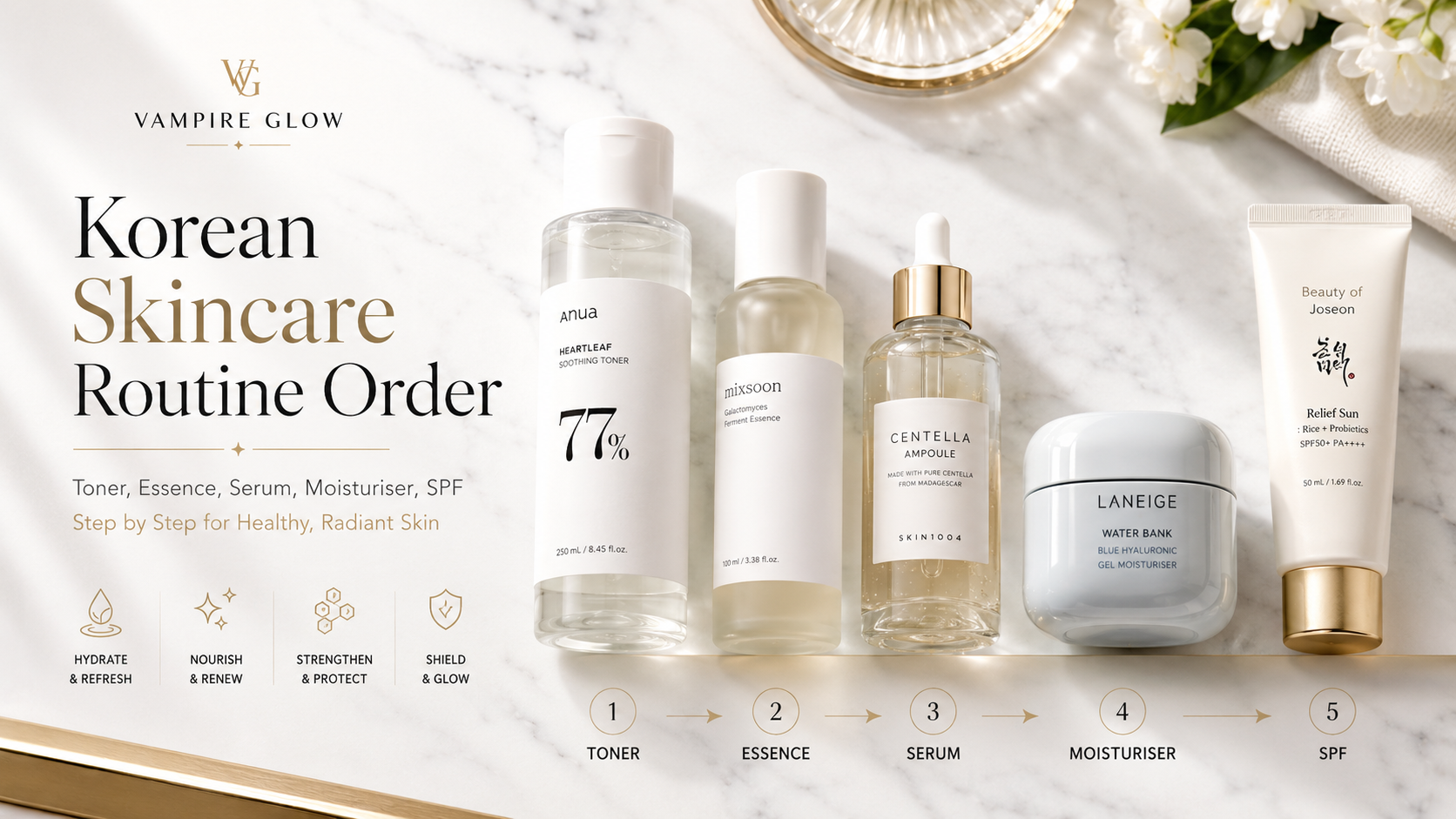
Korean skincare is built around layering, and layering only works when the layers go on in the right order. The logic behind the K-beauty sequence isn’t complicated once you understand the principle it’s built on: thinnest texture before thickest, water-based products before oil-based ones. Apply in the wrong direction, and lighter products can’t penetrate through heavier ones that have already sat on the skin. Apply in the right direction, and each layer absorbs properly and prepares the skin for the next.
The confusion usually happens around toner, essence and serum, three products that sound similar, overlap in marketing language and often look alike on a shelf. Understanding what each one actually does, not just where it goes, is what makes the difference between a routine that looks like K-beauty and one that actually performs like it.
This guide explains each product in the sequence, why it sits where it does, how they interact, and how to adapt the ordering logic for Saudi Arabia’s heat, AC and UV conditions.
The Core Principle: Why Order Matters in Korean Skincare
The skin absorbs products most effectively when they’re applied from lightest to heaviest, thinnest to thickest, water-based to oil-based.
A light watery product applied after a thick occlusive cream will sit on the surface rather than absorbing into the skin. The cream has already created a seal that the lighter product can’t penetrate. Reverse the order, light then heavy, and each layer absorbs into the skin, with the next layer going on top of an absorbed base rather than a surface film.
This matters more in Saudi Arabia’s climate than in milder ones. In the heat, heavy products applied too early in the sequence trap heat against the skin and contribute to congestion. Lightweight layers applied first absorb quickly before the ambient temperature makes them uncomfortable to wear. Products designed to absorb need to be applied when the skin is open to receiving them, before heavier layers close the surface.
Step One: Toner
Where it goes: Immediately after cleansing, before everything else.
What it does: A Korean toner is not the same as the Western astringent toner it once was. It does not strip or exfoliate the skin (unless it’s a treatment toner, which is a sub-category). Its primary job is to rebalance the skin’s pH after cleansing and deliver the first layer of hydration that the rest of the routine builds on.
Cleansing, even with a gentle cleanser, disrupts the skin’s natural slightly acidic pH. A toner brings the skin back to a range where it can absorb subsequent products optimally. Applied immediately after cleansing on slightly damp skin, a hydrating toner also creates the moisture surface that the essence and serum above it can draw from and bind to.
Texture: The most watery product in the routine. Thinner than water in some Korean formulas.
How to apply: Pressed into the skin with clean palms (the Korean hand-patting method) or swept on with a flat cotton pad in outward, upward strokes. Hand-patting is generally preferred for hydrating toners since it’s gentler and wastes less product.
What to look for: Alcohol-free, pH-balancing, hydrating actives such as hyaluronic acid, centella asiatica, panthenol or beta-glucan. In Saudi Arabia’s AC environments, a hydrating toner is particularly valuable since moisture loss throughout the day starts from a better baseline if the skin is well-hydrated at the beginning of the routine.
Step Two: Essence
Where it goes: After toner, before serum.
What it does: The essence is the step that most clearly separates K-beauty from Western skincare routines. It sits between the toner (lightest, most watery) and the serum (more concentrated, treatment-focused), filling the role of a first treatment layer that adds meaningful hydration while beginning a lighter version of the active work the serum will continue.
Essences are typically more viscous than a toner but lighter than a serum. They deliver hydrating actives, fermented ingredients, skin-balancing compounds and sometimes a light treatment ingredient such as niacinamide or snail mucin at a lower concentration than a dedicated serum. Their role is not to replace the serum but to prepare and prime the skin for it.
In a K-beauty routine, the essence is also the layer that creates what Korean estheticians describe as the “plumping” base: well-hydrated, softened skin that absorbs the more concentrated treatment serum above it more efficiently. Dry or tight skin absorbs serum poorly. Essence-prepped skin absorbs it much better.
Texture: Slightly thicker than toner, watery or lightly viscous, absorbs within 20 to 30 seconds.
How to apply: Pressed into the skin with clean palms, working outward from the centre of the face. Two to three drops or a small dispenser amount is usually sufficient.
What to look for: Fermented ingredients such as galactomyces ferment filtrate or bifida ferment lysate for antioxidant and brightening benefits. Hyaluronic acid for hydration. Snail secretion filtrate for barrier repair. Centella for calming. Mixsoon is known for clean, minimalist essence formulas well-suited to the K-beauty layering method.
Step Three: Serum
Where it goes: After essence, before eye cream and moisturiser.
What it does: The serum is the treatment step, where the highest concentration of targeted active ingredients sits. If the toner prepares the skin and the essence hydrates and primes it, the serum delivers the concentrated active work: brightening, anti-ageing, oil control, barrier repair, post-acne mark fading or whatever the skin’s specific concern requires.
Because of its higher concentration of actives, the serum has the most direct influence on a targeted skin concern. It also has the most potential for irritation if applied to unprepared skin, which is why the toner and essence steps underneath it matter. Well-hydrated, pH-balanced skin absorbs a serum more efficiently and with less risk of the stinging or sensitivity that can occur when a concentrated serum is applied directly to dry, stripped skin.
Texture: More concentrated than an essence, but still lighter than a moisturiser. Most serums are gel or gel-oil in texture and absorb within 60 seconds.
How to apply: Two to three drops, pressed into the skin with fingertips or flat palms. If using multiple serums, apply from thinnest to thickest, the same ordering rule applies within the serum step itself. Allow each serum to absorb before applying the next.
What to look for: Based on skin concern. Niacinamide for oil control and pore refinement. Tranexamic acid or niacinamide for dark spots. Snail mucin or PDRN for regeneration and barrier repair. Peptides for anti-ageing. Hyaluronic acid for hydration.
Some By MI carries targeted treatment serums suited to oily and acne-prone concerns. Browse the full skin care range at Vampire Glow for treatment serum options.
Step Four: Eye Cream
Where it goes: After serum, before moisturiser.
What it does: Eye cream goes before the main moisturiser because the skin around the eye is thinner and more delicate than the rest of the face. It needs its own formula that is calibrated for this difference. Applying a richer face moisturiser to the eye area first and then eye cream on top means the eye cream is absorbed poorly. Apply the lighter, targeted eye cream first, allow it to absorb, then apply the face moisturiser.
How to apply: A small amount pressed very gently around the orbital bone using the ring finger, which applies the lightest pressure of all the fingers. Do not rub or drag.
Step Five: Moisturiser
Where it goes: After all serum and treatment layers, before SPF in the morning.
What it does: The moisturiser is the sealing layer. Its primary function is to slow the evaporation of everything applied underneath it: the toner’s hydration, the essence’s active prep layer and the serum’s concentrated treatment work. Without a moisturiser to seal it, much of that layered hydration and treatment will evaporate, particularly in Saudi Arabia’s dry AC environments.
The moisturiser also adds its own hydrating and skin-supportive ingredients, but its sealing function is what makes the products underneath it effective. A good K-beauty moisturiser completes rather than replaces the layers underneath.
Texture choice in Saudi Arabia: A lightweight gel or gel-cream for oily and combination skin in the heat. A slightly richer gel-cream for dry skin. A full cream only for very dry skin or the cooler winter months. The heat and AC combination in Saudi Arabia makes heavy cream moisturisers generally impractical, since they trap heat on the skin surface and can contribute to congestion.
Step Six: SPF (Morning Routine Only)
Where it goes: The absolute final step of the morning routine, after moisturiser.
What it does: Protects all the layers underneath from UV degradation. In Saudi Arabia’s year-round high-UV conditions, SPF is not a summer product or an optional add-on. It is the step that determines whether every other product in the routine produces its intended result or is undone by unprotected UV exposure. SPF applied before moisturiser gets diluted by the moisturiser going on top, which reduces its effective protection. SPF applied last maintains its full protective function.
The Complete Morning Routine Order
Cleanser, toner, essence, serum (or serums, thinnest to thickest), eye cream, moisturiser, SPF50+. These steps run every morning without exception in a complete K-beauty routine in Saudi Arabia’s climate.
The Complete Evening Routine Order
Oil cleanser, water-based cleanser, toner, essence, serum or treatment active (retinol, BHA, AHA on applicable evenings), eye cream, moisturiser or gel-cream, sleeping mask (two to three evenings per week). SPF is omitted in the evening routine.
What Happens When You Apply in the Wrong Order
The most common ordering mistake is applying serum directly after cleansing and skipping or misplacing the toner and essence.
A serum applied to un-toned skin lands on a skin surface that hasn’t been pH-balanced after cleansing, which can affect how well the active ingredients function. The skin also hasn’t been hydrated by the toner and essence layers, so it’s in a drier, more depleted state when the serum arrives. Dry skin absorbs concentrated serums less efficiently and with a higher risk of stinging or sensitivity, particularly for any serum containing niacinamide, vitamin C or exfoliating actives.
Applying a thicker product, such as the moisturiser, before the serum creates a physical barrier on the skin surface. The serum applied on top cannot penetrate through the already-seated occlusive layer and ends up sitting on the surface rather than absorbing into the skin where it can do its work.
The ordering logic thin to thick, water to oil, isn’t a preference. It’s the sequence that allows each product to reach the skin layer it was formulated to work in.
Common Ordering Mistakes in K-Beauty Routines
Applying SPF before moisturiser. SPF applied underneath a moisturiser gets diluted by the moisturiser layer going on top, reducing effective protection. SPF is always last in the morning.
Applying retinol or a strong serum before essence. Retinol applied to unhydrated, un-prepped skin has a significantly higher risk of causing irritation and barrier damage. The toner and essence steps underneath reduce this risk.
Using multiple serums without respecting the thin-to-thick rule within the serum step. Two serums in the same routine should go in order from the lighter-textured to the thicker one. A watery niacinamide serum before a thicker peptide formula, not the reverse.
Rushing through layers. Applying the next product before the previous one has absorbed means the products are mixing on the surface rather than each one being separately absorbed. Allow 20 to 30 seconds between lighter steps and 60 seconds after a serum before applying the moisturiser.
Adapting the Routine Order for Saudi Arabia’s Climate
The sequence doesn’t change for Saudi Arabia, but the textures within each step change significantly. Heat means each layer needs to absorb faster and feel lighter. What works in a cooler climate as a comfortable mid-weight routine can feel suffocating in the Gulf summer.
Toner: Choose a water-thin hydrating toner that absorbs instantly. No thick essence-toner hybrids in the morning during summer months.
Essence: Lightweight, watery texture. Not a thick, rich essence. Apply and allow to absorb before the serum step. In the heat, the essence step is the most practical way to add treatment-adjacent hydration without the weight of a second serum.
Serum: One to two targeted serums maximum. More than two in the same session adds weight to the routine without proportionally adding results.
Moisturiser: Gel-cream or water-gel format for most skin types in Saudi Arabia’s heat. Switch to something richer only for dry skin or in the winter months when indoor AC creates a colder, drier environment.
SPF: A lightweight Korean SPF that absorbs flat and doesn’t add shine. The heaviness of some SPF formulas is the main reason the step gets skipped in heat. A well-chosen Korean SPF that finishes like a serum or primer removes that barrier to compliance.
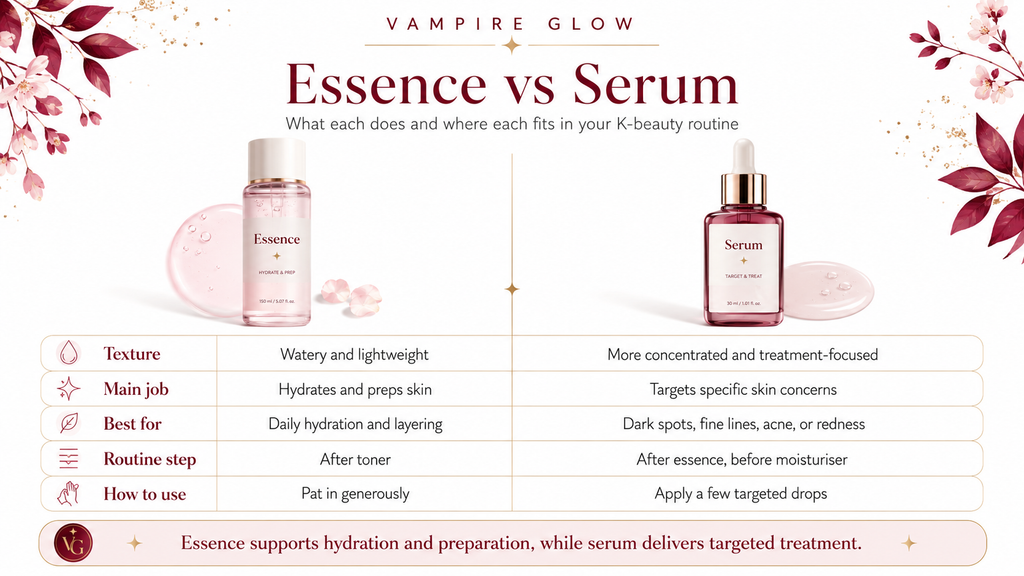
Essence vs Serum: The Most Commonly Confused Pairing
| Essence | Serum | |
| Primary purpose | Hydration base, skin prep, light treatment | Concentrated treatment of a specific skin concern |
| Active ingredient concentration | Low to moderate | High, targeted |
| Texture | Watery to lightly viscous | Gel to gel-oil, denser than essence |
| Routine position | After toner, before serum | After essence, before moisturiser |
| Can they be skipped | Yes, but reduces absorption efficiency of the serum above it | Not ideal, since it’s the treatment step |
| Can they be used together | Yes, this is how most full K-beauty routines are structured | Yes |
| Result speed | Supports gradual overall hydration and skin quality | Faster targeted results on specific concerns |
| Best in Saudi Arabia | Particularly valuable in AC environments for sustained hydration | Essential for targeted concern treatment |
| Common examples | Snail mucin essence, galactomyces essence, centella essence | Niacinamide serum, tranexamic acid, PDRN, vitamin C |
Possible Side Effects and Precautions
Layering multiple products with strong actives in the same routine increases irritation risk. A routine with a vitamin C serum, a niacinamide serum, a retinol and an AHA toner all used simultaneously is more likely to cause sensitivity than a targeted, simpler approach. Build the routine gradually, one new product at a time, so any reaction can be attributed to its source.
Serums containing actives such as AHA, retinol or high-percentage vitamin C should not be introduced all at once. Start with one, establish tolerance over four weeks, then add the next.
Anyone with a damaged skin barrier should simplify the routine to the foundation steps (toner, a calming essence, ceramide moisturiser, SPF) until the barrier is recovered before reintroducing treatment serums.
Patch test any new product on the inner arm before applying to the full face. Anyone pregnant, breastfeeding or on prescription skin treatment should consult a doctor before adding new actives to their routine.
What Does a Full K-Beauty Routine Cost
The full toner, essence, serum and moisturiser sequence varies significantly by product count, brand selection and formula type. Vampire Glow displays pricing in AED for Gulf shoppers and in USD for other regions. Live prices are on each product page and update regularly. Delivery options for Saudi Arabia and the wider GCC are confirmed at checkout.
Building the routine in stages, starting with cleanser, toner, moisturiser and SPF, then adding essence and serum once the foundation is established, is both more budget-friendly and more skin-safe than introducing the full routine at once. Browse the current skin care range at Vampire Glow to compare current options across steps.
Why Choose Vampire Glow
- Authentic Korean brands with batch codes and expiry dates verified on arrival
- A curated selection covering every step of the K-beauty routine, from toners and essences to targeted treatment serums and barrier repair moisturisers
- Cruelty-free brands only
- Delivery across the UAE and the wider GCC, including Saudi Arabia, confirmed at checkout
- Full ingredient lists and usage guidance on every product page
FAQs
Should I use essence, toner, or serum first? Toner goes first, directly after cleansing. Essence goes second, after the toner. Serum goes third, after the essence. The sequence follows the thin-to-thick rule: toner is the most watery, essence is slightly more viscous, serum is the most concentrated. Applying in this order ensures each layer absorbs into the skin properly rather than sitting on top of a heavier layer that was applied before it. If you skip the toner, apply the essence directly after cleansing. If you skip both toner and essence, apply the serum to cleansed skin, though prepping with toner first significantly improves how well the serum absorbs.
Do I use a serum before or after a toner? Serum goes after toner, not before. Toner goes on first, directly after cleansing, to rebalance the skin’s pH and deliver the first hydration layer. Serum goes on after, either directly after toner (if skipping essence) or after toner and essence both. Applying serum before toner means the serum lands on skin that hasn’t been pH-balanced or hydrated, which can reduce absorption efficiency and increase the risk of sensitivity from concentrated actives. The thinnest products always go closest to the skin first.
What is the correct order of skincare in a K-beauty routine? Morning: cleanser, toner, essence, serum (thinnest to thickest if using more than one), eye cream, moisturiser, SPF50+. Evening: oil cleanser, water-based cleanser, toner, essence, treatment serum (or retinol, BHA or AHA on applicable evenings), eye cream, moisturiser or gel-cream, sleeping mask two to three times a week as the final optional step. The governing principle throughout is thin to thick, water to oil, and SPF last in the morning without exception.
Can I use serum and essence together? Yes, and this is exactly how a complete K-beauty routine is designed. They serve different functions at different concentration levels and don’t compete. The essence goes first, after toner, delivering a preparatory hydration and light treatment layer. The serum goes second, after essence, delivering the concentrated active treatment for the skin’s specific concern. Allow the essence to absorb for 20 to 30 seconds before applying the serum. If a serum already contains similar actives to the essence, such as a serum that already leads with hyaluronic acid and niacinamide, a separate essence may be optional, but for most routines both are beneficial.
Which is better, serum or essence? Neither is universally better. They do different things at different points in the routine and serve different purposes. An essence is the hydrating prep layer that improves how well the serum above it absorbs and performs. A serum is the targeted treatment step that addresses the specific skin concern with concentrated active ingredients. If forced to choose only one, a targeted serum for a specific concern delivers more direct results on that concern. But a routine with both produces better outcomes than either alone, since the essence creates the optimal skin environment for the serum to work in.
What is the difference between a toner and an essence in K-beauty? A toner is the lightest, most watery step after cleansing. Its primary roles are pH rebalancing and the first thin layer of hydration. A Korean essence is slightly thicker, sits above the toner in the routine, and begins a light treatment function, often including fermented ingredients, snail mucin, centella or other actives at lower concentrations than a full serum. The key distinction is concentration: toner preps, essence hydrates and lightly treats, serum treats at the highest concentration. Together the three build from the lightest functional product to the most concentrated one.
Build Your K-Beauty Routine in the Right Order at Vampire Glow
The K-beauty routine sequence isn’t about owning more products. It’s about applying the right products in the order that lets each one actually work. Toner first, essence second, serum third, moisturiser to seal, SPF to protect. That structure is consistent across every skin type and every concern, with the textures and actives inside each step adapting to what the skin specifically needs. Shop the skin care range at Vampire Glow to build each step in the right order, with formulas from Mixsoon, Some By MI and more. For a personalised routine recommendation, email support@vampireglow.com.
About author