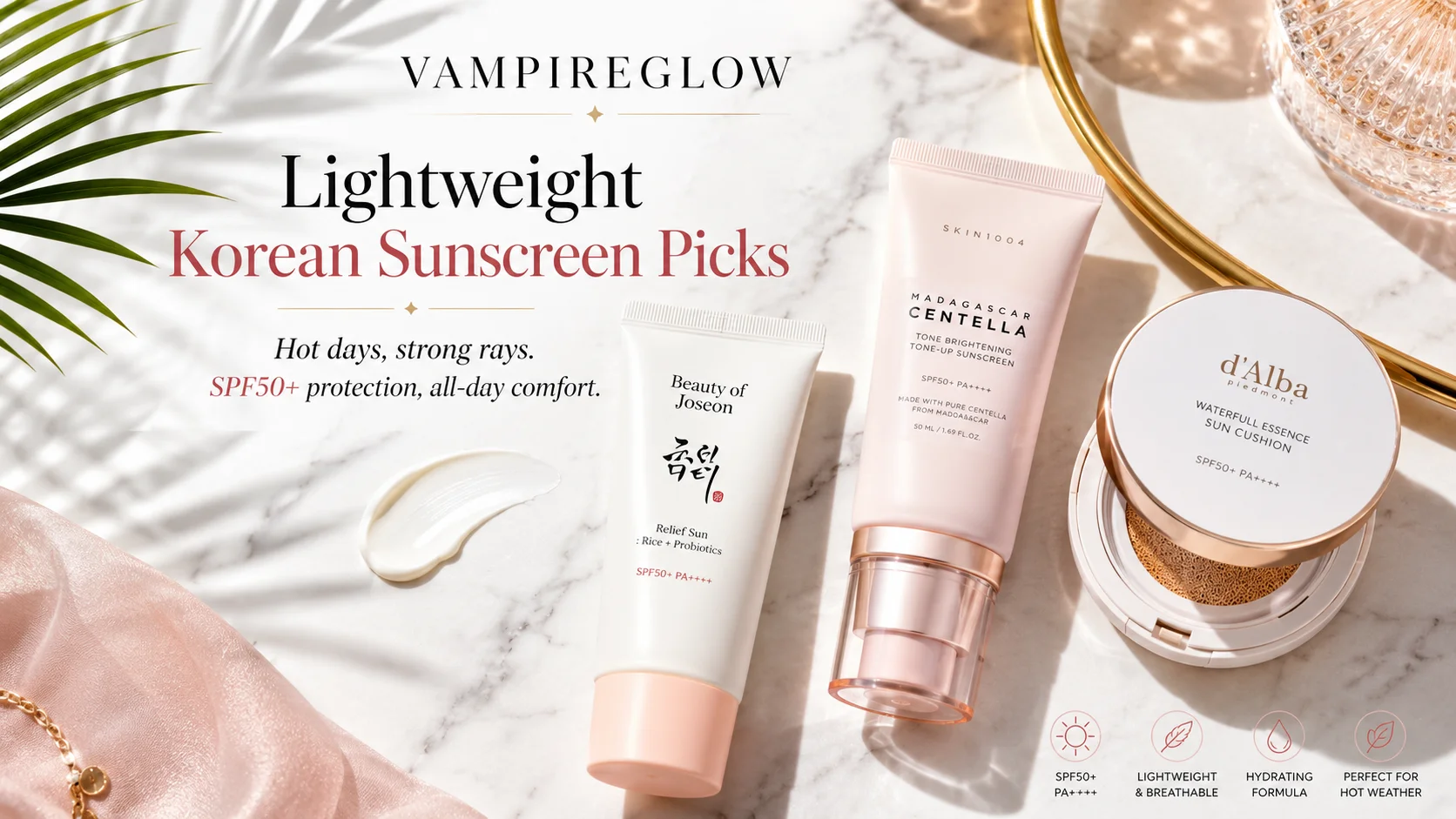
Best Korean Sunscreen for Saudi Arabia: Lightweight SPF50+ Picks
In Saudi Arabia, sunscreen isn’t optional. The country sits in one of the highest UV-exposure zones in the world, and the sun doesn’t soften in winter the way it does in Europe or North America. Year-round intense UV, long daylight hours, and outdoor temperatures that push skin to its limits mean SPF isn’t a summer product here. It’s a daily necessity with consequences when you skip it.
Table of Contents
- Why Korean Sunscreen Is Different
- Who Should Use This Guide
- Benefits of Korean Sunscreen for Saudi Arabia's Climate
- Understanding SPF and PA Ratings on Korean Sunscreen
- Chemical vs Physical: Which Korean Sunscreen Is Right for You
- What to Look for in a Korean Sunscreen for Saudi Arabia's Heat
- How to Apply Korean Sunscreen Correctly
- How Often to Use It
- Aftercare Tips: Making Korean Sunscreen Work All Day in Saudi Arabia
- Possible Side Effects and Precautions
- What Does Korean Sunscreen Cost
- Why Choose Vampire Glow
- FAQs
- Shop Korean Sunscreen at Vampire Glow
The problem most people run into is the texture. Western sunscreens that work beautifully in moderate climates can feel like a layer of warm plastic on your face in Riyadh’s July heat. Greasy finish, visible white cast, pilling under makeup, stinging eyes when you sweat. And so sunscreen gets skipped, not because people don’t know they need it, but because the product experience is bad enough that it doesn’t survive the morning routine.
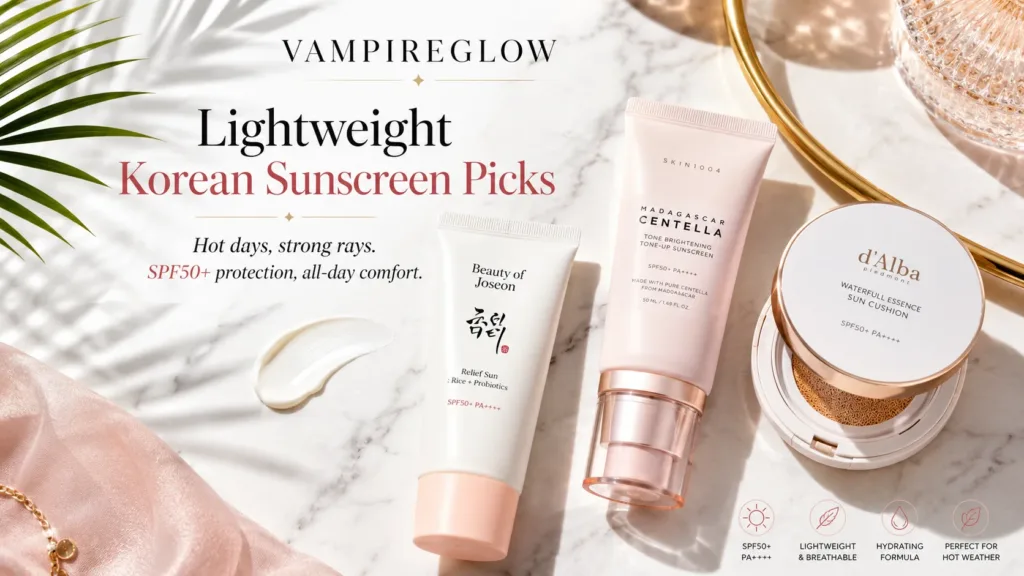
Korean sunscreen solves most of those problems. The formulation technology has evolved significantly beyond what most international brands offer, with finishes that genuinely disappear into skin and textures light enough to wear under makeup, under a hijab, or on a bare face in full sun. This guide explains what to look for, how to tell a good formula from a mediocre one, and which qualities matter most for Saudi Arabia specifically.
Why Korean Sunscreen Is Different
Korean sunscreen development has been driven by two things: a skincare culture that treats daily SPF as a fixed routine step, and access to UV filter technologies that are approved in South Korea and Japan but not in the United States. The result is a generation of formulas that protect effectively while finishing more like a serum or primer than a traditional sunscreen.
European-approved UV filters like Tinosorb S and Tinosorb M provide broad-spectrum coverage with lighter textures than older-generation American chemical filters. Many Korean formulas combine these with antioxidants, hydrating actives and skin-calming ingredients, turning a product that exists purely for protection into something that also supports the skin underneath.
For oily and combination skin types in Saudi Arabia’s heat, Korean sunscreens designed for a dewy or matte finish make SPF something you’re willing to put on every day rather than avoid because of how it feels by 10am. Browse the current sunscreen and skin care range at Vampire Glow to see what’s in stock.
The sunscreen stocked at Vampire Glow is the 3W Clinic UV Sun Block BB Cream at SPF50+ PA+++, which doubles as a light base so sun protection and coverage happen in one step.
Who Should Use This Guide
Anyone living in or visiting Saudi Arabia who struggles to wear sunscreen consistently because of texture, finish or weight. Specifically useful if you have oily or combination skin that reacts badly to heavy formulas, if you wear makeup over SPF and have experienced pilling, if you wear a hijab and need a finish that doesn’t feel suffocating in heat, or if you’ve tried physical sunscreens and can’t get past the white cast.
Dry and sensitive skin types also benefit from Korean SPF, since many formulas include hydrating and calming ingredients that support rather than deplete the skin during long outdoor days. Those with diagnosed photosensitive skin conditions should consult a dermatologist before switching products.
Benefits of Korean Sunscreen for Saudi Arabia’s Climate
- Lightweight textures absorb quickly and don’t add visible grease in heat
- Many formulas leave no white cast, which matters for a range of skin tones common across the GCC
- Advanced UV filter combinations (chemical and some physical blends) provide genuine broad-spectrum SPF50+ protection
- PA++++ rated formulas offer the highest category of UVA protection under the Asian grading system
- Skin-supporting ingredients in the formula mean SPF doubles as a last skincare step rather than sitting on top of everything else
- Finishes range from matte to satin to subtle glow, so there’s a texture that works under every kind of daily routine
- Non-comedogenic formulas designed not to clog pores, which matters in heat where pores are already open and skin is sweating
Understanding SPF and PA Ratings on Korean Sunscreen
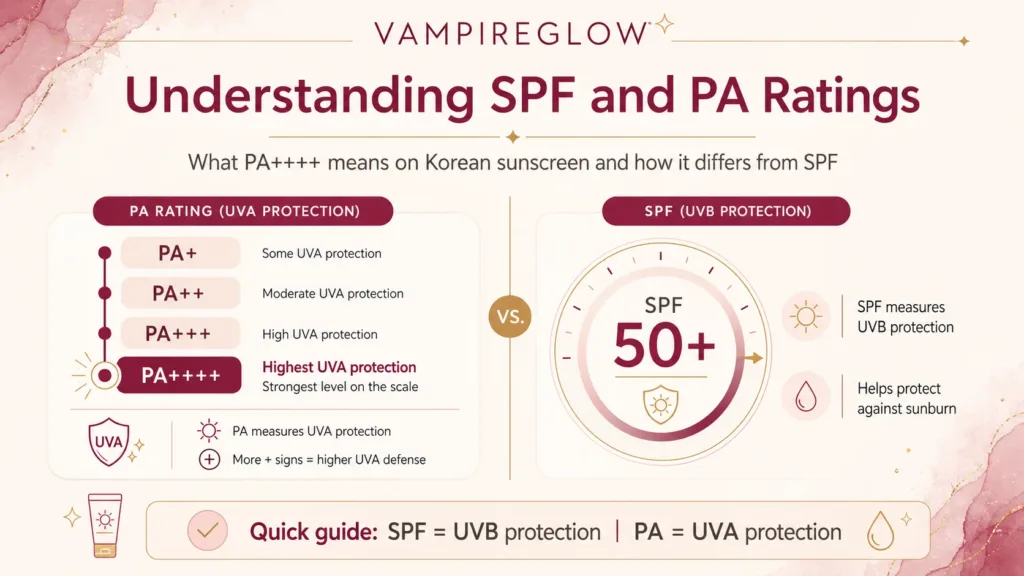
Korean sunscreen packaging uses two rating systems that some buyers in Saudi Arabia encounter for the first time.
SPF (Sun Protection Factor) measures UVB protection, the rays responsible for burning. SPF50 blocks roughly 98 percent of UVB. SPF50+ indicates the formula has been tested above SPF50, the standard used across Korean, Australian and European products for maximum UVB protection.
PA (Protection Grade of UVA) is the Asian UVA protection system, ranging from PA+ to PA++++. PA++++ is the highest available and indicates broad and substantial protection against UVA rays. UVA penetrates glass, reaches deeper into the skin, and is responsible for long-term pigmentation, collagen breakdown and photoaging. In Saudi Arabia’s year-round sun, PA++++ matters as much as the SPF number. Look for both on any Korean sunscreen you consider.
A product labelled SPF50+ PA++++ is the full package. Both systems together indicate broad-spectrum protection at the highest tested levels.
Chemical vs Physical: Which Korean Sunscreen Is Right for You
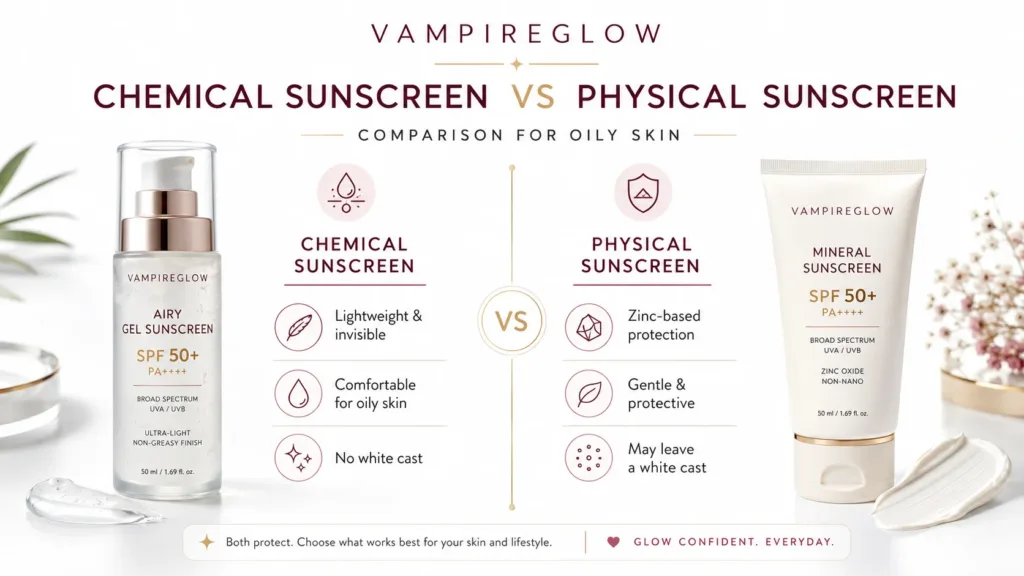
| Chemical (Organic) Sunscreen | Physical (Mineral) Sunscreen | |
| How it works | Absorbs UV and converts it to heat | Sits on skin and reflects UV away |
| Key ingredients | Avobenzone, Tinosorb S, Helioplex, Uvinul | Zinc oxide, titanium dioxide |
| Texture in Saudi heat | Lightweight, absorbs fast, no residue | Can feel thicker, higher white cast risk |
| Finish | Satin, matte or dewy depending on formula | More matte, sometimes chalky on dark skin |
| White cast | Minimal to none in most Korean formulas | Present in higher concentrations |
| Good for | Oily, combination, everyday wear under makeup | Sensitive, reactive skin, children |
| Time to protection | Needs 15 to 20 minutes to activate | Protects immediately on application |
| Best climate fit | Excellent for Saudi Arabia’s heat and sweat | Works but heavier textures can struggle in extrem heat |
For most oily and combination skin types in Saudi Arabia, a well-formulated Korean chemical or hybrid (chemical plus low-concentration mineral) sunscreen delivers better all-day wear than a pure physical formula. Sensitive skin or skin reactive to chemical filters may prefer a Korean mineral formula, which has improved significantly in texture and reduced white cast compared to older generations.
What to Look for in a Korean Sunscreen for Saudi Arabia’s Heat
With dozens of options available, these are the qualities that actually matter for this specific climate.
SPF50+ PA++++. Non-negotiable. Anything lower is underprotecting in Saudi Arabia’s UV index.
Water-resistant rating. If you’re outdoors, sweating, or at the beach, water resistance determines how long the protection holds. Look for this on the label and reapply regardless.
Non-comedogenic formula. Clogging pores in the heat, especially under a headscarf, leads to breakouts. Check the label or product description.
Lightweight, fast-absorbing texture. Milky, gel, essence or serum-type textures absorb without pilling and don’t fight with makeup applied on top.
No white cast, or a minimised white cast. This matters for darker skin tones, for wearing makeup over SPF, and for the kind of clean finish that Saudi Arabia’s heat doesn’t forgive. Korean formulas using Tinosorb S or hybrid filters typically achieve this better than traditional physical formulas at high concentrations.
Skin-supportive actives. Niacinamide for pore care, centella for calming, hyaluronic acid for light hydration. Many Korean sunscreens include these, turning a protective step into a functional skincare one.
Browse the skin care range at Vampire Glow to compare current formulas. The 3W Clinic and MISSHA brand archives are worth checking, since both carry established SPF lines that have been available in Korean skincare for years.
How to Apply Korean Sunscreen Correctly
Application technique changes how well a sunscreen actually works, and most people use significantly less than the amount the SPF rating was tested at.
Use the right amount. The standard dermatological guideline is two milligrams per square centimetre of skin, which translates to about a quarter to a half teaspoon for the face alone. A thin layer applied with one finger swipe is usually not enough. The American Academy of Dermatology consistently cites under-application as one of the main reasons SPF underperforms in real conditions.
Apply as the last step of your morning routine. After moisturiser, before makeup. Allow it to absorb for one to two minutes before applying any base products on top.
Don’t rub aggressively. Pat or press the formula in rather than rubbing it across the face. Rubbing can drag it unevenly and reduce the effective layer.
Apply to all exposed areas. Ears, neck, the back of hands, any skin exposed to sun. These are the areas most people skip and the first to show UV damage over time.
Reapply during the day. SPF degrades with UV exposure, sweat and touch. Reapply every two hours if outdoors, or after swimming or heavy sweating. SPF cushions and powder SPF products make midday reapplication easier without disturbing makeup.
How Often to Use It
Daily. Every single morning, regardless of whether you’re going outdoors. UV penetrates windows, passes through glass in cars, and accumulates over time even during brief exposure on a commute or a walk to the car. Saudi Arabia’s UV index stays high year-round, not just in the peak summer months.
For reapplication, the guideline is every two hours of outdoor exposure, or immediately after significant sweating or water exposure. Midday reapplication is easier with a cushion compact or spray format SPF product rather than a full reapplication of a cream over makeup.
Aftercare Tips: Making Korean Sunscreen Work All Day in Saudi Arabia
Do carry a small SPF cushion or reapplication product for midday touch-ups rather than going unprotected after your morning application wears down. Do allow sunscreen to fully absorb before applying makeup, since rushing this step is the main cause of pilling. Do apply sunscreen to the neck and décolleté every day, not just the face.
Don’t layer sunscreen on top of another sunscreen product that claims SPF. The two formulas can interact unexpectedly and the combined SPF is not additive in the way the numbers suggest. One well-chosen, correctly applied formula is more effective than two stacked ones. Don’t store your sunscreen in a hot car, glove compartment or in direct sunlight, since heat degrades the UV filters over time and the protection weakens before the bottle runs out.
Possible Side Effects and Precautions
Chemical UV filters cause sensitivity reactions in a small number of people, typically presenting as redness, stinging or a rash. If this happens, switch to a mineral-based formula with zinc oxide. Anyone with a diagnosed allergy to benzophenone or similar filter families should check product ingredient lists carefully before purchasing.
Patch test any new sunscreen formula on the inner arm before applying to the full face. This is especially important for sensitive or reactive skin types.
Some sunscreens contain fragrance, alcohol or botanical extracts that can irritate reactive skin in heat. Look for fragrance-free options if sensitivity is a concern. Anyone pregnant or breastfeeding should confirm with a doctor which UV filters are considered appropriate before purchasing a new formula.
What Does Korean Sunscreen Cost
Pricing depends on a few real factors rather than a single fixed number.
- Bottle or tube size and how long it lasts at the correct daily application amount
- Whether you’re choosing a dedicated facial SPF, a tinted formula or a body SPF, since pricing differs
- Currency and region: Vampire Glow shows prices in AED for Gulf shoppers and in USD for other regions
- Delivery destination within Saudi Arabia or the wider GCC
Check live prices directly on the product pages, since they update and differ by region. Sunscreen is one category where going slightly higher quality is worth the investment, since the texture difference between a good and a mediocre formula is what determines whether you’ll actually use it daily.
Why Choose Vampire Glow
- Authentic Korean brands, batch codes and expiry dates checked on arrival
- Curated specifically for Gulf skin and Gulf climate conditions, not a generic global catalogue
- Cruelty-free brands only
- Delivery across the UAE and the wider GCC, including Saudi Arabia, confirmed at checkout
- Ingredient lists and usage notes on every product page so you know exactly what you’re buying
Related reading
- Adjusting your routine for summer heat and air conditioning
- How morning and night routines should differ
- The best Korean skincare for oily skin in hot weather
- The best Korean dark spot serums for hyperpigmentation
FAQs
What is the most lightweight sunscreen for everyday wear? Korean chemical and hybrid sunscreens are consistently among the lightest available. The most lightweight formulas are typically milky emulsions, essence-type textures or gel formulas that absorb within 30 to 60 seconds and leave almost no residue. The lightest physical sunscreens use low concentrations of zinc oxide blended with silicones to reduce the chalky feel, though they’re rarely as light as a well-formulated chemical sunscreen. For Saudi Arabia’s heat, a fast-absorbing Korean formula rated SPF50+ PA++++ is the practical starting point.
What is the best Korean physical sunscreen? The best Korean mineral sunscreen for most people balances adequate zinc oxide concentration for real UVA protection against a white cast that isn’t visible on the skin. Korean brands have improved this considerably, with micronised zinc formulas that tone-adapt better than older generations. Sensitive skin, reactive skin and anyone who can’t tolerate chemical UV filters benefit most from mineral options. Browse the skin care range at Vampire Glow for current mineral and hybrid formula stock.
Which Korean sunscreen is best for the face? For the face specifically, the key criteria are no white cast, a non-comedogenic formula that won’t clog pores in the heat, SPF50+ PA++++ protection, and a finish that sits cleanly under or without makeup. Many Korean facial sunscreens include skin actives like niacinamide or centella that support the skin underneath the SPF layer. Brands with established SPF lines include 3W Clinic and MISSHA, both stocked at Vampire Glow.
What does PA++++ mean on Korean sunscreen? PA stands for Protection Grade of UVA, a rating system developed in Japan and used widely across Korean and Asian skincare markets. The plus signs indicate the level of UVA protection, from PA+ at the lowest end to PA++++ at the highest. PA++++ means the product has been tested and verified to provide the maximum available protection against UVA rays, the type responsible for photoaging, deep pigmentation and long-term skin damage. In Saudi Arabia’s year-round UV conditions, PA++++ is the standard to look for.
Can I skip moisturiser and just use Korean sunscreen in Saudi Arabia’s heat? Some Korean SPF formulas are hydrating enough to work as a final moisturising step on oily or combination skin in warm weather. Whether you can skip a separate moisturiser depends on the specific formula and your skin’s hydration needs. Dry skin types almost always need a separate moisturising step underneath. Oily skin on humid or very hot days may find a hydrating SPF formula is sufficient as the last step. Check the product description and try it on a few dry AC days versus outdoor days to see how your skin responds.
Does Vampire Glow ship Korean sunscreen to Saudi Arabia? Yes. Vampire Glow delivers across the UAE and the wider GCC, including Saudi Arabia. Delivery options and timelines are confirmed at checkout for your specific region. Shop the current sunscreen and skin care range and find your formula before the order goes in.
Shop Korean Sunscreen at Vampire Glow
Saudi Arabia’s UV doesn’t wait for you to find the perfect formula. A Korean SPF50+ PA++++ product with a lightweight finish is one of the highest-impact changes you can make to your routine, because protection applied consistently beats a technically superior formula left in the drawer. Browse the Vampire Glow skin care range to find current stock, compare formulas by texture and skin type, and get it delivered across the GCC. Questions about which SPF fits your routine? Email the team at support@vampireglow.com.
About author