
Hair Shedding vs Breakage: How to Tell Them Apart
You find hair on the brush, in the shower drain and on your pillow, and you wonder: is it falling out, or snapping off? Hair shedding vs breakage matters because the two have different causes and need different fixes. Shedding comes from the root. Breakage happens along the strand, so the hair is shorter and the root stays put.
This guide covers how much hair fall is normal for a woman, how to check the hairs you find, how to tell if short hairs are new growth or breakage, which nutrients are linked to shedding, and how to read the stages of hair loss.
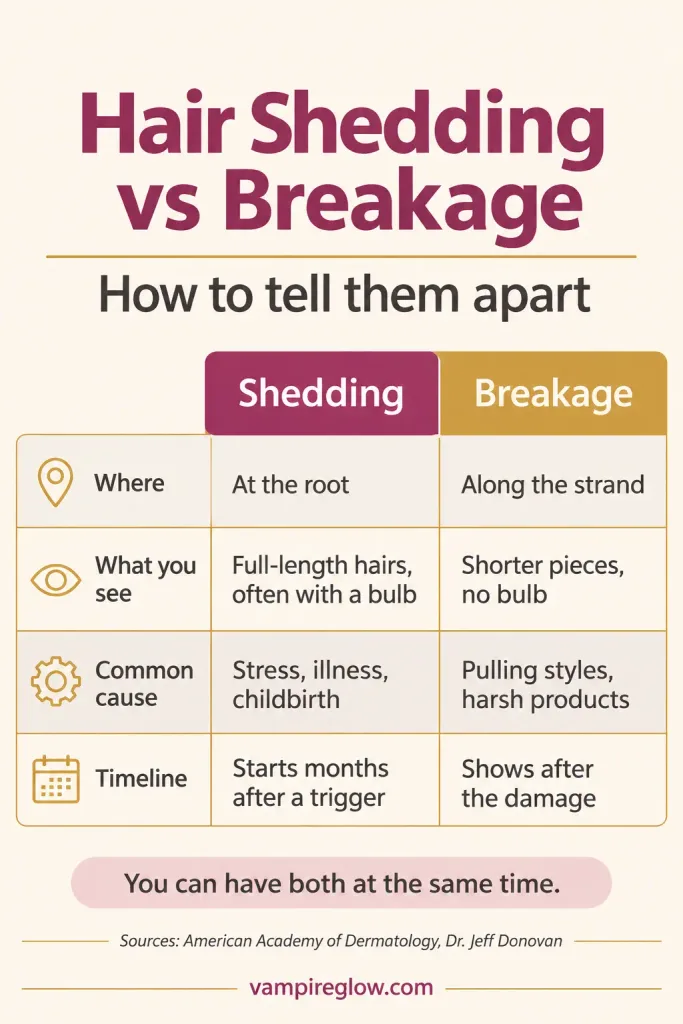
Hair Shedding vs Breakage: The Quick Difference
| Shedding | Breakage | |
| Where it happens | At the root | Along the strand |
| What you see | Full-length hairs, often with a small bulb at the root end | Shorter pieces with no bulb |
| Typical cause | A trigger such as stress, illness, childbirth or crash weight loss | Pulling hairstyles, harsh products, rough handling |
| Usual timeline | Often begins a few months after the trigger | Shows after the damage happens |
| Where you notice it | Overall thinning or a heavier brush | Frizz, split ends, short flyaways |
The American Academy of Dermatology (AAD) calls excess shedding telogen effluvium and says it is usually temporary. Hair tends to regain its normal fullness within six to nine months, though ongoing stress can prolong it. The AAD also says simple hair-care changes can prevent breakage that can eventually cause hair loss.
The bulb detail in the table is a general observation, not a diagnostic test. If you are worried, a dermatologist can look at your scalp and tell you which one you have, or whether you have both.
What Is a Normal Amount of Hair Fall Per Day for a Woman
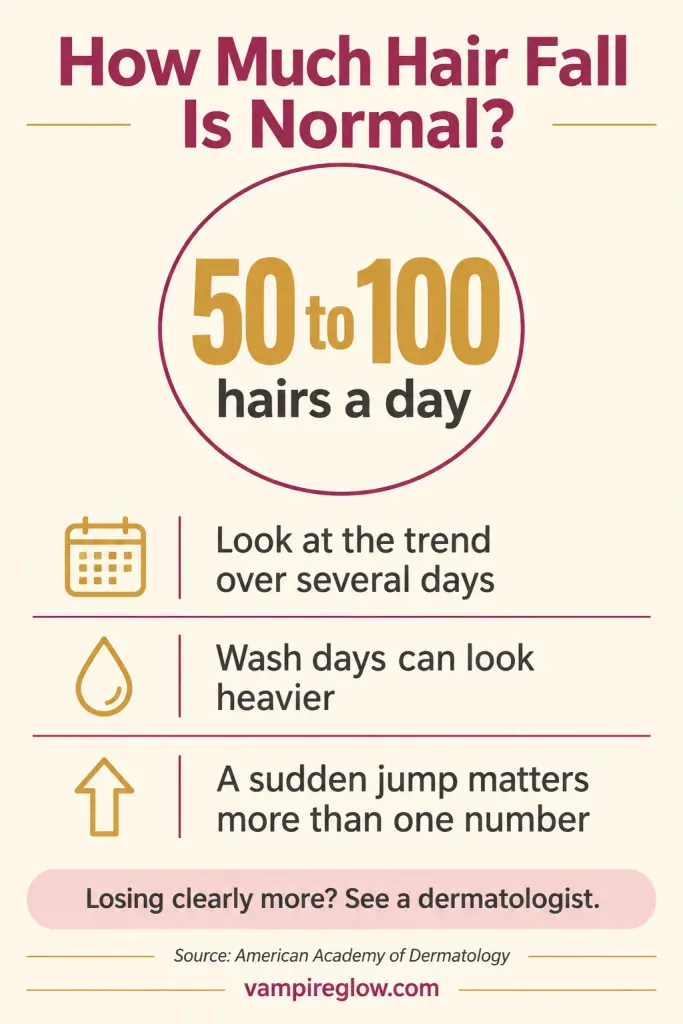
The AAD says it is normal to shed between 50 and 100 hairs a day. It does not give a separate figure for women, so the same range applies. Shedding beyond that is what the AAD calls telogen effluvium.
Counting is harder than it sounds, because many of those hairs fall in the shower or during brushing. Three tips, which are my suggestions, not clinical rules:
- Look at the trend over several days, not one day.
- Notice wash days. Hair that has been building up for a few days can come out at once.
- Compare against your own normal. A sudden jump matters more than a single number.
If you are losing clearly more than usual, or you can see your scalp more than before, book a dermatologist visit rather than guessing.
How to Tell Hair Shedding vs Breakage at Home
Collect a few days of hairs from your brush, then lay them on a white towel and look closely.
- Check the root end. A shed hair usually has a tiny bulb at one end. A broken piece has no bulb.
- Check the length. Shed hairs are close to your full length. Broken pieces are often much shorter.
- Check the tips. Frayed, split or uneven ends point to breakage.
- Check the pattern. Overall thinning across the scalp suggests shedding. Short hairs scattered around the hairline or crown, or snapped ends in the mid-lengths, suggest breakage.
You can have both at the same time. A hair clinic article by dermatologist Dr. Jeff Donovan makes the same point about short hairs: both kinds can appear together.
Short Hairs: New Growth or Breakage
This is where most people get confused. Dr. Donovan, a board-certified dermatologist who focuses on hair loss, gives one criterion: regrowing hairs end in a sharp, pointy tip, like a fresh blade of grass. Broken hairs end in a blunt, uneven edge, like grass that has been cut.
So the check is simple. Pick a short hair from your hairline or part and look at the tip under bright light. If it tapers to a fine point, it is probably new growth. If it ends flat or jagged, it is probably broken. That source does not cover length or texture, so do not rely on those alone.
Common Causes of Shedding and Breakage
Shedding triggers. According to the AAD, these include losing 20 pounds or more, childbirth, high stress, high fever, surgery, recovery from illness and stopping birth-control pills. Shedding often begins a few months after the trigger, so the cause may not be obvious.
Breakage and loss triggers. The AAD lists hairstyles that pull on the hair and harsh hair-care products among the causes of hair loss, and notes that breakage can eventually cause loss. In my view, hot tools and rough towel-drying belong on that list too, though the AAD page does not name them.
Other causes, such as hereditary hair loss, an immune reaction or some drugs, need a dermatologist to sort out. Do not stop a medicine you suspect is causing hair loss without speaking to your doctor first, because the AAD warns that serious side effects can follow if you stop suddenly.
What Vitamin Is Lacking If Your Hair Is Falling Out
No single vitamin explains hair fall. A US dermatology practice article quotes Dr. Esther Henebeng, MD, FAAD, and names five nutrients that are linked to hair loss when they are low:
- Iron (ferritin): low stored iron is tied to shedding and slower regrowth, and it is common in menstruating women, vegans and vegetarians.
- Vitamin D: linked to the hair growth cycle, and low levels are commonly seen in people with alopecia areata.
- Zinc: deficiency is associated with shedding and a dry, flaky scalp.
- Vitamin B12: most common in older adults, vegans, vegetarians and people with digestive disorders.
- Biotin: true deficiency is rare, but it can occur with long-term antibiotic use, Crohn’s disease or regular raw egg white consumption.
The same source advises against self-diagnosis. It recommends asking a dermatologist to test for deficiency and recommend specific supplements, and warns that relying on supplements alone can do more harm than good. The AAD also says supplements for hair loss have mixed evidence. In practice: get tested first, then fix what is actually low.
How to Identify the Stage of Hair Loss
First, work out which type you are dealing with.
- Shedding (telogen effluvium): sudden, widespread, and often starts months after a trigger. It is usually temporary.
- Female pattern hair loss: the AAD says it is the most common cause of hair loss in women. A widening part is often the first sign, hair near the temples may recede, and a ponytail may look thinner. It usually starts in midlife but can begin earlier, and it runs in families.
For pattern loss, clinics often use the three-stage Ludwig scale. This description comes from Kopelman Hair, a hair restoration clinic, so treat it as the practice’s own view:
- Stage I: early thinning around the centre part, with volume mostly intact.
- Stage II: the part looks wider and the top of the head is less dense.
- Stage III: thinning across the crown, with the scalp clearly visible.
You cannot confirm a stage yourself. Other conditions can look like female pattern hair loss, so the AAD says a dermatologist should confirm the diagnosis, and that early treatment works best.
Hair Shedding vs Breakage in Gulf Heat and Air Conditioning
The climate here does not cause hair shedding vs breakage on its own, but it can add stress to the hair you already have. These points are my reasoning, not study results.
- Sun, chlorine and sea water dry the strand, which can make mid-length breakage more likely over a summer.
- Cold air conditioning and hot outdoor air can leave the scalp feeling tight or flaky, which is easy to mistake for a shedding problem.
- Tight buns and ponytails under hijabs, scarves or caps can add pull at the hairline. The AAD lists pulling hairstyles as a cause of hair loss.
- Heat styling in short bursts is easier on hair than daily high heat.
Nothing here replaces a medical check if the shedding is sudden or heavy.
Hair Care at Vampire Glow
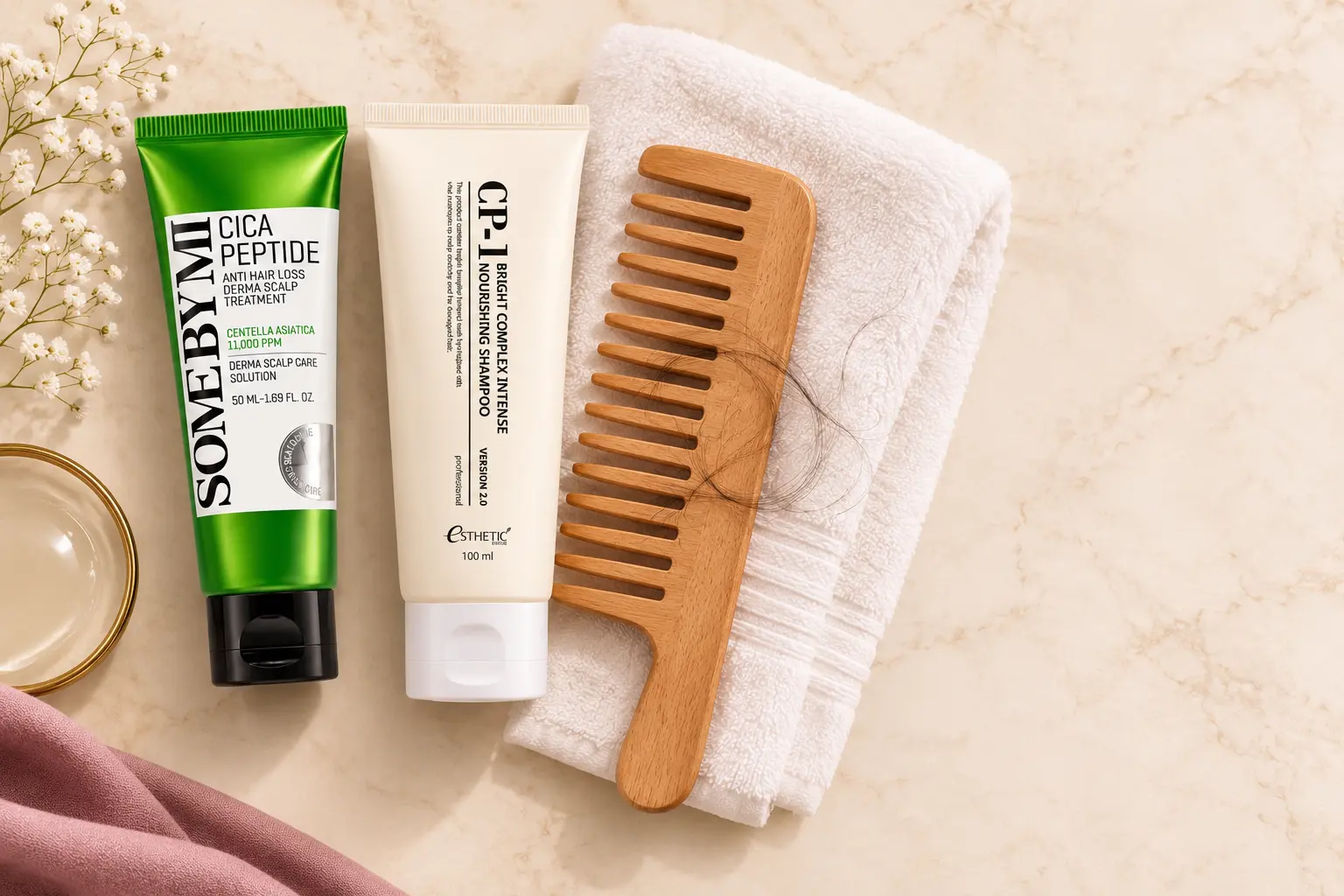
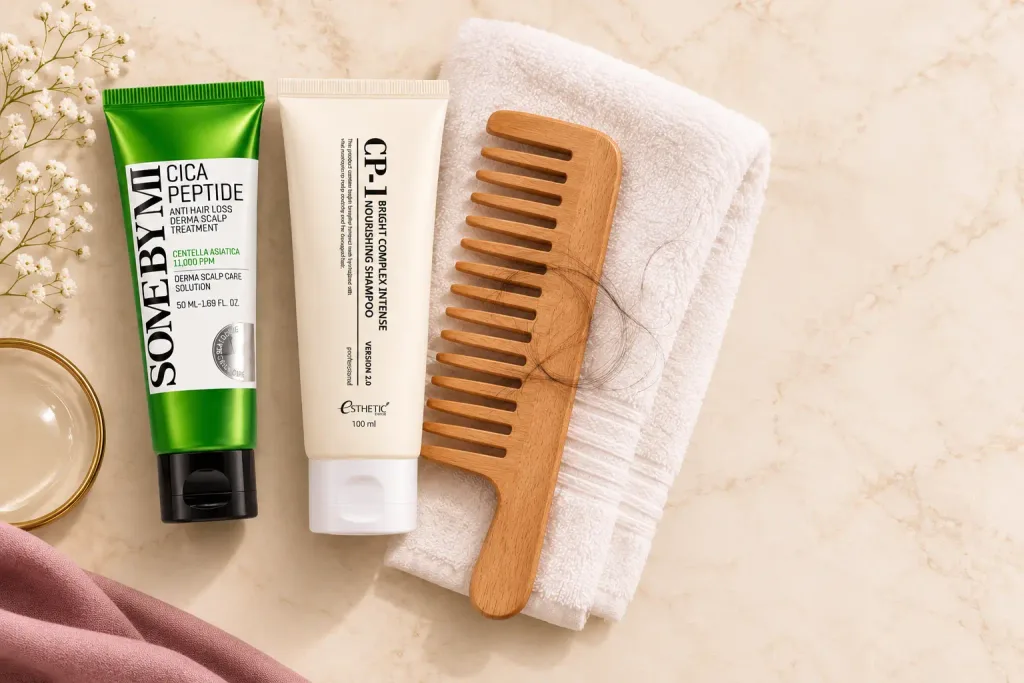
We do not have a product that treats shedding, and no shampoo can regrow hair. The AAD says plainly that hair loss shampoos cannot regrow hair. These are scalp and hair-care products you can use alongside a dermatologist’s advice:
- Cica Peptide Scalp Treatment. A 50 ml scalp and hair cream. The product page lists centella asiatica extract, madecassoside, peptides, biotin, panthenol, menthol, salicylic acid and zinc pyrithione, plus fragrance. The page describes use on wet hair for 2 to 3 minutes, then rinse. Its claims about reducing hair fall are brand marketing, not clinical results. Patch test first, and skip it if your scalp is irritated. To read more about the ingredient, see our guide to centella asiatica benefits.
- CP-1 Bright Complex Nourishing Shampoo. A 100 ml shampoo for dry or damaged hair. The ingredient list includes wheat protein, oils, keratin amino acids and fragrance, and it also lists sulfate cleansers, so check the pack if you avoid them. It is a cleanser for damaged lengths, not a treatment for shedding.
- Marine Collagen Peptide Powder with Biotin. A drink-mix supplement. The full ingredient list is on the pack, and it is made from marine collagen, so check the label if you have fish or shellfish allergies. The page’s hair claims are marketing, not clinical evidence. Speak to your doctor before starting any supplement, especially if you are pregnant, breastfeeding or on medication, and follow the label.
Delivered across Saudi Arabia, the UAE and the wider GCC.
When to See a Dermatologist, and Precautions
The AAD encourages you to see a dermatologist if you are worried about how much hair you are losing, or to find out whether you have hair loss, excess shedding or both. See someone sooner if shedding is sudden, patchy or painful, if your scalp is red, sore or scaly, or if your part is visibly widening.
Patch test any new scalp product on a small area first. Stop using it and wash it off if you notice itching, burning or stinging. Do not take supplements for hair loss without a doctor’s advice, and never exceed the label amount. This guide is educational and does not replace medical care.
FAQs
What is the normal daily hair fall for a woman? The AAD says it is normal to shed between 50 and 100 hairs a day. It does not give a different number for women. Count the trend over several days, and see a dermatologist if you are clearly losing more than usual.
What is a normal amount of hair loss per day? Between 50 and 100 hairs a day is normal, per the AAD. Shedding beyond that is called telogen effluvium. Many of those hairs come out in the shower or while brushing.
What vitamin is lacking if my hair is falling out? There is no single vitamin. Low iron (ferritin), vitamin D, zinc and vitamin B12 are linked to shedding, and true biotin deficiency is rare. A dermatologist can test for deficiency, and you should avoid guessing with supplements.
How to identify hair loss stage? First decide whether it is shedding or pattern loss. For pattern loss, a widening part is often the first sign, and clinics use the three-stage Ludwig scale from early thinning to a visible scalp. A dermatologist should confirm the diagnosis.
How to tell if short hairs are new growth or breakage? Check the tip. New growth ends in a sharp, tapered point. Broken hair ends in a blunt, uneven edge. Both can appear together.
How long does hair shedding last? The AAD says hair usually regains its normal fullness within six to nine months, though ongoing stress can prolong shedding.
Does stress cause hair shedding? Yes. The AAD lists high stress among the common shedding triggers, and shedding often begins a few months afterwards.
Is hair shedding the same as hair loss? Not exactly. The AAD describes shedding as usually temporary, while hair loss happens when something stops hair from growing, and the hair will not regrow until the cause is addressed.
Can a shampoo stop hair shedding? No. The AAD says hair loss shampoos cannot regrow hair. A gentle shampoo can help keep hair and scalp comfortable, but a dermatologist should look into the cause of shedding.
Should I take biotin for hair fall? Only on a doctor’s advice. True biotin deficiency is rare, and the AAD says supplements for hair loss have mixed evidence. Test first and follow the label.
Can breakage turn into hair loss? The AAD says simple hair-care changes can prevent breakage that can eventually cause hair loss. Loosening tight styles and using gentler products are good first steps.
Check the Tip, Then Check the Cause
Hair shedding vs breakage comes down to where the hair lets go: at the root or along the strand. Check the tips, count the trend, and see a dermatologist if the change is sudden or heavy.
Explore our hair care picks at Vampire Glow, delivered across Saudi Arabia, the UAE and the wider GCC.


About author