
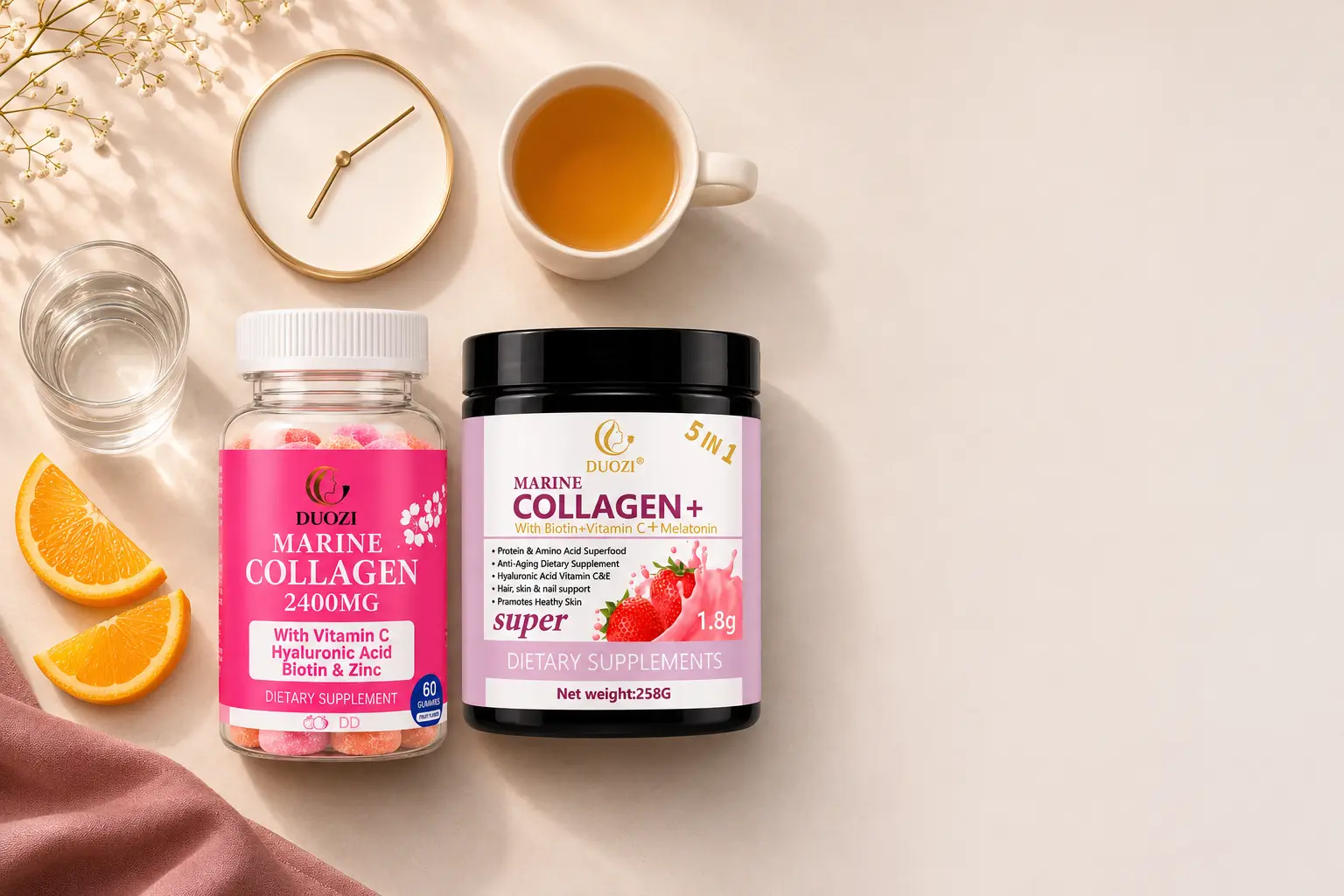
Best Time to Take Collagen: Morning, Night or With Food
Everyone has a different answer. One brand says morning, another says bedtime, a third says empty stomach. The honest answer is less exciting: the best time to take collagen is the time you will actually stick to, because the evidence for one clock time beating another is thin.The best time to take collagen depends on your daily routine, supplement format and what helps you stay consistent.
This guide covers what dietitians and studies say about morning, night and food, whether an empty stomach helps, how vitamin C fits in, what “collagen deficiency” really means, how long to wait before you judge results, and how to choose a supplement.Many people choose morning as the best time to take collagen because it is easy to include in their breakfast routine.If evenings suit your schedule better, the best time to take collagen can simply be after dinner or before bedtime.
The Best Time to Take Collagen: The Short Answer
Two registered dietitians quoted by EatingWell disagree slightly on timing but agree on the main point: consistency matters more than the exact hour. Their views, in brief:
- Morning: may suit skin elasticity and gut health, per dietitian Diana Nguyen.
- Evening: may suit muscle and joint recovery, because the body repairs itself during sleep, per the same dietitian. Another dietitian, Ayat Sleymann, cites a very small study linking evening collagen to better sleep, and the article says more research is needed.
- Around training: studies suggest one hour before or after resistance training for muscle health, but the article does not name them.
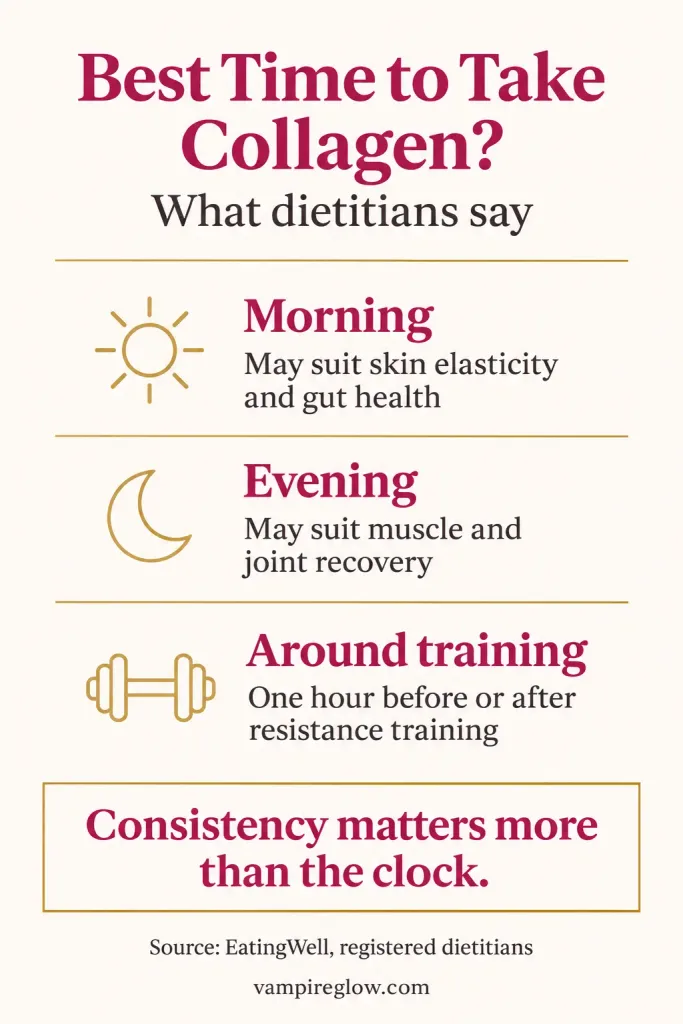
So if your goal is skin, pick a time you can repeat daily. Do not change your routine because a label says “night formula” or “morning ritual”. Those are marketing choices, not proven rules.
Morning, Night or With Food: Which Fits You
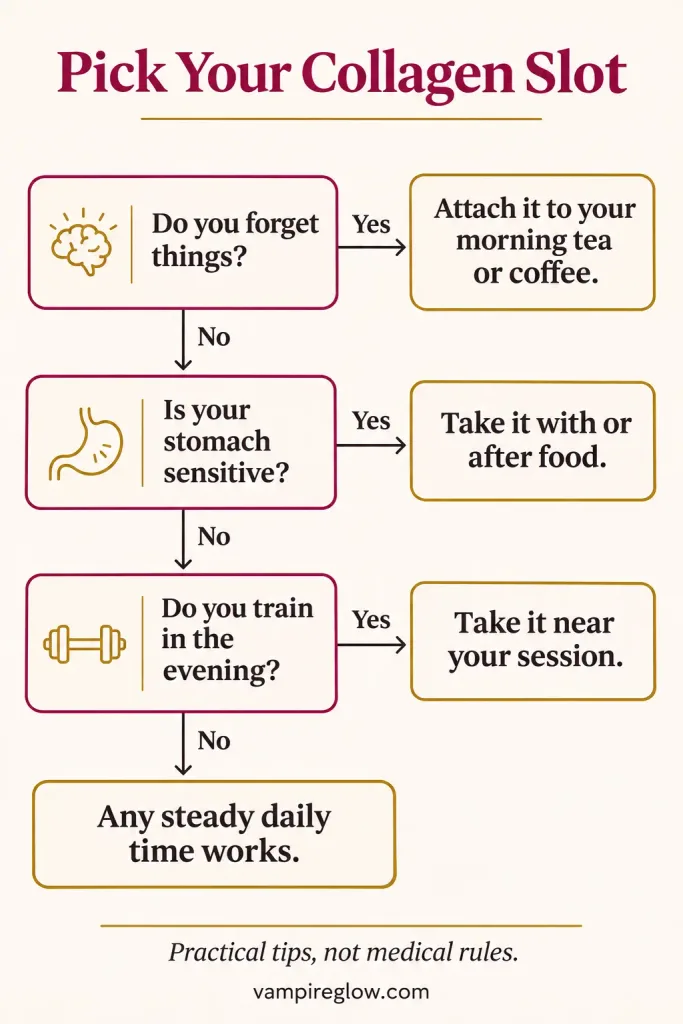
Use these as practical starting points, not medical rules.
- You forget things. Attach it to something you already do, such as your morning coffee or tea, or your evening wind-down.
- You have a sensitive stomach. Take it with or after food. This is my suggestion; no source tests it.
- You train in the evening. Take it near your session if muscle recovery is part of your goal, in line with the dietitians’ training advice.
- You take other supplements. Keep the timing simple and ask your pharmacist or doctor if you take medicines. The EatingWell article notes that medicines that lower stomach acid may affect protein digestion.
One more point: collagen is a protein. Whole-food protein and vitamin C-rich foods still matter, and supplements are not a replacement for them.
Collagen on an Empty Stomach: Is There a Benefit
We did not find a reliable source showing that an empty stomach improves collagen results. The EatingWell article does not address it. The one relevant detail is that stomach acid helps break down protein, which is about digestion in general, not a timing trick.
Many people prefer a morning drink before food because it is easy to remember. If that works for you and you feel fine, there is no evidence that it hurts. If it makes you nauseous, move it to after a meal. The right answer is the one your stomach tolerates.
Collagen, Vitamin C and the Form You Choose
Your body needs vitamin C to build collagen. The US National Institutes of Health says vitamin C is required for collagen biosynthesis, and low vitamin C weakens connective tissue. The adult recommended intake is 75 mg a day for women and 90 mg for men, with 35 mg more for smokers.
The EatingWell article notes that collagen supplements often include 80 to 150 mg of vitamin C, and it recommends vitamin C-rich foods. It does not say whether the two must be taken at the same moment. A practical approach: have collagen with a meal that includes fruit or vegetables, and do not megadose vitamin C. High doses commonly cause stomach upset, and the NIH sets an upper limit of 2,000 mg a day for adults.
Form matters too. According to registered dietitian Dana Angelo White, writing for the Academy of Nutrition and Dietetics, powders typically provide about 20 g of peptides per quarter cup, while gummies provide roughly 1 to 2 g per piece. Always follow the serving on the label, and do not take more than it says.
Signs of Collagen Deficiency
Here the sources are honest about what they do not say. We found no recognised everyday test or checklist for “collagen deficiency” in the dermatology sources we read. What they do say:
- Cleveland Clinic dermatologist Dr. Shilpi Khetarpal says that starting in our mid-20s, we make less collagen every year.
- Smoking, heavy alcohol use, sun and other environmental factors can lower collagen or break it down.
So visible changes such as less bounce, finer lines and drier skin are common with age and sun exposure, and they are not a diagnosis. Persistent joint pain, easy bruising, slow wound healing or skin that stretches unusually are different. Those need a doctor, not a supplement. That last point is general advice, not from the sources above.
What Are the First Signs Collagen Is Working
There is no instant sign, and the studies measure skin, not feelings. A systematic review of 11 randomised, placebo-controlled trials with 805 patients (Choi and colleagues, Journal of Drugs in Dermatology, 2019) found that oral collagen increased skin elasticity, hydration and dermal collagen density. The trials ran from about 4 to 24 weeks.
The Academy of Nutrition and Dietetics article similarly links 8 to 24 weeks of oral use to better wound healing and skin elasticity.
What this means in practice, from my reasoning, not a study result:
- Give any supplement at least 8 weeks before judging it.
- Look for small changes in how hydrated and bouncy your skin feels, not dramatic ones.
- Take a photo in the same light every two weeks so you are not relying on memory.
- If nothing changes after a few months, it may not be right for you, and that is a valid result.
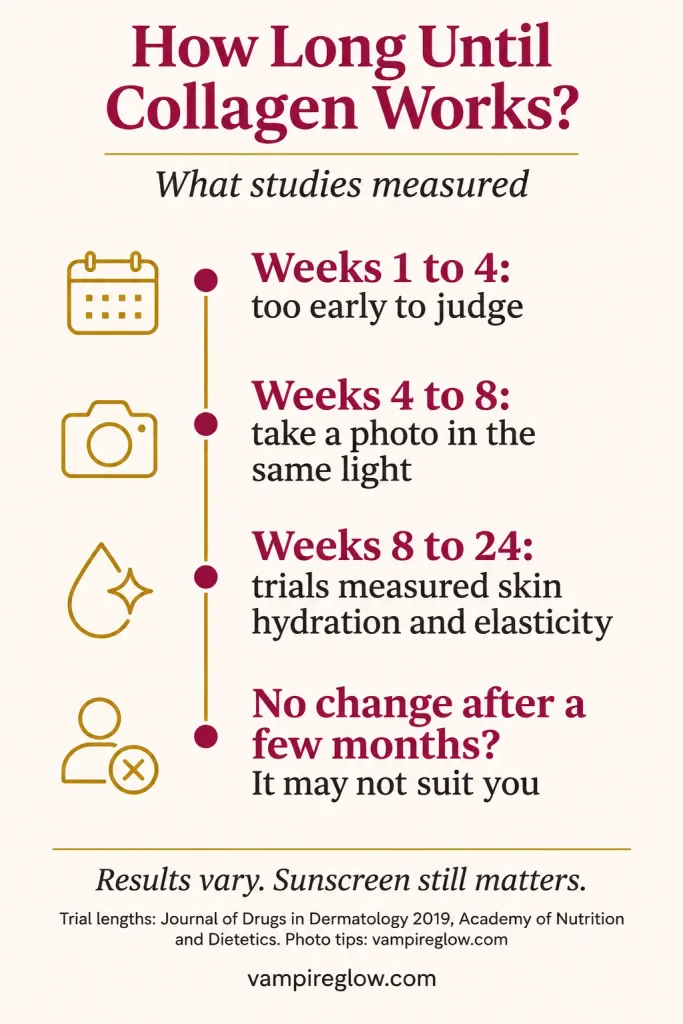
Remember that daily sunscreen and good sleep affect the same outcomes, so they will skew your judgement.
What Is the Best Collagen Supplement for Me
There is no single best product. There is a best fit for your goal, diet and budget. Use this checklist, drawn from the Academy of Nutrition and Dietetics advice and our own label-reading:
- Third-party tested. Look for testing for purity, dose and label accuracy.
- Know the source. Collagen can come from chicken, cow, pig or fish. If you avoid pork, or have a fish or shellfish allergy, read the label and ask the seller.
- Halal. If halal matters to you, ask for the certificate. Do not assume.
- Type. Types I and III are the ones linked to skin, bones and tendons. Type II is for cartilage.
- Form and dose. Choose the form you will use every day and follow the label.
- Clear labelling. Skip products that hide amounts or make big promises.

For more on that side, read our guides on Korean skincare ingredients for glowing skin and the 5-step Korean skincare routine, which includes SPF.
Best Time to Take Collagen During Ramadan and Gulf Summers
These points are my practical reasoning, not research findings.
- During Ramadan, pick one fixed slot, such as after suhoor or after iftar, and keep it the same each day. Consistency is the main lesson from the dietitians.
- If you fast, avoid forcing it into the fasting window. Choose a meal time instead.
- In summer heat, a powder in a cold drink or a gummy that does not melt in your bag can be easier to keep up than something that needs preparation.
- Whatever the season, wear sunscreen daily. UV exposure is one of the environmental factors that degrade collagen.
Collagen at Vampire Glow
Our range includes these options. Please check each pack, because our product pages do not list every amount.
- Marine Collagen Gummies. A bottle of 60 gummies made with hydrolysed marine collagen, biotin and hyaluronic acid. The full ingredient list and serving are on the pack. Because the collagen is marine-derived, check with us if you have a fish or shellfish allergy. The page does not state halal status, so ask before you buy if that matters.
- Marine Collagen Peptide Powder with Biotin. A drink mix. The page suggests stirring it into warm water and says it can also go into soups, smoothies or other drinks. The full ingredient list is on the pack.
- Best Collagen Booster Package. Six items together: Snail Whitening Oil, 3W Clinic Snail Eye Cream, Reedle Shot 300 sheet masks, Marine Collagen Gummies, Vitamin C Gummies and Marine Collagen Peptide Powder. Read each pack before use.
Precautions
Speak to your doctor or pharmacist before starting any supplement, especially if you are pregnant, breastfeeding, managing a medical condition or taking medicines. Follow the label and do not exceed the stated serving. Check the source for allergens such as fish or shellfish. Stop and seek advice if you get a rash, swelling or stomach upset. Patch test any new topical product before use. This guide is educational and does not replace medical care.
FAQs
What are the signs of collagen deficiency? We found no recognised everyday checklist. Collagen production falls from the mid-20s, and sun, smoking and heavy alcohol use can lower it further. Dryness and fine lines are common with age and are not a diagnosis. See a doctor for joint pain, easy bruising or slow wound healing.
When should one take collagen? Take it when you will remember to, every day. Dietitians suggest morning may suit skin and evening may suit muscle recovery, but they agree consistency matters more than the exact time.
Are there any benefits to taking collagen on an empty stomach? We found no reliable evidence of a benefit. If it makes you feel sick, take it with or after food instead.
What are the first signs that collagen is working? Expect gradual changes in skin hydration and elasticity, not overnight results. Trials ran from about 4 to 24 weeks, so give it at least 8 weeks and take photos in the same light.
What is the best collagen supplement for me? It depends on your goal, source preference, allergies and budget. Choose a third-party tested product with a clear label, check whether the source is marine, bovine, porcine or chicken, and ask for halal certification if it matters to you.
Is it better to take collagen in the morning or at night? There is no proven winner. A dietitian suggests morning for skin elasticity and evening for muscle recovery, but this rests on limited evidence.
Should I take collagen with vitamin C? Your body needs vitamin C to make collagen, so eating vitamin C-rich foods is sensible. The sources do not say you must take them at the same moment. Avoid very high vitamin C doses.
Can I take collagen with coffee or tea? We found no evidence that it is a problem, and many people use that routine to remember it. This is practical advice, not a tested finding.
Can I take collagen every day? Studies tested daily use over weeks to months, and the reviewed trials reported no adverse events. Follow the label, and speak to your doctor if you have a medical condition.
Do collagen supplements really work? The evidence is promising but preliminary, according to a 2019 systematic review of 11 trials.
How long does collagen take to work? Trials ran about 4 to 24 weeks, and the Academy of Nutrition and Dietetics links 8 to 24 weeks of use to better skin elasticity. Results vary.
Pick a Time, Then Stay Consistent
The best time to take collagen is the one you can repeat without thinking. Choose morning or night, with a meal if your stomach prefers it, give it at least 8 weeks, and protect your skin with sunscreen in the meantime.
Browse our collagen range at Vampire Glow, delivered across Saudi Arabia, the UAE and the wider GCC.

About author