Stretch Marks: What Actually Helps
You are standing in front of the mirror, a few months after pregnancy, a growth spurt or a long gym season, looking at lines that were not there last year. Stretch marks are one of the most searched skin worries, and one of the most oversold. Shops promise they will vanish. Dermatologists say something more careful.
Here are the five truths this guide is built on. Stretch marks are scars, and scars do not disappear. Early marks respond better than old ones. No cream or oil has been proven to prevent them in pregnancy. Some treatments can make them less noticeable. And how you feel about your skin matters as much as how it looks. We will cover what helps, what does not, how to use a body oil sensibly, and how to build confidence along the way.
Can You Really Get Rid of Stretch Marks Completely
No. The American Academy of Dermatology (AAD) puts it plainly on its stretch marks page: “Like any scar, stretch marks are permanent, but treatment may make them less noticeable.” A dermatology reference page by Dr Davin Lim and Dr Philip Bekhor on dermcoll.edu.au says the same: no treatment will remove them completely.
That does not mean nothing helps. Stretch marks fade in colour over time on their own, and the right approach can soften how visible they are. The honest goal is “less noticeable”, not “gone”. Any product that promises complete removal is selling a result the evidence does not support.
What stretch marks actually are
A stretch mark is a type of scar that forms when skin stretches or shrinks quickly. Common triggers listed by the AAD include puberty growth spurts, pregnancy, rapid weight change, fast muscle growth from weight training, and long-term corticosteroid use. Hormones and family history also play a part, which is why two people with the same pregnancy can have very different skin.
Under the surface, the supporting layers of skin change. The Lim and Bekhor page describes altered collagen, reduced elastin and swelling in the deeper layer of skin. That is why a surface cream struggles to reverse them.
Is It Too Late to Treat Old Stretch Marks
It is not too late to improve them, but it is harder, and expectations need to be realistic.
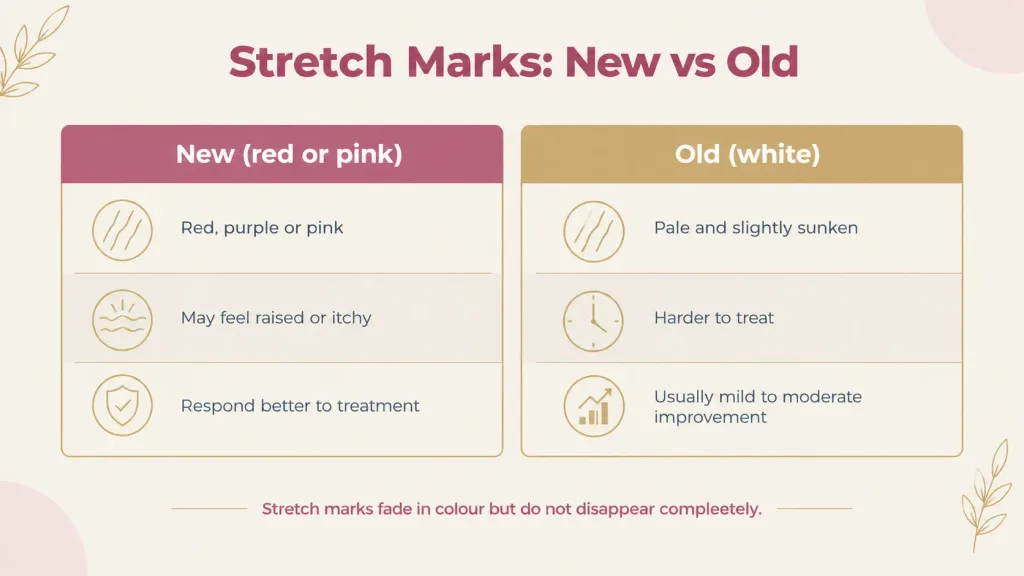
New stretch marks are usually red, purple or pink, and may feel raised or itchy. The AAD says that over time the colour fades and the narrow bands sink beneath the skin. Older marks look pale, sometimes slightly sunken.
Colour matters because it predicts how well treatment works:
- Red or pink marks (early): respond much better. According to the Lim and Bekhor page, pulse dye laser is the most promising option and usually needs three to five sessions a few weeks apart.
- White marks (mature): very difficult to treat, with usually mild to moderate improvement after several sessions. The AAD adds that treatment “seems to have little effect on mature stretch marks” when it comes to creams and lotions.
So if your marks are old, think of improvement as gradual and partial. A board-certified dermatologist is the right person to say what is realistic for your skin tone and type. The AAD notes that in-office procedures have proven more effective than creams, lotions and gels.
What Actually Helps With Stretch Marks
Here is the evidence, from strongest to weakest, based on the AAD page.
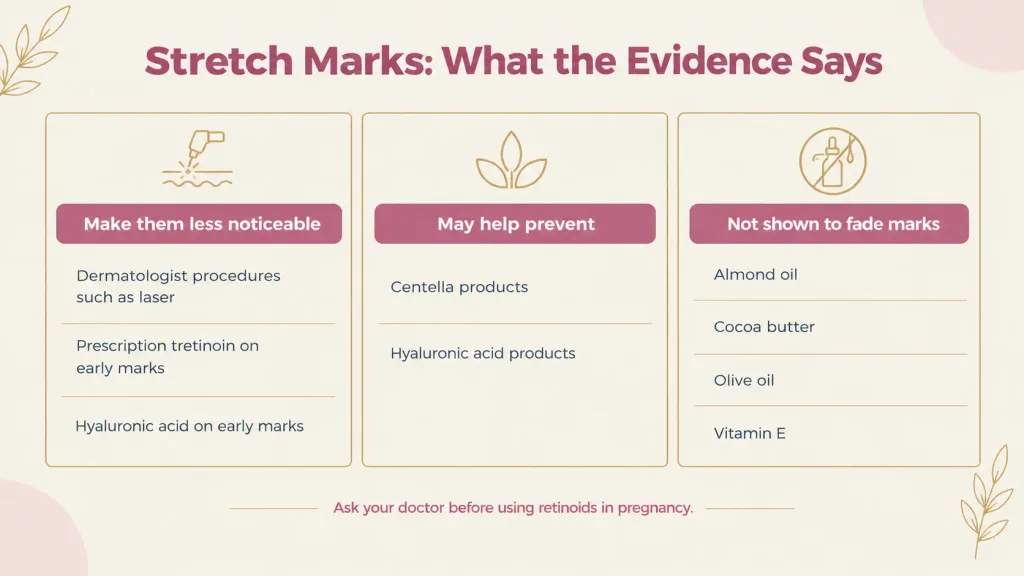
Dermatologist procedures. Chemical peels, laser therapy, microdermabrasion, radiofrequency and ultrasound can make marks less noticeable. The AAD is clear that none of them can get rid of stretch marks entirely, and side effects are usually minor and temporary.
Prescription tretinoin. This retinoid made early stretch marks less noticeable in studies. In one study, nightly use for 24 weeks reduced their visibility. Retinol, its gentler cousin, may also help early marks. Neither is for use in pregnancy or while breastfeeding without a doctor’s approval.
Hyaluronic acid. In two large studies, hyaluronic acid applied to early marks made them less noticeable. If hydrating ingredients interest you, read our guide on snail mucin vs hyaluronic acid for dry skin.
Centella. The AAD says products with centella or hyaluronic acid may help prevent stretch marks. Our guide to centella asiatica benefits for skin covers the ingredient.
Home oils and vitamin E. In studies, almond oil, cocoa butter, olive oil and vitamin E did not fade existing marks. The Lim and Bekhor page adds that they are not proven, though they may be worth trying.
Tanning. Tanning does not hide stretch marks. It makes them more visible. A self-tanner can camouflage them but does not treat them.
So where does a body oil fit?
A body oil is a moisturising, massaging step. It can make skin feel softer and more comfortable, and a daily massage habit helps you stay consistent. What we cannot say is that any specific oil removes or erases stretch marks. Use it as part of care, not as a cure, and see a dermatologist if you want a stronger result.
Can You Prevent Stretch Marks During Pregnancy
Probably not with a cream or oil. A Cochrane review of topical products found no high-quality evidence that any cream, lotion or oil prevents stretch marks in pregnancy. It covered six trials with 800 women, including olive oil and cocoa butter. Products did not make a statistically significant difference to whether stretch marks developed, and the trials were small, with only three of six judged at low risk of bias. You can read the Cochrane summary yourself.
The AAD’s own answer to prevention is “Maybe”, pointing to centella or hyaluronic acid products. The same page says oils and vitamin E did not prevent stretch marks in studies. Genetics and hormones appear to play a large role, which no product changes.
If you are pregnant, keep it simple:
- Moisturise for comfort. A daily massage can ease dryness and itch, even if it does not prevent marks.
- Ask your doctor before using any new product, especially anything with retinol, which the AAD says can harm the baby.
- Do not feel you failed. Marks in pregnancy are common and largely outside your control.
How to Boost Collagen to Prevent and Reduce Stretch Marks
We did not find a study showing that collagen supplements or collagen creams prevent or reduce stretch marks. So we will not claim it.
What is known is that stretch marks involve changes in collagen and elastin in the deeper skin. That has led people to wonder whether adding collagen helps. The evidence has not caught up with the idea. Our own guide on how long marine collagen gummies take to work for skin explains what collagen supplements may realistically support, which is skin hydration, not scar repair. Supplements support general wellbeing and do not replace medical care. If you are pregnant, breastfeeding or on medication, speak to your doctor first.
Habits that make sense without overpromising:
- Avoid sudden weight swings. Rapid weight change is a listed trigger, so slower, steadier change gives skin more time to adapt. This is my reasoning from the trigger list, not a study result.
- Eat enough protein and a varied diet. It is basic support for skin, not a stretch mark treatment.
- Skip tanning, which makes marks more visible.
- Look after your skin barrier. Dry, irritated skin is uncomfortable. See our guide on how to repair a damaged skin barrier.
How Long Does It Take to See Results From a Stretch Mark Serum or Oil
Think weeks to months, not days. And think “less noticeable”, not “gone”.
- Creams, lotions and oils: the AAD advises massaging them in and applying daily for weeks, and says they work best on early marks.
- Prescription tretinoin: one study used nightly application for 24 weeks.
- Laser: three to five sessions a few weeks apart, per the Lim and Bekhor page.
- Our own product pages: the Gluta Up Stretch Mark Oil page says marks fade gradually and results vary.
A practical plan: take a photo of the area in the same daylight today and again each month. Memory is unreliable, photos are not. If you see no change after about three months of consistent use, that is my own rule of thumb, not a clinical one, see a dermatologist rather than spending more on products.
This applies to serums too. Our range currently features body oils for stretch marks, but the same timeline and the same limits apply to any topical product.
How to Use a Body Oil on Stretch Marks
Consistency matters more than quantity. A sensible routine:
- Patch test first. Apply a small amount to the inner arm for 24 hours before using it on a larger area. This is advised on both product pages.
- Start with clean, dry skin. Apply after a shower, once you have patted dry.
- Use a small amount and massage in circular motions until absorbed.
- Follow the product label for how often to use it.
- Be consistent for weeks. Pair it with your normal moisturiser if your skin is very dry.
- Avoid tanning on the area, as it makes stretch marks more visible.
Gulf air conditioning dries skin quickly, so a body oil applied after a shower may feel more comfortable than a thin lotion. For daily routine ideas, read our Korean skincare routine for Saudi summer heat and AC.
Do not apply to broken skin, and stop if you notice stinging, redness or itching.
Stretch Marks Products at Vampire Glow
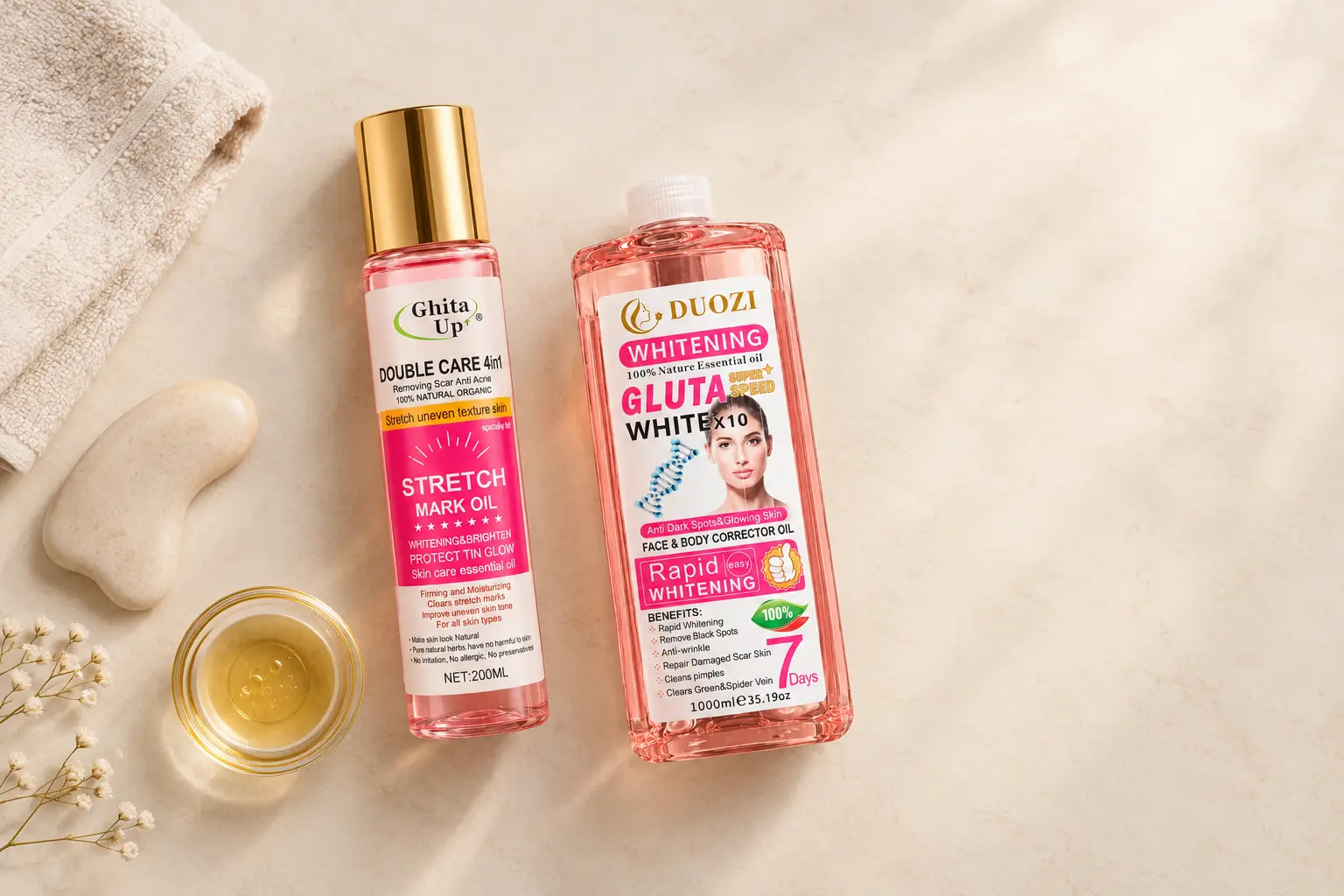
Two body oils in the range are aimed at stretch marks and uneven skin texture. Both are marketed as care products. Neither is a medical treatment, and the evidence above applies.
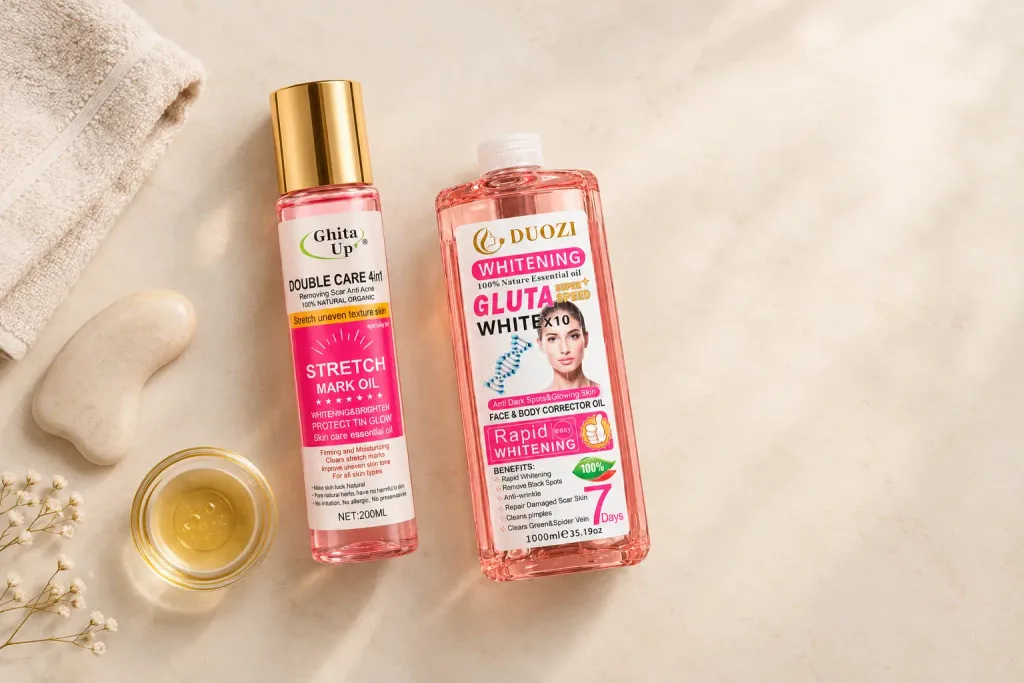
Gluta Up Stretch Mark Oil is a body oil for stretch marks and uneven texture linked to pregnancy, weight change or growth. According to the product page, it is lightweight, quick-absorbing and non-greasy. The page says to massage a small amount into clean, dry skin and use it twice daily on affected areas, and that marks fade gradually and results vary. It is from the Gluta Up range.
1L Gluta Whitening Oil from DUOZI is a plant oil blend with glutathione in a 1 litre size. The page describes it as a lightweight massage oil and moisturiser for dryness, uneven tone and the look of stretch marks, best used consistently. The large bottle suits a daily routine across bigger areas such as legs, hips and thighs. We found no research on glutathione in a topical oil for stretch marks, so treat it as a body oil first. The page points children’s sensitive skin to the Kids Eczema Oil instead, so ask a doctor before using this oil on children.
Which to choose? For a targeted routine on a few areas, start with the Gluta Up oil. For whole-body use, the 1L bottle gives you more product. Neither page lists the full ingredients online. The full list is printed on the pack and carton, so read it before use, especially if you have allergies or are pregnant.
Browse the wider skin care range at Vampire Glow, delivered across Saudi Arabia, the UAE and the wider GCC.
How to Build Confidence With Stretch Marks
Treatment is optional. The Lim and Bekhor page calls stretch marks a cosmetic concern, which means you decide whether to treat them at all.
Some things that help:
- Reframe what they are. They are scars from growth, pregnancy or change. Your skin did its job.
- Be careful with filtered images. Edited photos on social media rarely show real skin.
- Choose care you enjoy. A daily oil massage can be a calm ritual rather than a fight with your body.
- Set a limit on spending. The AAD suggests seeing a board-certified dermatologist if you have spent a lot on products without results.
- Talk to someone. If worry about your skin is affecting your mood, relationships or daily life, speak to a doctor or a mental health professional. You do not have to manage it alone.
Precautions
Test any new body oil on a small patch of skin first. Check the full ingredient list on the pack, especially if you have allergies or sensitive skin, and stop if you notice persistent stinging, redness or itching. If you are pregnant or breastfeeding, ask your doctor before starting any new product, particularly anything with retinol or other actives. Body oils do not replace medical care. See a dermatologist for stretch marks that are painful, spreading fast or linked to long-term steroid use or other health conditions.
FAQs
Can you really get rid of stretch marks completely? No. The American Academy of Dermatology says stretch marks are permanent like any scar, though treatment may make them less noticeable. They fade in colour over time but do not vanish completely.
Is it too late to treat old stretch marks? It is not too late to improve them, but old white marks respond far less than new red or pink ones. Creams have little effect on mature marks. A dermatologist can discuss laser and other procedures, which usually give mild to moderate improvement over several sessions.
Can you prevent stretch marks during pregnancy? Not reliably. A Cochrane review found no high-quality evidence that creams, lotions or oils prevent them. Moisturising can help with dryness and itch, and the AAD says centella or hyaluronic acid products may help. Ask your doctor before using anything new while pregnant.
How do you boost collagen to prevent and reduce stretch marks? We found no evidence that collagen supplements or creams prevent or reduce stretch marks. Steady weight change, a balanced diet, avoiding tanning and a healthy skin barrier are sensible habits, but they are support, not a treatment.
How long does it take to see results from a stretch mark serum or oil? Expect weeks to months, with modest results at best. The AAD advises daily use for weeks on early marks, and the Gluta Up Stretch Mark Oil page says marks fade gradually and results vary. If nothing changes after about three months, see a dermatologist.
How do you build confidence with stretch marks? Remember that they are scars from normal changes and that treatment is optional. Limit time with filtered images, choose care you enjoy, and talk to a doctor or mental health professional if worry about your skin is affecting daily life.
Do stretch marks go away on their own? They fade in colour over time, from red or purple to pale. They do not disappear completely.
Do oils and creams work on stretch marks? Evidence is weak. Almond oil, cocoa butter, olive oil and vitamin E did not fade existing marks in studies. A body oil is best treated as a moisturising step for comfort, not a cure.
Can men get stretch marks? Yes. The AAD lists puberty growth spurts, rapid weight change and fast muscle growth from weight training among common triggers.
Do stretch marks itch? New ones can. The AAD notes that early marks may feel raised and itchy. Moisturising may ease dryness, and see a doctor if itching is severe.
Does tanning help hide stretch marks? No. Tanning makes them more visible. A self-tanner can camouflage them but does not treat them.
Care for Your Skin, Set Honest Goals
Stretch marks may fade in colour, but they do not disappear. The best approach combines realistic goals, consistent care and a dermatologist when you want a stronger result.
If you want a body oil as part of your routine, explore the Gluta Up Stretch Mark Oil or the 1L Gluta Whitening Oil, available now at Vampire Glow and delivered across Saudi Arabia, the UAE and the wider GCC.
About author